Carol Dweck On Nurturing a Growth Mindset

In Mindset: The New Psychology of Success published by Random House, Inc. the author, psychologist Carol Dweck advocates that human beings must shed themselves of a “fixed mindset” and acquire a “growth mindset” in order to attain personal growth and progress. I am not a fan of motivational books; however Dweck makes sense; adults, especially those in charge of children ought to take her core ideas to heart. The book’s premise may be summed up in Dweck’s own words thus:

 “When we teach people the growth mindset, with its focus on development, these ideas about challenge and effort follow. Similarly, it’s not just that some people happen to dislike challenge and effort. When we (temporarily) put people in a fixed mindset, with its focus on permanent traits, they quickly fear challenge and devalue effort.” (p. 10)

Also there is a great chart by Nigel Holmes at the end of the book that highlights the difference between a “fixed” and “growth.” (p. 245). Rip it out and toss the rest of the book. Tape it to your mirror and study it daily. It alone is perhaps worth the price of the book. The book is a well-paced easy read which succeeds in engaging the attention of even the most distracted reader. Its practical tips will aid many instructors in their personal growth and in imparting knowledge to students. Dweck is right; every individual has unique gifts and gaps. We look to coaches, teachers and parents to be nurturing firm guides by the sides of malleable youngsters

As with any book, there is much to disagree with in Mindset. Chapter 7 is, for me, the most insightful part of the book; however it is the section I had the most issues with. Here, Dweck quotes Rafe Esquith, a Los Angeles second grade teacher who denigrates restaurant labor as “flipping burgers.”

“Esquith bemoans the lowering of standards. Recently, he tells us, his school celebrated reading scores that were twenty points below the national average. Why? Because they were a point or two higher than the year before. “Maybe it’s important to look for the good and be optimistic,” he says, “but delusion is not the answer. Those who celebrate failure will not be around to help today’s students celebrate their jobs flipping burgers.… Someone has to tell children if they are behind, and lay out a plan of attack to help them catch up.”” (p. 198)

“Flipping burgers” is an honest, dignified living that can lead to leadership positions, either as manager or owner of the restaurant. There are special needs children for whom “flipping burgers” would be a major milestone to be celebrated. Indeed, many parents fleeing troubled lands toil with pride in these jobs in order to provide for their offspring. I think that school systems should be ensuring that children are college and career ready. Messages like this send mixed signals to teachers and demoralize whole populations of students who may not be going to college.

Dweck relies on several scholars, thinkers and corporate leaders to make her case about the difference between a “fixed” and a “growth” mindset. However besides Jaime Escalante and Marva Collins there are few minorities of note in her examples.  On the other hand, the vast majority of her examples of entertainers and sports jocks are minorities. If this was a teacher’s resource I would urge that the examples be supplemented by a diverse group of examples. By the way, Jaime Escalante and Marva Collins were not without controversy. Jaime Escalante was rightly eulogized by the world when he passed as this New York Times obituary shows. But his methods did not always meet with approval. There is a good analysis here of Escalante’s efforts. Also, this Reason magazine article does a great job of analyzing the complex man that Escalante was. Similarly, Marva Collins was also steeped in controversy as this biography shows.  It is true that corporations are headed exclusively by white males in today’s world; however that may be changing as Carla Power’s illuminating article in Time magazine shows. “India’s Leading Export: CEOs” (August 1, 2011).

Dweck’s message is compelling, but the frequent recourse to non-clinical experiments diminishes the credibility of her conclusions. Example: There is a puzzling experiment with African American students who were asked to write an essay to be graded by Edwards Caldwell III, who Dweck describes as “a distinguished professor with an Ivy League pedigree… a representative of the white establishment.” The professor grades the kids harshly and many of the kids respond with similarly harsh feedback of his grading. Dweck concludes somehow that these kids have a fixed mindset about a “white establishment figure.” How she concludes in the experiment that all the black kids saw was a “white establishment” figure rather than merely a cantankerous adult is unclear to the reader. The notion that because they are black, they would all see him as part of a “white establishment” seems patronizing. There are many such “experiments” in the book that reek of pseudo-science.

Mindset is about 200 pages too long, stretched relentlessly to make the same point ad nauseam. It is an uneven, preachy book that focuses too much on the power of individuals to change complex organizations. Robust institutions rely on structures and talented people but Dweck cites numerous instances of organizations and corporations felled by powerful leaders that were hobbled by a “fixed mindset.” There is little reflection on the corporate structure and culture that deified one individual.  Structural issues in complex organizations seem glossed over to make an admittedly compelling point. Indeed, it is the case that structural imperfections amplify what she rightly refers to as “CEO disease.” Dweck should probably have collaborated with scholars of corporate systems and structures.

Many people would disagree with Dweck that the great John McEnroe was burdened with a fixed mindset; he may have had a fixed bad attitude, but a fixed mindset? Similarly some of the examples that Dweck cites glowingly as having a “growth” mindset have since met different and unfortunate fates; for example, Jack Welch. Robert Trigaux, writing in the St Petersburg Times had this to say of Welch:

“…the Myth of Jack Welch — Superhero of Corporate America — has long needed serious deflating. (Manager of the 20th century? Get real.) Welch also acquired the nickname “Neutron Jack” — a dubious monicker much like the one owned by less revered cost-cutting champ,”Chainsaw” Al Dunlap — for introducing to GE the policy of routinely firing the “bottom 10 percent” of the company’s work force. Welch reasoned that fear was the best way of keeping GE’s minions on their toes.”

Human beings are complex manifestations of what many would call multiple intelligences. Mindset raises many questions. Does genetics play a role in resilience? Does wealth or the lack of it sustain a willingness to thrive in the face of adversity as in the case of Christopher Reeve? Is the inability to accept failure a function of society’s expectations? How do parents view failure? What about cultural norms? Is there an immigrant perspective? I found Dweck’s analysis of mental health issues too glib. A celebrated chef commits suicide and she ascribes that to a “fixed mindset.” Depression, suicide, etc. are mysteries that are yet to be fully unraveled by modern science.

Dweck advises against praising for ability rather than for effort. “Praising children’s intelligence harms their motivation and it harms their performance.” (p 175) Many would disagree and say that kids should be praised for using their innate intelligence for the good. From my experience, the problem has been selective praises for what society accepts as accomplishment. As the book suggests, children do need honest and constructive feedback. The influence of adults makes a difference.  We should not praise kids as smart because we run the risk of turning them into “liars, simply by telling them they were smart.” (p 73)

I did learn something new about Alfred Binet’s motivation for inventing the IQ test:

 “… Binet, a Frenchman working in Paris in the early twentieth century, designed this test to identify children who were not profiting from the Paris public schools, so that new educational programs could be designed to get them back on track. Without denying individual differences in children’s intellects, he believed that education and practice could bring about fundamental changes in intelligence.” (pp. 4-5)

I did not know that.

The Balance of Our Stories

Reprinted for archival purposes only. First published December 2007

I wake up to dawn in America and our preteen daughter Ominira is peering at me, needing my attention, hankering after my wallet. I need money for my cafeteria account daddy! I get up praying that I can find a check book in this house and that said check will find money in our bank account. I wander around the house looking for the brief bag that houses my cluttered existence – there must be a check book in there somewhere. Writing checks! That is so analog. I hardly ever write checks preferring a digital fiscal existence through my trusty laptop Cecelia. I wander around this house of rooms each with its own name. It is not a big house, but America allows the living poor to dream about things that others really have, like rooms with their own names. Why do we have a sun room? I don’t know. What happens when the sun goes down, do we flee the sun room for the breakfast nook? And what if it is lunch time? Ah, there is the family room! But I am not feeling like family right now. My family is fleecing me penniless, they want checks! We are at the breakfast nook; Ominira grabs the check from me, and she points to Chimamanda Ngozi Adichie’s book Purple Hibiscus leaning on Cecelia at the breakfast table. “I am reading that,” she says matter-of-factly. She is ready for school draped in my favorite wind jacket (note to myself, buy a really ugly jacket next time!). I walk her to the door – she is weighed down with my jacket, too many clothes, a monstrous book bag, her iPod, and her cell phone and she is miraculously clutching Purple Hibiscus. Bye daddy! I open the door to America and Ominira clatters out all the way to the school bus like an American soldier with too many weapons.

It is good that Ominira is reading Purple Hibiscus. It is a good book. It is not as sure-footed as Adichie’s second book, the epic Half of a Yellow Sun but it is a good first effort and I heartily recommend it to anyone. My children love to read books. Just like their father. I pray that they don’t grow up enjoying cognac. Just like their father. Some pleasures turn to burdens soon enough. It is a great time to be a connoisseur of Nigerian literature. There are all these Nigerian writers doing some really exciting work and there are not enough hours in the day to consume all their wares. While I can practically count the Nigerian writers of my childhood on my ten fingers, I am afraid to list all of Nigeria’s contemporary writers whose works I have come across in books and on the Internet because I just know that I will leave someone out. And quite a number of these writers are doing us proud judging by the international awards they are garnering for their works. More importantly, these writers are extremely influential because their stories are fast becoming the literary prism by which Nigeria, certainly Africa is judged by the Western world. It is therefore critically important to examine their works to ensure that there is indeed a balance to their stories. I have had occasion in the past to express vigorous objections to the prejudiced slant of the stories being told about Africa in books written by Westerners like Tony D’Souza (Whiteman).[1] I am afraid however, that reading Nigerian writers, especially those writing from places far away from Nigeria, one also observes the same worrisome trend – of disrespect for Nigeria and a tendency to project Nigeria using dated and tired images. Interestingly, most of these writers have been away from Nigeria for a very long time but their themes return again and again to the Nigeria of their fading memories. In that respect, I just finished reading Chris Abani’s Graceland a story set in the Nigeria of the seventies and the eighties and this is one book I pray my children never read. From the perspective of this Nigerian, it is a dreadful book and when I am done with it I shall return it to the good friend that loaned it to me. This is one book that will never grace my book shelf. Some books are better off not read.

Don’t get me wrong, I am sure that by all literary standards it is a well written book and in certain parts of the book, Abani’s muscular talents are on display. In fact, I became a fan of Abani’s after reading his book, The Virgin of Flames, a book similar in theme to Graceland, but this time based in Los Angeles, America. Thanks to a delightful experience with that book, I jumped at the opportunity to load up on more of Abani’s crisp prose. Unfortunately, reading Graceland was a traumatic experience for me; the book made me very sad. Abani, that son of Africa with a brain on steroids takes his immense literary gifts and markets a nightmarish Nigeria to an adoring West. Reading the book one imagines Nigeria as one huge filthy latrine. We are not talking about mere squalor here; we are talking about an irredeemable Nigeria, of inchoate characters babbling even more inchoate sentences.

And the Western world loves this book. The first thing that the reader notices is that Graceland is garlanded with fawning blurbs from Western literary heavyweights; there is absolutely no comment from any African literary practitioner. It is perhaps a smart marketing move by Abani, albeit at Nigeria’s expense. And Abani hits pay dirt. The blurbs drip with saccharine praise for a body of work that confirms the West’s prejudice of Africa – one huge disease ridden latrine that houses people who somehow survive the filth and the degradation by moping around their nuclear zone and muttering half-sentences. Hear the legendary Harold Pinter struggling to outdo the other blurb writers with his praise-song: “Abani’s poems are the most naked, harrowing expressions of prison life and political torture imaginable. Reading them is like being singed by a red-hot iron.” The stench of rotting flesh assaulting your nostrils is Abani’s Nigeria. Nigeria has done nothing to deserve the ire of Abani’s boundless imagination. Ah, yes, his imagination is boundless.

As an aside, in terms of structure, and content, Graceland is a puzzling book; it seesaws between the seventies and the early eighties, telling a story, or several stories, that go nowhere, perhaps a deliberate metaphor for Nigeria’s fortunes. We follow this strange “Nigerian” boy Elvis, who when he is not dreaming of making it big in America like his namesake Elvis Presley, surrounds himself with a sad, sad cast of subhuman caricatures posing as Nigerians. Throw in filth and squalor, rape, incest, reams of death and destruction, awful, inchoate, contrived dialogue and the recipe is complete for the making of the African writer to be adored by a fawning West. And the contrived language – an infuriating mix of American slang and half sentences gets in the way of making sense of the book. For heaven’s sake, who in Nigeria speaks like this?

“But as soon as he go, my hand was on de cage and suddenly de weaver was in de air. It beat its wings against my face and was gone. I was surprise to hear myself laughing. I was free and I stood in de small rain dat began to fall again. I was powerful, aagh.[2]”

The dialogue – and the imagery are contrived. From my perspective, this is unnecessary and unfortunate. As another aside, in the book Abani obsesses nonstop about hidden meanings trapped inside the lobes of the mystical kolanut and several chapters start with some esoteric psychobabble about the revered kola nut as in: “We do not define kola or life. It defines us.” The book’s one redeeming feature is its inventory of Nigerian recipes. Buy this book if you need a good cookbook of Nigerian dishes. I have no need for the recipes though; I have a copy of Nigerian Cookbook (Riverside Publications) by Miriam Isoun and H.O. Antonio. Find a copy and buy that instead of Graceland, it is a better cookbook.

My point is that it is hard to imagine Abani’s Nigeria of the 70’s and the 80’s. I would know; I lived through those years in Nigeria and while Abani’s perspective may be true of the slums of Maroko, it overwhelms the totality of what Nigeria was like in those days. There is absolutely no balance to his stories of the Nigeria of that era. Instead, there is a near-obsession with tragedy and irredeemable despair, sexual abuse and associated depravities, child abuse, sexuality issues, rapes filth and death in its most ghoulish and ghastly form. What is it with Abani and hooks, sexual depravity, handcuffs and bodily secretions? Abani’s fantasy world is populated by mumbling individuals with scant control over their surroundings, their bodily functions, and their sexual urges. Graceland is a pit bull of a book tearing at Nigeria with steely teeth housed in muscular literary jaws. It is a deliberate production, one that was carefully marketed to a gullible West by a brilliant but narcissistic son of Africa. If this book was written by a white man, we would all be asking for a pound of flesh.

I propose however that we all turn our rage inwards and acknowledge our contribution to the frustrating disrespect that Africa endures in the world today. Some of our writers may not know it but they are unwittingly helping to reduce Africa to ridicule and irrelevance in the global community. Abani is not the only culprit in this new rush to pawn off Africa’s dignity in the capitalist markets of the West. I think that many of us living abroad (and I include myself in this criticism) who claim to be writing about Africa’s issues are culpable to varying degrees. There is enough blame to go around. The world has finally calmed down from its righteous indignation and apoplexy induced by Professor James Watson’s quiet ruminations about the intelligence quotient (or lack thereof) of black folks. As far as I am concerned, the resulting dust storm has been insincere; it is hard to see what the fuss is all about regarding Professor Watson’s commentary. He has only said what many of our own thinkers say out loud and for great profit. Different strokes for different folks. Consider this: For Watson’s utterances, he has been stripped of several perks including his livelihood (don’t worry, he won’t die of hunger). But for saying worse things albeit in muscular prose, V.S. Naipaul, the Trinidadian who fancies himself a Briton, was awarded the Nobel Prize. Go read Chinua Achebe’s methodical deconstruction of the troubled mind that is V.S. Naipaul in the book Home and Exile, specifically the essay, Today, the Balance of Stories. In that essay, Achebe takes Naipaul to task over his African novel A Bend in the River and he quotes this particularly obnoxious passage from the book:

“The first time, that in colonial days the hotel boys had been chosen for their small size, and the ease with which they could be manhandled. That was no doubt why the region had provided so many slaves in the old days: slave peoples are physically wretched, half-men in everything except in their capacity to breed the next generation.”[3]

Achebe’s response to Naipaul’s unnecessary roughness is a thunder clap of unalloyed fury and he roars: “That is no longer merely troubling. I think it is downright outrageous. And it is also pompous rubbish.”[4] Now comes another Nobel Prize Winner of African descent, Nigeria’s very own Wole Soyinka in his book You Must Set Forth at Dawn. In the following passage eerily similar to the above by Naipaul, Soyinka describes a whimpering obsequious old man struggling to serve him in a rest house somewhere in Nigeria:

“I … sometimes gratefully enjoyed the courtesy of rest houses built for the colonial district officers, where the uniformed waiter, immaculate in standard attire, service-conditioned from colonial days would pad in gently in the morning with a tea tray…. But I did not ask for tea! Yes, master, he (old enough to be my father or even grandfather) replies, setting down the tray and pulling back he curtains…. No! Leave that alone, I’m not awake…. Yes, master, he replies, pulling the curtain open all the way…. Will master like me to make fried or scrambled eggs with the toast? Oh, you house-trained antiquated robot, master would like to scramble Papa’s head for breakfast!”[5]

One can almost hear Achebe cursing the darkness and saying of Soyinka’s prose: “That is no longer merely troubling. I think it is downright outrageous. And it is also pompous rubbish.” Now, if these hurtful words had been written by Watson, we would be asking for his head. My point is that if the world took us seriously, they would be insisting on the same standards for our very best. Perhaps, the Western world truly believes that Africans are children of a lesser god. And our very best thinkers seem to agree with them. For our words, our writers’ stories, drip with the self-loathing that confirms the worst hiding in other people’s dark hearts.

There is some hope that the Western world is getting fed up with our tales of woe. Some of our writers protest too much and even for a gullible readership there is such a thing as too much misery. In April 2006, Nathan Ihara reviewed Abani’s book Becoming Abigail in the LA Weekly and he pronounced himself fed up with Abani’s fare. He courageously protested the all-you-can-eat buffet of unnecessary suffering and deprivation served up by Abani thus:

“[s]tarvation, torture, AIDS and murder have become the background noise of our entertainments, the wallpaper pattern of our newspapers. We are so inured to tales/images/instances of pain that a direct assault on our cauterized nerve endings no longer works. Literature must come upon us athwart, enter the heart by sneak attack. Peter’s debasement of Abigail — “Filth. Hunger. And drinking from the plate of rancid water. Bent forward like a dog” — is disturbing yet remote. The staccato rhythm and the graphic language are so direct, so lurid, that they fail to pierce the skin. The scene is grimly fascinating, but lacks emotional resonance. Suffering in literature must be more oblique, more sideways; it must be a void into which the reader falls.” [6]

A recent copy of the literary magazine Granta features short stories from Adichie and Helon Habila, two of Nigeria’s star writers.[7] In the midst of several robust offerings by other writers, we read the same tired overcooked gruel from two of our very best – of victims being thrown out of storey buildings by over-sexed generals, etc, etc. Why are we so depressed? Is there no joy in our existence? Why do our writers peddle the same tired stories, all the while ignoring fresh palm wine frothing in the sunlight? How is it that our best and brightest are not mindful of the end of the machete that hurts our motherland?

There may be hope but from strange quarters. The July 2007 edition of Vanity Fair, guest edited by the musician Bono, was a bumper issue devoted solely to Africa. It was a beautiful edition and all those who truly love Africa, should find a copy and keep it for posterity. For once Africa was in the limelight and it was not all about disease, war, famine, corruption and associated clichés. Bono’s Vanity Fair made the point that generations of award-winning African writers have failed to make – that Africa is not a lost cause, lost to disease, war, famine, ceaseless despair and hopelessness. Rather, just like Africa, the magazine was a comforting collage of some of Africa’s success stories, some of whom had been carefully rescued from Africa, by the West. We saw literary jewels from the very young and talented Nigerian writers Uzodinma Iweala and Ngozi Chimamanda Adichie to aging lions like Chinua Achebe and Wole Soyinka. One gets goose bumps from seeing in living color all these beautiful people, irreplaceable offspring of Africa’s loins luxuriating in the adulation that has eluded them in their own Africa.

No doubt war has been hard on African writers. It would appear, for instance, that in terms of abuse and suffering, Abani has paid his dues. Ihara points out that Abani was imprisoned several times in Nigeria for his literary works, and tortured as a political prisoner: he apparently endured beatings, electrical shocks and solitary confinement. There needs to be closure – a Truth Commission that invites people with claims of horrid abuse to come testify – and for the perpetrators to publicly apologize once and for all. Regardless, our writers have every reason to be worried about the situation in Africa. The question becomes: What are they doing about it? Many of our writers spend a lot of time painting gory pictures of Africa’s sorry state and selling the result to Westerners. When Westerners gasp from shock, they complain that Westerners are being patronizing and racist. Right after posing for Bono’s Vanity Fair, Iweala penned an indignant editorial in the Washington Post decrying the tendency of Westerners to “promote the stereotype of Africa as a black hole of disease and death.” He was unhappy that “news reports focus on the continent’s corrupt leaders, warlords, “tribal” conflicts, child laborers, and women disfigured by abuse and genital mutilation.[8] Is this the same author that posed for Vanity Fair’s bumper Edition on Africa, the same African who wrote the best-selling book Beast of No Nations a novel about child soldiers?

Iweala’s editorial comes across as the protests of one who wishes to eat his cake and have it. At the very least, he is guilty of being overly sensitive. Fresh from posing prominently in the Africa issue of Vanity Fair, he rushes to the Washington Post to chide Western superstars like Bono and Bob Geldof and presumably the entire West for a patronizing attitude towards Africa’s challenges. He makes the profound point that a lot of humanitarian efforts from the West directed at Africa are driven by less than altruistic motives. But those who read Bono’s Vanity Fair will be forever haunted by the before-and- after images of African AIDS patients who have been miraculously rescued by the anti-retroviral drug that is now available in African countries thanks to the Lazarus Project and the efforts of Westerners like Bono. Those pictures in Vanity Fair are the most graphic reminders of what can happen to Africa if the world stopped for a second and paid her much needed attention. Iweala’s rage is sadly misplaced. Instead, Iweala and the rest of us should erupt in lusty songs of protest against African leaders who continue to loot Africa’s treasures and deposit them in the West even as they loudly berate the white man for all of Africa’s problems. According to Vanity Fair, the United States has quadrupled aid to Africa over the last six years under President George W. Bush. Once you get over that shock, a rising rage wells up in you because you have your suspicions as to what happened to all that money. Nigeria is a wealthy county. She should not be receiving aid and sympathy from any country.

One can only hope that the horrible images of Africa as one giant beggar-continent will someday be erased when Africa’s intellectuals and writers like Iweala direct their rage inwards. The first step is for African writers and intellectuals to stop feeding the West stories of irredeemable despair that turn Africa into a caricature continent. Ironically, Iweala has risen to international prominence by penning a best-selling fiction of a drug-crazed child-soldier who runs around a barely fictitious African country killing people and babbling in an inchoate form of English that is at best contrived. If a Western writer had written such a story, Iweala would be up in arms decrying the racism inherent in such a caricature of Africa. There is another young writer from Sierra Leone, Ishmael Beah who is making a killing selling his story, A Long Way Gone: Memoirs of a Boy Soldier, a chronicle of his life as a child soldier.[9] A good deal of this may be reality; however it gets a lot of play in the West because it sells. And African writers have been only too willing to play along for riches and fame.

Where are our writers’ loyalties to be found? It is an important question. Compare Abani’s Graceland to The Virgin of Flames and one wonders where the author’s interests lie. For one thing, where Graceland is stale in its message, The Virgin of Flames is current and reflects an immediacy depicted by someone who truly knows Los Angeles as it is today. Should our writers, especially those abroad be oblivious to their current dispensation because it is easier to mine the stories of the past? It is an important question. Westerners fawn with delight over Iweala’s book, Beasts of No Nation and they should; it was written exclusively for them by an expatriate offspring of Africa. But the book does Africa no good. I have to take the reader back to Achebe’s essay in his book Home and Exile – The Balance of the Stories. Where the main character in Joyce Cary’s Mr. Johnson was a bumbling buffoon dreamt up by a racist author, the African characters in books by our Iwealas and Abanis are bumbling buffoons incapable of putting together complete sentences. And we are in the 21st century.

I ask the gentle reader: Where is the outrage? Never mind that these are talented writers in their natural elements. In a recent edition of the magazine Granta, Iweala shines as an American author.[10] This edition of Granta features works by, as the magazine bills them, the “best of young American novelists. From America’s perspective, Iweala is an American writer. In his short story Dance Cadaverous, Iweala shines as an American telling a wholesome all-American story of two boys, lips locked in love and in lust and Iweala takes us through scenery that only an American would portray – with love and caring. It is not great literature; chased perhaps by the demons of an editor’s deadline, the story gallops to an undignified end and claims its rightful place in the pantheon of enjoyable but forgettable stories. But it is told nonetheless by an American. Iweala is a Nigerian. Iweala is an American. Iweala is the sum of his experiences. And this illuminates issues in a debate raging rather savagely in my head. Who are we? And, who are we writing for?

What to do? It is a good question. We have been talking about books written mostly by Nigerians abroad and I still say the book is dying. We must look also for fresh thinking in the new e-books thrilling us on that wondrous playground called the Internet. The written essay of our childhood is now roaming free and happy out there, crackling free and fresh on the Internet – in blogs, websites and on YouTube. Our new thinkers are talking up a storm about the new Africa. No one is listening for now because we are still attached to the book. I propose that the astute reader should look to the new medium of ideas called the Internet. The dreams of Africa lurk quietly in e-places where there is a total surrender to a return of the oral tradition of our forefathers and foremothers. Take YouTube for instance. The Western world calls that technological innovation. Our people say YouTube was Africa’s theater from the beginning of time. The more things change the more things stay the same. Every day history is made. But if the West insists on making up history to suit its own agenda, it must not be with the willing cooperation of our thinkers. It is time to correct course.

We must return to Achebe who again reminds us of the East African proverb: Until the lion tells the story of the hunt, the hunt will always be glorified by the hunter. We must tell the truth, nothing but the absolute truth in our own stories. It is a great time for the lion to tell his story because the essay is born again, live, as dying alphabets, former myrmidons of the Empire, flee, shoved out of YouTube by the agents of change. There is hope, because there is a return to the oral tradition of storytelling by our ancestors and they call this change. Long live Africa. Let us continue to remind our writers of this: Cannon-balls of joy and hope are booming clear across the valleys and our thinkers must listen past the smell of dollars and euros for the triumph of song over grief. For now, our thinkers are, backs turned, fawning over alien booms. And there is no balance to our stories. Our stories are unrelentingly Naipaulitan, to coin a perversion from the name of V.S. Naipaul. In our stories, Naipaulitan verse after Naipaulitan verse is hurled, like mean bricks, through Africa’s dainty windows. And strangers peek in to the devastation and spit on what is left and we are outraged.

Finally, I write this in memory of one of Nigeria’s great story tellers, Cyprian Ekwensi, anyi, loyal teacher, who just moved on to the pantheon of our ancestors. I celebrate the life of a great soul, Cyprian Ekwensi, rising one last time in joyful defiance of the call of the sokugo. I also salute Flora Nwapa, Buchi Emecheta, Odia Ofeimun, Gabriel Okara, Zulu Sofola, Elechi Amadi, Ola Rotimi, Chukwuemeka Ike, Kenule Saro-Wiwa, James Ene Henshaw, T.M. Aluko, Okogbule Wonodi, Ogali A. Ogali, Wole Soyinka and J. P. Clark-Bekederemo, seer-poets with a deep abiding love for and pride in our people. It was probably a function of their time – you just knew you were not going to be rich from writing books but in the name of our ancestors you were going to enjoy doing it. These visionaries wrote for a precocious generation that went through books with the same intensity with which today’s children surf the pages of the Internet. The pressures on these writers were enormous; readers were impatient for entertainment and education and they just could not get enough of their stories. And their voices never stopped singing, they delivered story after story, as they painstakingly but lovingly transferred their stories long-hand from foolscap papers onto the typewriter. And this was all before the gods cooked up the wonder that we now call the Internet. And as children, we sat at the foot of these teachers and listened with rapt attention, in awe, to the stories of these gentle warriors.

As a devotee of this generation of writers, I learnt that there is a clear distinction between the products of words merely put together even if effectively, and a labor of love by the genuinely gifted and committed. As you read their works, you feel the passion and the love for the word, pulsating through every word; there is a near obsession for perfection that borders on a disability. If you think of the writer as a wordsmith, you can visualize her seated before a canvas, surrounded by all these words buzzing around the workshop. The wordsmith picks one word up, examines it closely, like a practiced shopper would a mango, looks at her canvas for just the right placement, finding none, shakes her head, flings the blighted word over her shoulder and resumes the search for the perfect word, the perfect phrase and the perfect placement. Part of the joy of reading the resulting product is feeling the spirit of the artist wandering around the words like a proud farmer tending her crops, watering a plant here, trimming a tendril to health over there. The presence of the writer’s spirit among the words fills the reader with something and the reader holds the words with respect, and depending on the gifts of the writer, gently leads the reader to approach the written word with reverence. Now, that, my people, is a gift. I propose that there has to be a higher purpose to writing, one that is definitely not self-serving. The Nigerian writer must return to focusing on the true condition of the land without reducing the land and her people to ridicule.

Stories of the past remind us that, like the sokugo, even today is all about change. The sokugo? Ah, if you have never read Ekwensi’s Burning Grass, find a copy and read of Mai Sunsaye’s restless journey under the arresting spell of that mesmerizing wandering disease, the sokugo. There is a message in Burning Grass. The sokugo is a metaphor for the constancy of change even as we endure the daily rituals of living, teaching, learning and loving. The world we live in is a different world from that inhabited by the youths of Achebe, Ekwensi and Soyinka. It is a world at once large and small – there is an impish deity up there re-arranging our world and relationships. In the beginning the gods created walls, clans and villages. There was too much order and then they created sea-faring vessels and air-faring vessels. And there was still too much order. And then they created the radio, television, telephone and faxes. And there was still too much order. And then they created the Internet and all hell broke loose. What will the gods think of next? I don’t know. They are too busy rolling on the floor laughing their impish heads off. How do we manage change today, as the thinkers before us did? I believe that the first step is for the writer to accept some ownership for the circumstances Africa finds itself. We need to begin to show some respect for Africa, actually model respect for Africa and everything African. Immersing ourselves in a contrived culture of despair may earn us fame and fortune but the damage to Africa is permanent and incalculable. We must not be like the Stepin Fetchit character that occupies a prominent place in contemporary African American folklore. It is all about investing in self-respect and dignity. It will pay off in the long run; it certainly won’t hurt Africa. John Whitehead says children are the living messages we send to a time we will not see. Our stories like Things Fall Apart and Burning Grass are like our children. What messages are we sending off to the future? Long live Africa.

Notes:

[1] Tony D’Souza, Whiteman (Harcourt)

[2] Chris Abani, Graceland (Picador), p. 49

[3] V.S. Naipaul, A Bend in the River (New York: Vintage, 1989), p. 3

[4] Chinua Achebe, Home and Exile ( Oxford University Press), p. 87

[5] Wole Soyinka, You Must Set Forth at Dawn (Random House), p 47

[6] http://www.powells.com/review/2006_04_30.html

[7] Granta 99, Fall 2007, pp 31-37, pp 225-238

[8] The Washington Post (Uzodinma Iweala, Stop Trying to “Save” Africa, July 15, 2007)

[9] Ishmael Beah, A Long Way Gone: Memoirs of a Boy Soldier (Sarah Crichton Books)

[10] Granta 97 Spring 2007, pp 195-211

On Okwui Enwezor and the Politics of Exclusion

The Ghanaian artist Rikki Wemega-Kwawu has an  essay out on the politics of African Arts representation, titled The Politics of Exclusion: The Undue Fixation of Western Based African Curators on Contemporary African Diaspora Artists. It is an interesting essay, thought-provoking, perhaps merely provoking, but deemed important enough to have been featured in the brochure accompanying the Tala Madani exhibition at the Stedelijk Museum in Amsterdam that opened from December 10, 2011 through February 5, 2012. Wemega-Kwawu’s essay, confronts what he views as “the undue focus of Western-based African curators on contemporary African Diaspora Artists, as representative of the contemporary art of the African continent.” Wemega-Kwawu is not happy with Diaspora-based artists. He pulls no punches and starts out his complaints, guns blazing:

“There is a new phenomenon emerging in Europe and America as regards the curating of contemporary African art shows and the publication of surveys on the subject. It is without doubt that African artists living in the West are preferred and circulated well above their counterparts living in Africa. If it is an exhibition, the number of foreign based artists always outweighs the continent-based. If it is the latest book survey on contemporary African art, it is all about African Diaspora artists, dotted with one or two well-known names from the African continent. The same representative names are re-circulated from one show to the other, from one book publication to the other, as if contemporary African art were caught in a static granite frieze. This emergent development of contemporary African art curatorship is harmful and detrimental to the growth of contemporary art on the mother continent.”

He trains his guns on the world-renowned Nigerian curator Okwui Enwezor (here is a bio that does a good job of showcasing his extensive and intimidating credentials) and deploys harsh words to denounce what he characterizes as Enwezor’s undue influence on what the West perceives as African art. He denounces what he calls:

“… the growing perception of a grand scheme spearheaded by the Nigerian-born international curator and writer Okwui Enwezor and his cohort of disciples, which includes Okeke-Agulu, to shift the polarity of contemporary African art practice and discourse from Africa to the West. This strategy is obnoxious and harmful and must be challenged and condemned in no uncertain terms. The Enwezor School paints a bleak picture of Africa, as if nothing worthwhile is happening on the continent. The School has developed a complex, bizarre philosophy based on the writings of V.Y. Mudimbe and Paul Gilroy.6 It suggests that Africa and African culture are imaginary concepts, a figment of the imagination, that no common African culture exists. It says that the real Africa is the African Diaspora, the Africa that has come in contact with the West. Based on this false and unfounded philosophy, all their curatorial work and writings on contemporary African art are skewed in favour of the few African artists residing in in Europe or America; this work marginalizes the bulk of their counterparts who live and work on the African continent.”

He accuses Enwezor of favoritism  and of deliberately excluding artists in Africa from the Western feeding trough. He is particularly incensed by what he sees as Enwezor’s attempt to render the works of African artists in Africa irrelevant through the definitions he offers in his writings:

“….finally, the doors were perceptibly opened to allow Enwezor and his handpicked artists, mostly African Diaspora artists, access into the world of global critical discourse and the doors quickly shut again. Most of the African diaspora artists Enwezor has endorsed have highly successful careers today, whilst their colleagues in Africa still operate on the fringes. Once Enwezor found himself in the comfort of the curatorial world’s seat of power, he forgot that he had at one time knocked obstreperously on the doors of the Establishment to open up for African art. Now he practises  exclusion…”

“On a number of platforms and in his writings, the latest being his book co-authored with Okeke-Agulu, Contemporary African Art Since 1980 (2009), Enwezor frames the genesis of contemporary African art within an historical time capsule from the 1980s to 1990s. In his critique of Africa ’95, he writes that African artists, intellectuals, and writers ‘pressurized by totalitarian regimes have either fled into exile or have been silenced by censorship’. Younger artists ‘are no longer indebted to a vision of pan-Africanism’ and ‘have joined the exodus’. The outward flow of talent, he says, means that ‘a great many African artists…are no longer resident on the continent. This is a major shift, reversing much of the pioneering work undertaken in the 50s and 60s’. Enwezor presupposes that the African artists’ migration to the West is what gave birth to contemporary African art, predicating its global entry, reception and recognition. There are serious factual inaccuracies in his assertions. Unlike the Second World War, which drove many twentieth century avant-garde artists to New York from Paris, the exodus which took place from Africa because of the strangulating economic conditions, dictatorial regimes, The World Bank/ IMF’s Structural Adjustment Programs (SAP), etc, did not shift the production of art from Africa to the West.”

“Many of us continue to live in Africa by choice. African artists living in Africa are enraged and incensed by Enwezor’s African Diaspora bias. They see it as a diabolical strategy against them, calculated to undermine their efforts in Africa and hamstring their growth. So, instead of working in unison for the common good of Africa, African artists in Africa now see themselves pitched in an unholy confrontation against their counterpar ts abroad: the local versus the Diaspora. This development must be nipped in the bud. Since Enwezor has the clout to organize mega-shows, it behoves him to quickly redress this lopsided status quo through new shows and publications focusing on artists on the continent. He would be correcting the negative perception he is creating or has created in the minds of artists in Africa, and be saving his own badly tarnished image and legacy as well. Enwezor and his team must look for the necessary funding and embark on frequent curatorial trips to Africa.”

What do I think? Fascinating. Some of it smacks of a sense of entitlement and it is pretty interesting the power he assigns to Enwezor. The man is a powerhouse in the international arts scene but can one person (and his chosen cohorts) so define the notion of African art? Some would say that this is exactly what is happening also in African literature, that indigenous African literature which is alive and well is being crowded out by African Diaspora writing. There is no competition between the two.

Anyway, here is the rest of the essay beginning on page 10 of the magazine.

Biographical note: Rikki Wemega-Kwawu (Ghana, 1959) lives and works as an artist and writer in Takoradi, Ghana. He is an alumnus of the Skowhegan School of Painting and Sculpture, Maine, U.S.A. In 2008 he was an Adjunct Professor in Art at the New York University – Accra, Ghana Campus, where he taught Post-Colonial Studio Practices. His essay ‘The Politics of Exclusion: the Undue Fixation of Western-based African curators on Contemporary African Diaspora Artists’ has earlier been published in a slightly different form in the Maple Tree Literary Supplement.

Book Review: Toyin Falola’s A Mouth Sweeter Than Salt

[Note: Reprinted for archival purposes; first published June 8, 2008]

“I am no more than an observer who saw more than enough, heard more than necessary, and listened to an excess of words.”

–          Professor Toyin Omoyeni Falola, A Mouth Sweeter than Salt: An African Memoir

And so the other day, time came again to take me away from the tedium of my daily existence off to the tedium of travel. Orlando Florida. I am headed in the wrong direction. I should be headed home to Nigeria. I yearn for the salt-sweetness of my homeland. I so badly want to surprise my mother Izuma, princess of the stout bushes, with my lean frame easing into her happy space. I am headed in the wrong direction away from my mother’s grin but life goes on. There is a conference waiting for me, offering an excuse to escape familiar stresses. The airplane awaits me, bird that will take me in its beak and deposit me in kitschy places. The airplane! The airplane never ceases to amaze me, this thing of wonder. I always board a plane with great respect and awe. For me, the miracle is not that the airplane was invented; the miracle is that someone was foolish enough to be its first passenger. Gulp! Besides, I don’t enjoy traveling anymore. It is too stressful. Who needs the hassle when one can read up on these exotic places on the Internet? Time to go but my laptop Cecelia would not go with me. Overweight and middle-aged, she has become cranky, balking at being groped by alien hands at the security booth. So I took a surrogate laptop to comfort me in the warm reaches of my cold hotel room. Big mistake.  I should have frog-marched Cecelia with me to Orlando. In my hands, Cecelia’s surrogate choked with shyness and simply refused to turn itself on despite all my entreaties. My Blackberry tried gamely to keep me connected with the Internet and the world, but my Blackberry is no Cecelia. Far away in the suburbs of Washington DC, Cecelia lay in my bedroom, my world trapped in her ample bosom. Without Cecelia and the Internet, I was miserable beyond the telling of it.

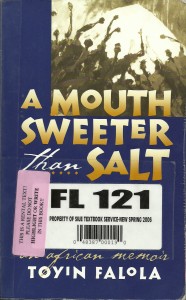
Orlando! Stuck in a resort that celebrates anti-intellectualism, I thanked the gods of my ancestors that I took a book with me, A Mouth Sweeter than Salt: An African Memoir by Professor Toyin Falola. I bought the book a while back because this pretty spirit loitering around the watering holes of the new world without walls, that coven without wires called the Internet, asked me to read the book.  I don’t know her name; her pseudonym is an avatar, but she is a spiritual sister brimming with soul and intelligence and the other day she asked me: Have you read Toyin Falola’s A Mouth Sweeter than Salt? And I bought the book, meaning to read it sometime, but my life is crazy, there are only so many books you can read in a lifetime. And so it sat on my coffee table, waiting for my daughter Ominira to pick it up and read. On my way out to the airport, spying the book on my coffee table, I swiped it and shoved it into my reading bag.

A Mouth Sweeter than Salt is an evocative narrative of Falola’s world as a child in Yorubaland. In this book we follow Falola as he navigates a most mystical labyrinth of a world that will never be. The closest book that I can remember in terms of richness and depth is Wole Soyinka’s Ake: The Years of Childhood. This is not so much a memoir but a rollicking history lesson told by Falola with all his might. If I was a dictator I would decree that every African must buy this book and read it. This boy soldier offered us a long peep into the rich dark corridor of a patriarchy. For this book, Falola employs a folksy narrative richly spiced with Yoruba parables and sayings; the audience is seated stitched to seats, rapt in attention. It is a quaint old paradigm – Falola is the charming sage on the stage waxing eloquent before an attentive audience but it is so effective.  His narrative weaves in some metaphysics and playful hints of Soyinka-esque ruminations emerge. Falola’s memoir hearkens to a time in life when thoughts were spare yet deep – a time when people were not really poor, but enjoyed a clarity of choices:

“I was rushed out of my mother’s womb by war songs, the last war songs that the Ibadan army sang over and over again.” (p5)

It goes on and on as reams of gentle erudition wash over the reader’s eyes like pretty waves:

 “My discovery is not like that of David Livingstone, who claimed to have discovered the Victoria Falls when it was actually Africans who showed him the place, later named by his fellow citizens as one of the seven wonders of the world. Neither was mine similar to that of the European explorer, Mungo Park, credited with having discovered the River Niger in the 19th century, a river that Africans had used for centuries to travel and fish, and one whose long banks had made many settlements flourish.” (p 7)

Falola is masterful at painting the most complex of relationships as in his relationship with his grandfather Pasitor. In the book he and Pasitor go on several trips in search of the mostly elusive (justice, truth, etc) but come across powerful chieftains like the late Chief Akinloye, African Big Men who have mastered traditional structures to suit their own self-serving needs. Out of heartbreaking defeats, his grandfather triumphantly bonds with him through stories about character, perseverance and honesty. My all-time favorite chapter is Chapter 4 (Mamas and Money) Just plain delightful is all I can come up with. And absolutely hilarious. This is Falola at his best – a child in awe of his surroundings. The historical context is deadly accurate. This chapter has to be the most vivid, most robust portrait of the dynamics of the extended family that I have ever read. It is also a rollicking ode to motherhood. His descriptions of the various mothers that gave him succor (and it appears, infinite albeit loving grief) are my favorite. Tart, wicked and downright hilarious. My favorite of all of Falola’s umpteen mothers was Mama Ayo. She had me laughing in my hotel room like a merry lunatic:

“Mama Ayo never had money to give, and running errands for her was mandatory and without compensation. Her tongue was a horse, and she knew how to ride it. With me, it was a rough ride, not to give her trouble as I had none to give, but to get her what she wanted – a quick errand. She could not read a clock, but when it came to an errand Mama Ayo knew when I had been gone too long and asked me to account for each minute. With her husband and others, the horse rode gently, taking her to safety. Whenever anybody praised her, I would become upset, annoyed that anyone would say something nice about her.” (p 98)

And hear this for initiative, can-do, and enterprise:

“No one asked me to fill out a form to indicate my mother’s name, which I did not know. Whenever anyone asked about my mama, I answered in the plural, “they are home.” I never acted or behaved as a child with one mother. When a crack appears in a wall, the lizard finds the opportunity to enter. The crack that I was looking for was the mama with generosity at a particular time, one who would give me more food. When the mamas did not coordinate their activities, I could have two dinners by judging when the food would be ready in two places. They had to give me food anyway.” (p 99)

 The book is personal; it transports me to a genesis, the beginnings of my childhood starting out at birth in Lagos, through “eba” kindergarten school and primary one in Ibadan.  The reader soon joins Falola in lamenting the eroding of the present into the past.

 Ise agbe nise ile wa

Eni ko sise a maa jale

Iwe kiko laisi oko

Ko I pe o ko I pe o

 Farming is our main occupation

Who ever does not work will steal

Education without a hoe

Is not enough, not enough (p 149)

This was practically our primary school anthem in Ibadan. We sang it every day and it has stuck with me. To this day, on certain Saturday mornings my kids can still hear me going at that song with all the lusty gusto that I can muster. Falola’s book takes me to many places where the heart remembers. I remember my grandmother and her unadulterated love for us. I especially remember the way things were as a boy during the Nigerian civil war hiding out in the village awaiting the outcome of the war. This reader remembers with great fondness the joys and strengths of the extended family system. I salute those who believed in it at the time and held my generation across the new river to the other shore. I hope that the generation after mine will be kind in similarly judging our performance. My memories of childhood are gently fading now, gently thrown under the bus by the fatty tissue of life’s issues and choices. The little boy in me hangs back, recedes downcast as the guiding lights of the middle passage refuse me playing rights with my past. I look back and I wave but the boy in me defiantly refuses to acknowledge me. Hands in his khaki pockets, barefooted he kicks stones and stories about, like they are soccer balls. He will play all by himself while I play at being an adult finally. He never leaves my eyes’ windshield; this punishment shall go on for a long time. I salute Professor Toyin Falola for this exquisite trip.

Falola’s book is easily the most comprehensive treatise on patriarchy that I have ever read outside of Chinua Achebe’s books, Things Fall Apart and Arrow of God. In a certain sense, this is also about life as war, about the plight of children, child soldiers born into a war of cultures that they did not ask for. In many ways, I would argue that Falola’s memoir is a legitimate story of a surviving child soldier. The book offers robust opportunities for a wide ranging discussion on several topics; from patriarchy, the decision tree branches into several other topics each touched upon with great depth. What a treat.  Falola’s views on the current dispensation – the move from patriarchy, the shift to nuclear families and on feminism could also be glimpsed. Falola does not invest much in political correctness and it shows Regardless this is not a mere hagiography of a halcyon past; it is living history because he carefully plots and recreates how things were, how things are and the reader is left agape at how a people can bastardize well founded cultures and traditions for the perverse benefits of a few.

 “From the evening to night and at every moment, Yoruba culture was being displayed in ways that were different from what occurs today. As I have enjoyed the lived culture, embodying many aspects of it, I have also grown to become the narrator of a past that is no more.  The real shock to me is that what I saw at Ode Aje, whether it was a marriage or death ceremony, money raising or debt repayment, has disappeared or been modified so substantially within a period of thirty years. I have read about profound cultural changes in centuries long gone, but I never knew that a similar process could occur within a life span, within my own generation, which is a project in the making. I have never fully recovered from the shock of change and the agony of revisiting a past that has been violently reshaped.”  (p 162)

Of all the characters in the book and they are legion, I was most struck by Iya Lekuleja, Leku the old woman. The mystery of the relationship between Falola the boy and Leku the diviner is simply awesome. I read with rapt attention, hushed with the veil of a certain mysticism each time Falola entered Leku’s room. The mystery of that place renders the English Language a wretched vehicle for conveying its depth. It is a big shame because with the dying of the oral tradition things are not being passed on in writing. It is almost as if our world started when the white man’s letters came ashore.

At the tender age of nine, Falola develops a near-tragic fascination with trains (Ibadan is a central railway hub). He ends up inside one all by himself and he is so enthralled he does not get off the train until he is forced out by a ticket collector at Ilorin. I have a nine-year old boy and my jaw dropped as Falola describes his survival on the streets of Ilorin far away from home, conscripted into child labor by a beggar. He would become a “stick boy” for this “blind” beggar.

 I knew what a boy was. I was one. I could not combine the stick and the boy. It was my first job in life. ‘Stick boy” was an occupation, a great job for that matter. The job started immediately. The man, tall and able, would pretend to be blind. I would hold a stick, with him at the back holding the tail and I holding the head. I led, and he followed behind, whispering to me, giving me directions where to go, telling me to move to a person sitting quietly in front of his house. The blind man would beg, offering prayers. I would repeat the prayer or offer my own. Alms would come, we would give a short thanks, and quickly move on to the next person who might not be so king. I would collect the alms and pass them on to him. He never missed my hands as received the money; he never missed his pocket as he put it there. At the end of the day, he would give me my allowance. This was easy to understand. (p 67)

 Falola is no shrinking violet. His book is rife with opinions on a wide range of subjects like divorce and feminism. The book soaks you in the varied world of herbalists, diviners, charm makers, priests and priestesses and a thoroughly fascinating world of cults, masquerades, magic and witchcraft. And in polygamy we find politics in everything, including sex. In Chapter 9 (Seasonal Pleasures) any lie that Nigerians are inhibited when it comes to sex is laid bare (no pun intended). This chapter is a long oriki to sex. It is an interesting take on phallic symbols, sex and sexuality among the Yoruba. It would make for a very interesting debate because it comes across as overly male-centric, expressing the feelings of the man, some would say in a most vulgar manner – sex as conquest.

 The most hilarious story in book is when Falola and his friends set about trying to hook up a friend of theirs Sali with a girl named Risi. They would pen love letters reminiscent of the kinds of letters in the Onitsha Market literature of my childhood. Here is a ribald teaser; the “love letters” alone are worth the price of the book:

 “Oh beautiful Queen! The geography of your body is perfect. Your body is full of milk and honey, your fingers are richer than gold, your eyes see better than the moon and sun, your head contains more wisdom than the sea can hold water. Queen Risi is the model of perfection, accepted by the angels, created by God on a Sunday when He had no time for other duties. You are the last Queen created by God. Other women that came after you are servants of the king.” (p 179)

 The outcome when the boys are found out by their elders is almost tragic. What happened to Falola as a result of this adventure still gives me shivers – it would qualify as child abuse in Western societies. Read the book. All I can say is that Falola is a generous heart. With great affection he transcends major childhood trauma to paint a heartfelt and compelling portrait of an enduring relationship with various adults.

 Falola is first and foremost a historian and a remarkable one at that. If the prose sizzles, it is his depiction of the history of a place that time forgot that makes it so. On the new dispensation:

 There was nothing wrong with Yoruba food, but the new elites in power were making bread and tea more important than corn and beans, turning the students’ taste buds away from local foods and toward imported ones, preparing them for a future that would enslave them in the global economy. (p 145)

 The book’s most important selling point is that is instructive. There is so much that is new to the reader. I was pleasantly surprised to learn about the difference between the phenomenon known as emere as compared to abiku:

An emere… was… worse than an abiku. Unlike the abiku, who was honest with his intention to live in the world for a few days or months, the emere would not give any clues. So deceptive was he that he would show great promise and courage in order to prevent his parents and the diviners from preparing the necessary prophylactic comprising a rich arsenal with which to oppose death. (p 73)

 Falola is a man enchanted by and truly entrenched in the people and its customs. His childhood memoir is a rich stew of proverbs and idioms. However, in faithfully recording the changing of the seasons and the times, Falola sometimes adopts a historian’s attitude and it robs the prose of some crispness.  Also, sometimes, something gets lost in the translation of the sayings and the profound becomes obvious and trite; the sayings lose their robustness in a sea of English words:

 A twisted hand finds it difficult to grip well. (p 79)

 Rotten wood cannot be carved. (p 80)

But be patient, this book is fun. This is also an important book. I would strongly recommend reading it along with Professor Wole Soyinka’s childhood memoir, Ake: The Years of Childhood. They complement each other very nicely.

As great literature goes, Falola is neither Wole Soyinka nor Ola Rotimi when it comes to dramatic flair and he certainly cannot light a candle to Chris Abani’s prose. But what he has is plenty, more than plenty.  Falola earns my respect as a masterful storyteller adept at turning stories into power. This story starts out trembling like a sly train but soon roars to life filled with Ogun’s fires. And man, do sparks fly! The beauty of the book is in its arrangement – in chunky hearty almost stand-alone chapters than can be devoured in no particular order. Then there are these five black and white photographs, all five of them tastefully grainy. These photos of childhood took my breath away. Like rider-less horses they take you to a time that will never come back. Each photograph is a story. Haunting are the pictures – priceless the time stamp of a time gone for ever. Ominira will read this book. Someone should put Falola on YouTube and make him read his book to us in Yoruba. That would be something. That would be something. Indeed.

Falola is right. Our world has changed and not all of it for the good. But life goes on. We welcome the new villages without walls, with strange names like www.barackobama.com, Facebook and YouTube, defiant celebrations of the spirit and spirited denunciations and renunciations of the weaknesses of the flesh. Life goes on. On earth, today is the Internet’s yesterday. And out on the Internet, the new town-criers blare out tomorrow’s news. On the Internet, tomorrow has already come today. Amazing. Today, my son Lion Cub steps out onto the driveway of our existence, grabs today’s newspaper and drops it in the recycling bin. The newspaper is worthless; we read today’s news on the Internet yesterday. Amazing. Ominira walks into my space her voice greedy harbinger of her wants: “Daddy may I use the phone?” I take one look at her impish face and we both start laughing. When did Ominira start using out landline to communicate with her friends? She is trying to give me the illusion of control; her generation has no need for landlines. Welcome new world, welcome old world. The more things change… Hurry, hurry, hurry, go buy Falola’s book before your world changes yet again.

Mrs. Oluremi Obasanjo: Life with an Animal

Reprinted for archival purposes; first published November 30, 2009

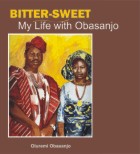
Trolling books in search of pleasure is fraught with peril; one never knows what darkness lurks between the covers of a book. There is the danger of inheriting someone else’s demons. Life is too short for such burdens, but it happens. Patrick French’s stellar biography of the writer V.S. Naipaul The World Is What It Is is an excellent example of hard covered darkness. As you read that dark book, the mind simply recoils from Naipaul’s misogyny and the heart fills with the mystery of what depravity and deficits in self esteem would permit a woman to endure such horrors of misogyny. This is a long rambling way of saying for the record that no book has upset me more in recent times than Bitter-Sweet: My Life with Obasanjo, written by Mrs. Oluremi Obasanjo, Chief Matthew Aremu Olusegun Obasanjo’s first wife. This is one horrible book on many levels. It is a perverse metaphor for all that is wrong with Nigeria, but ultimately there is a gripping story under that book’s covers. Yes, it is a gripping book; I could not put it down. Read this book and weep for the fate of the women and children of Nigeria.

This is one horrible book on many levels. It is a perverse metaphor for all that is wrong with Nigeria. My copy came in a “hard cover,” to use that term extremely loosely. The pages seemed affixed to the covers with the liberal use of eba as an adhesive. Everything about it is poorly done – the writing, the research, the production, the editing. It was perhaps not edited. Diamond Publications Ltd, the publishers of this book should be embarrassed; this is not a book befitting the status of the ex-wife of a former ruler of Nigeria. Unfortunately, this sorry excuse for a book did not prevent blurb writers of stature (Reuben Abati, Femi Osofisan, etc) from lustily singing its praises. How it is possible that they could have read past the numerous typos and grammatical errors in that book speaks volumes for the level of indifference to excellence in today’s Nigeria. To cap it all, the “foreword” was written by a university don, Professor Adigun Agbaje, Deputy Vice-Chancellor and Professor of Political Science at the University of Ibadan. It is quite simply disgraceful that a university don would append his name and prestige to such sloppiness. Why, the book is so bad, even the clichés are mangled.

In this book, Mrs. Obasanjo chronicles an acrimonious and violent marriage to a narcissistic partner, who is horrible and abusive, mean spirited, and nasty to boot. In most societies the allegations against Obasanjo, if proven in a court of law would have earned him a long stay in jail. Mr. Obasanjo is portrayed as a serial manipulator and wife abuser who loves charming all manners of women into his perverse space. In her spell-binding narrative, Mrs. Obasanjo’s life has been a terrifying roller-coaster since she first had the misfortune of meeting him late in 1955.  According to the book, Obasanjo is a ruthless man, one who was fond of offering unsolicited slaps and merciless beatings to subordinates, house help and wives (the late Stella Obasanjo included). Nothing seems beneath Mr. Obasanjo – witchcraft, sorcery and diabolical behavior. To understand the specific nature of the allegations, imagine an African statesman (Aremu Obasanjo), knife in hand, chasing his terrified wife (Oluremi Obasanjo) down the street, not to give her flowers, but perhaps to murder her. Mrs. Obasanjo has been abused beyond the imagining of it. It is tempting to heap blame on Mrs. Obasanjo for hanging around long enough to endure such horrors, except that psychiatrists would describe her odd enabling behavior (of Obasanjo’s sick antics) as emanating from the abused spouse syndrome. Regardless, she represents Nigerians’ willingness to take unspeakable abuse from leaders – for a chance at the table of wretched crumbs.

In the celebration of the remains of narcissistic ME the author glosses over substance at every opportunity. It is largely because, like her husband, she is innocent of substance. When she tries to be deep, it is comical. It is all about style for her. All sizzle and no suya. This is a shame because through the roughness peeps sensitivity. She needed a good ghost writer. There is very little analysis, although there are interesting anecdotes. Mrs. Obasanjo reveals that during the civil war years, there were simmering tensions between Benjamin Adekunle and Obasanjo. Chukwuma Kaduna Nzeogwu cuts a dashing and romantic, if quixotic figure, He showered her with the kind of attention normally reserved for lovers – she should have married him, he was such a gentle man. It is a book about missed and wasted resources. We come face-to-face with pathetic lives preoccupied with the accumulation of the banal and the trite. There are all these powerful soldiers and civilians accumulating an army of dead peers, victims of naked ambition – none related to securing Nigeria’s fortunes.

By Mrs. Obasanjo’s own account, Obasanjo treated her worse than the wretched chickens of Otta Farms. Still, it is strange, after all that she went through, she was in the habit of loitering around the corridors of power calling herself Obasanjo’s wife and apparently collecting favors. As his “wife”, she led “delegations” to other countries, to do what, it is hard to tell. Gaps in the narrative rankle and blatant hagiographies abound as she strangely channels Obasanjo’s delusions of grandeur. Her spirited defense of her daughter Iyabo Obasanjo defies and defiles logic. It tears to shreds the book’s pretense to credibility. The self-absorbed ME looms large in the narrative and once more Nigeria is an Okada motorcycle being ridden to its demise by a handful of overweight riders. In this sad horrid book, everything comes together in one perverse convergence – the collusion of rogue intellectuals with rogue soldiers and a willing populace to screw Nigeria to death. History will hopefully be just to Obasanjo and Nigeria. Obasanjo was a horrid husband; Mrs. Obasanjo would know. Obasanjo was a horrid leader, we would know.

For John Pepper Clark-Bekederemo: Triumphing Over an Imaginary Tragedy

Note: Reprinted for archival purposes; first published June 20, 2011

I revere Buchi Emecheta, Ola Rotimi, Flora Nwapa, Elechi Amadi, Cyprian Ekwensi, Gabriel Okara, Chinua Achebe, John Pepper Clark-Bekederemo, Vincent Chukwuemeka Ike, Wole Soyinka, and TM Aluko. Together, they raised and nurtured those of my generation who loved the world of ideas and we devoured their works like starved children. We owe much of what we are today to these great owners of words.

So imagine my excitement the other day when I chanced upon a used copy of Clark’s book, America, their America. As a teenager I had been awed by the audacity of this African that had gone to America, hated her patronizing and condescending attitude, and spat at her faux generosity. I cheered then, when in the end he was unceremoniously ejected from America for being a prickly non-conformist. Clark was defiant to the end. I was a hot headed youth in those days and I loved beret wearing, brandy swilling, cigar chomping rebels, so romantic. Besides I always liked JP Clark, as we called him in those days. As a playful secondary school student, I appreciated that his poems were always more accessible to me than those of Soyinka. Try this: Read Clark’s Abiku and then read Soyinka’s Abiku. Your headache will ambush you after reading the latter.

America their America. America, their America is an angry book from cover to cover written by a gifted young man that railed against the alienation and sense of loss he felt upon turning the corner and seeing the nightmare that was their America. Clark gleefully deployed muscular prose to settle scores with America. The America he saw was not the America of his dreams. And this young man was not impressed. He spoke truth to their power in prose. It is an important book; I will always include it in a study of Africans in exile, along with Nnamdi Azikiwe’s My Odyssey and Buchi Emecheta’s early books. I still think America, their America is an important book; however, upon re-reading the book recently, I was taken by how angry Clark was in the book. Clark used the novel to settle scores with his American guests. As I read the book again, it occurred to me that I did not know much about Clark beyond his poetry and the book. Indeed, we do not have a robust culture of writing reliable biographies of our literary heroes.

I am always filled with envy when I read unflinching high quality biographies of folks in the West, most recently of VS Naipaul by Patrick French. So, I was thrilled to learn that Adewale Maja-Pearce had just written a biography about Clark, titled, A Peculiar Tragedy: J.P. Clark-Bekederemo and the Beginning of Modern Nigerian Literature in English. I went online to buy the book; with taxes, shipping and handling and other forms of robbery fees, I was looking at $30. Not happening, the economy is bad. Seeing that the book was published in Nigeria (The New Gong), I begged friends to scour bookstores in Nigeria in search of the book. It turns out that The New Gong publishing company is owned by none other than Maja-Pearce himself and the distribution structure on the ground in Nigeria is non-existent. To cut a long story short, this self-published book is not available in Nigeria. I finally relented and bought the book online. I did not waste our family’s money but I expected more for $30, I really did.

Hagiography or Biography? So, how did this biography come about? It goes something like this: Maja-Pearce dreams up a proposal to write Clark’s “biography” and applies somewhere for a $63,000 grant to fund the project (don’t ask me why he needed that much to write a book). When he doesn’t get the grant, he approaches Clark who agrees to foot the bill for the “project.” A flattered Clark readily agrees and pays Maja-Pearce one million Naira (about $7,000) with a promise to pay an additional one million Naira later. There are other perks; Maja-Pearce is allowed free access to Clark’s records, house and wine bar (and Maja-Pearce admits that he helped himself generously to everything, especially the alcohol). Soon, things go wrong; Clark does not like drafts of the manuscript and balks at the use of a certain letter. The relationship goes south badly. Maja-Pearce is unceremoniously ejected from Clark’s home and heart and he goes off in a huff to write a stinging tell-all tale.

The conflict of interest inherent in this pay-for-your-hagiography scheme shreds whatever credibility the book has. Clark was right in demanding that the product fit his specifications. Well, think about it, if you commission an artist to paint your portrait wouldn’t you want the portrait to be flattering of your jowls? What doomed the project from the onset, besides the sloppy writing is the loss of credibility. When someone pays you to write his biography, he is most definitely not interested in an objective tome. He wants something that will provide a mirror to the side that flatters him the most. Why would you demand payment from someone to do their biography? Who does that? It reads like a shake-down to me. And it was.

What Maja-Pearce has written is not a biography in the real sense. I am not sure what to call it. Let’s just say that Clark will not be pleased with the book. Wole Soyinka will not be pleased either. Neither will Achebe. Maja-Pearce is an equal opportunity hack savaging the dignity of any and every one in his jaded sight. Which brings me to another point: Sometimes you wonder if this is really about Clark or about Maja-Pearce’s desperate need to put together all his sloppy research about various subjects in one book. He succeeds in that and fails in virtually everything else.

If the aim of the book was to diminish Clark and his generation of writers, Maja-Pearce misses the mark terribly. The reader actually comes away empathizing with Clark at the end of the book. And it was not for lack of Maja-Pearce trying. He expends extraordinary energy toward diminishing the man. Insults and put-downs fly gleefully and no one escapes Maja Pearce’s teasing, especially Soyinka and Clark. It is an unnecessary exercise that merely diminishes Maja-Pearce himself. And as an aside, the notion of setting Clark up as a rival to Soyinka and Achebe is a needless distraction. Maja-Pearce plays up the rivalry between Soyinka and Clark to very tasteless levels. Each writer is different, endowed with extraordinary gifts and if Clark is a literary failure, as Maja-Pearce implies, many of us would like to fail like that. The bottom line is this: The history of African literature, indeed English literature would be incomplete without Clark’s contributions.

Analysis or Personal Opinions? Maja-Pearce should have enlisted the help of someone who knows poetry; his analysis of the works of Soyinka, Okigbo and Clark is disgraceful. He readily admits that he knows little about Okigbo’s poetry but he did some work on it because it “was just a job with a modest fee at the end of it.” One thing about Maja-Pearce, he is honest. He presents himself as a hustler lurking in the seamy edge of the literary world scheming to make a quick buck. Here is a man who measures a writer’s worth by the number of google hits: Achebe is more important that Soyinka who is more important than Okri. Who does that? His standard of success is suspect. Biases and prejudices mar the book’s quality and credibility. I would read Robert M. Wren’s Those Magical Years: The Making of Nigerian Literature at Ibadan first before reading this book. The few insightful observations in Maja-Pearce’s book are inspired, if not lifted from that book.

In this highly disorganized book, Maja-Pierce fails to provide the appropriate context for his thesis. Who is Clark? Why are we reading this book? The analysis of several weighty issues falls short, for example Maja-Pearce lacks an appreciation for the complicated relationship minorities had among the major ethnic groups leading to and even after the Nigerian Civil war. He concludes that Clark’s decision to side with the Federal government, rather than the Biafran side, was reactionary and self-serving. To ascribe Clark’s decision to side with the Federal side as self-serving is to totally miss the complexities of that unfortunate war. Maja-Pearce does not get it: Clark and Saro-Wiwa especially would never have joined the Biafran side. His analysis of this issue is typical of the strands of his arguments – they are mostly shallow and glib retorts to weighty positions.

Despite all my misgivings, I would still recommend this book. Maja-Pearce spent a lot of time developing and accessing sources for his book. The cited sources alone are worth the steep cost of the book. It is a gossipy, fairly entertaining and engaging book written in an accessible style. He provides useful insights about the lives of Clark, Achebe, Soyinka and Okigbo. The reader learns for instance about the influence of the CIA on African intellectuals (funding grants, workshops, etc). One learns that Government College Umuahia produced a bountiful crop of great writers: Achebe, Elechi Amadi, Vincent Chukwuemeka Ike, and Gabriel Okara. Clark’s valiant struggle to sustain several high quality literary magazines is nicely documented here.

Slivers of Brilliance and Petulance. Maja-Pearce is more at home with plays. In Chapter 3, he devotes literary muscle and rigor to analysis of plays. Chapter 3 is almost worth the price of the book but it has little to do with Clark. It reads like a failed manuscript from a different project. The book provides some good history showing Clark as a visionary when it comes to promoting our literature (Mbari, Black Orpheus, etc.). However, Maja-Pearce manages to diminish Clark’s contributions by ascribing significant credit to the late Ulli Beier. He is genetically incapable of giving unqualified praise.

The most egregious failing of this book is Maja-Pearce’s misrepresentation of a 1975 letter which clearly showed that Clark was in the oil business and was soliciting business overseas. Maja Pearce sought to represent that Clark “benefitted from an oil contract for services rendered to the nation following his support for the federal side during the civil war.” The letter, a copy of which is in the book’s appendix, makes no such claim. I think it was irresponsible journalism, bordering on blackmail for Maja-Pearce’s part to make such an insinuation. In a responsible society he would have been hauled before an ethics commission.

Grammatical issues plague the book and careless statements are paraded as facts. The book is a dizzy harvest of tipsy thoughts struggling to pass the sobriety test. As a result, the book fails grandly. There are all these loopy drunken sentences dripping with vinegary venom. Maja-Pearce quotes myriad sources but there is ample evidence that he did not read them thoroughly. I urge a more talented writer to use the same sources and write a real book about a great man- John Pepper Clark-Bekederemo.

Shakedown Inc. Faced with Clark’s alleged pettiness, Maja-Pearce rises above the effluvium with his own brand of pettiness. In that department he easily bests Clark. The story of the book is of a shakedown gone awry. And Clark is the victim here. Maja-Pearce’s fee to write a shoddy book is a hefty $63,000 and he is piqued when Clark asks him why he would need all that money to write a damn book. This is one Nigerian intellectual pining for alien wines, turning tricks for quick bucks.

Maja-Pearce describes Clark’s eagerness to fund the book as part of an elaborate plan to rehabilitate his image, in the hope that he might get the Nobel Prize. Bizarre. Some of it smacks of megalomania on Maja-Pearce’s part. It is quite possible that Clark was unimpressed by the work. Maja-Pearce had trouble selling the book to Western publishers but he ascribed ulterior motives to their refusal to publish his book. Reading this poorly edited book, I can see why no one would want to touch the manuscript. It is poorly written, poorly organized and certainly not marketable as presented.

Maja-Pearce portrays Clark as a tragic Walter Mitty character who still harbors dreams of making it big on the world stage. Maja-Pearce is no angel himself. A self-confessed heavy drinker, in one forgettable passage, he leaves Clark’s dining table after a feud but does not forget to grab a half-empty bottle of wine on his way to his bedroom. What a class act. The Clarks were generous to him, paying for his writing and buying his wife’s expensive art. Still he whines nonstop; he even complains that the Clarks put him in a bedroom that lacked a balcony. Someone hand me my violin.

Broken Guns for Word Deities. Clark is a well-read complex thinker. It would have been more respectful and productive to pair him with a thoughtful and gifted interlocutor. Clark is an accomplished playwright and poet and nothing can take that away from him, not even his own demons and there are many of those.  Clark is not the only victim here; Maja-Pearce dismisses Achebe’s Things Fall Apart but offers no reason for such recklessness. Who does that? One of the chapters offers an egregiously awful rumination on writing in one’s own language, one that calls to serious question, Maja-Pearce’s ability to engage in these kinds of debates.  It is a poorly articulated filler that was relentlessly stretched to give the impression that it is somehow about Clark. There is scant evidence that he personally interviewed Soyinka, Achebe, Ike, etc. And missing are the insights of the female writers of the time, someone like Buchi Emecheta who is still alive.

The book is a petulant retort to a spurned relationship with JP Clark-Bekederemo Paul Theroux wrote Sir Vidia’s Shadow, a good book on VS Naipaul based on a sustained decades-long personal relationship with Naipaul. It was a work of rigor and scholarship. Maja-Pearce is no Theroux. For one thing, Maja-Pearce desperately needs to read new writing to update his opinions.

Many decades ago, Paul Theroux, a young aspiring writer befriended an older writer VS Naipaul. The friendship of two complex persons was to be a marathon journey of at least three decades that Naipaul ended abruptly and on a sour note.  Theroux did not take being unceremoniously dumped well. He wrote a caustic but important and well-received biography of Naipaul, Sir Vidia’s Shadow:  A Friendship Across Five Continents. Patrick French followed up with his own book, The World Is What It Is: The Authorized Biography of VS Naipaul which largely corroborated the main burden of Theroux’s book. In neither instance was the subject of the biography asked to pony up money for the privilege of being flattered or lampooned. Such an act would have been inappropriate and unethical. Maja-Pearce owes Clark a huge apology.

The chapter on how to win the Nobel Prize is yet another long unnecessary chapter that has a long unnecessary riff about Soyinka. The chapter has little or nothing to do with Clark. Tasteless is the rumination about whether Soyinka was worth the Nobel. One senses that he is unhappy with Soyinka because the latter wisely declined to be a reference for one of his numerous money making schemes. (p253).

Recreating Faux Naipaulean Drama. In his book, Maja-Pearce’s attempt to recreate a Theroux-Naipaul drama is self-serving and falls short on many levels. There is clearly no chemistry between the two men and Maja-Pearce is in too much of a hurry to make a quick buck to establish a rapport with a clearly more complex man. And when Clark boots him out of his house, he responds with a poorly written book that is remarkable mostly for its vindictiveness and cutting sarcasm. He paints Clark as a has-been writer for whom several doors are no longer open. Did he not know this before going to Clark with a proposal to write a biography about him?  This is the same man who in the book proposal to Clark praised him as the most underrated writer of four men, the rest being Achebe, Okigbo and Soyinka; who stated that Clark’s plays were more accomplished than Soyinka’s; and who shared that  he had a poor opinion of Achebe’s Things Fall Apart (p 125).. It would appear that he basically said all of this to make money off an old man.  The intellectual dishonesty is blatant and galling.

There is a pattern to Maja-Pearce’s mischief; he has sought to sustain a tottering career in letters by attacking better known and accomplished writers. He is probably best remembered for his long rambling attack-review of Soyinka in 2007 under the smirking title Credulous Grammarian a scathing “review” of Soyinka’s You Must Set Forth at Dawn that is so full of ridicule, it barely has room for substance.

Quoting liberally from Soyinka’s The Man Died, Maja-Pearce makes sinful literary hay out of the tensions between Clark and Soyinka and pits both men against each other. He is quite gossipy, Maja-Pearce is not someone you want to invite into your home, you will regret the result. The disrespect shown Okigbo, Soyinka, Achebe, Clark and even Odia Ofeimun is particularly troubling. There is no compassion for the bravery, intellect and erudition of these men who taught several generations of youths even as they were youths themselves. Despite their flaws and demons, these men deserve our gratitude not ridicule. Maja-Pearce owes these great men unqualified apologies.

Again, the burden on these brave warriors of letters in the face of the birth of a new nation is hard to quantify. They were certainly no angels, but that is what makes their narrative powerful, evocative and compelling. Try to imagine as a twenty something year old, writing Things Fall Apart long hand without the benefit of a word processor and definitely without the Internet and you get some sense of what these griots accomplished. A balanced objective biography that tells the truth warts and all and respectfully is what we need. In the twilight of their life’s journeys we should treat these brave men and women with compassion, respect and definitely with appreciation for making our world a better place than they met it. I salute Professor John Pepper Clark-Bekederemo, warts and all.

The Poet Lives in Us

As someone who thoroughly enjoys reading Nigerian poetry, let me just observe that several of our new poets are timid holdovers from the Soyinka-Okigbo era; that era that Chinweizu famously derided as unreadable and obscurantist. Such an uncritical adherence to that era ignores the fact that even as oblique as their works were, Wole Soyinka and Christopher Okigbo were truly relevant to the times in at least one sense. They spoke in decipherable code to their fellow intellectuals (some of them in military uniform) and the intended audience listened closely. Soyinka has many seasons of incarceration to show for the effectiveness of his poetic rage. Okigbo died carrying his message.

An uncritical adherence to a Euro-centric approach has the unintended consequence of isolating our best voices, and assigning their songs to a pantheon of obscure mediocrity. On behalf of our long-suffering people, I would like to urge a return of voices to the true songs of our people. Africa cannot afford the consignment of its griots to the barracks of the unreadable. How does the poet become truly relevant to the yearnings and anxieties of our people?

Soyinka, Gabriel Okara, Okigbo, these poets spoke to the oppressors in the language they understood. Our new oppressors do not understand the complex nuance of the type of poetry that many of our poets seem to favor, that pass the smell test in the West. And if therefore they do not read our poetry, when will they hear the clanging of the chains around our people’s necks? Which begs the question again: What are our poets living for today? It is about seizing opportunities. Our lands lie devastated, enduring rape upon rape. Our poets stare stunned, in disbelief and in shame, because, this time, their voices have been drowned in shallow pools of self-absorption. Word to the poet: turn your poems into songs of freedom, and let your songs morph into weapons of war. We are at war, what are you doing stringing together incoherent sentences?

The poet lives, breathes in all of us. And as Soyinka would probably say it, the poet dies in all who keep silent in the face of tyranny. Let us honestly divine the difference between poetry and unadulterated drivel. The consumer is the ultimate arbiter of what good poetry is and what is painful to the eyes. But I miss the haunting lyricism and imagery of poets like Okogbule Wonodi. Hear him sing to me: “But we have poured more wine/than the gods can drink/more than the soil can drink/and have become outcasts/dispersing the fishes/for which the baskets are laid/and the fisherman did not like us.” [Okogbule Wonodi, Icheke: IV]

Is Wonodi a bad poet? I would never know. I hope that there are many more bad poets where he came from. I come from a land of simple people who hide deep meanings inside simple words. One has to listen carefully to my people to get the insult or the accolade. I look for those kinds of poems to enjoy. Freed from the stifling confines of classrooms, I have taught myself to only pay for that which my heart seeks. If a poem turns out to be what the acerbic reviewer Randall Jarrell refers to as giving “the impression of having been written on a typewriter by a typewriter,” I will simply move on quietly to a more worthy pursuit. Our poetry is not dead; it just needs packaging.

Thriving societies of thinkers and doers look at their world and they see visions of possibilities and they say, why not? We have inherited a culture that celebrates customs as sacrosanct, and the past poses as the present tense. The great societies take their best thinkers and exhort them to think, no, dream of a better world, and worry about the constraints later. Every day, we lose our tenuous grip on our continent; I think we are going to drown in the syrupy fluid of Western customs and traditions.

In the beginning there were walls. And in the beginning walls defined every being and everything. The Berlin Wall is no more and poets lament the coming of the new dispensation. Except that the new dispensation is not new; it is here. Books are dying, poetry as we know it is limping on life support and prose is hawking her wares in obscure literary journals like a junkie in need of a fix.  But the world lives, life goes on and ideas continue to rock our foundations. In the seeming irrelevance of the written word, the poet lives. Poet, do not cripple your voice with silly little sentences that make sense only to the terminally drunk. I say, speak up, don’t stutter. Straighten up and lift our people’s dreams on the strong backs of your strong voices, and carry them through to the deaf myrmidons of darkness who live beyond the valley of darkness, past the hills of decadence. And sing it; sing it for a people long used to the silence of her priests. The poet lives. The poet lives in all of us.

For Professor Toyin Falola: Celebrating Our Stories…

Writing is a mystery. Why do we think about things and write them down? Writing is a laborious, messy, painful, sensual, time consuming process. The poor soul drawn to this form of self-flagellation er self-expression may attract fame, more likely notoriety, but it is almost always the case that riches will not accrue from this disability. Disability? Yes. Many would consider the ability to write and engage an audience a gift, but one suspects that a typical writer would confess to a crushing burden, of sometimes having to stop any and everything to record something. Many times, that something makes absolutely no sense. The truly burdened or gifted writer is moved by an unseen hand to transport mind matter through the hand into words – of wonder and sometimes of inanity. It is what it is, a mystery. But in the fiction of our word griots lies the history of our people.

Africa’s owners of words have attained a new status as custodians of our history because the oral history of our clans cannot compete with the written. Warriors die with their stories and the living are left to re-tell the stories. Stuff gets lost in the re-telling, memory is a forgetful lover. Some of the best poets I have ever known died without ever writing a book. Many more will die. It is the nature of things. But then, there is no book robust enough to capture all of history. History is easily distorted, as Chinua Achebe reminds us with the East African proverb, “Until the lions produce their own historian, the story of the hunt will glorify only the hunter.” We know now that much of what passes for African history is defined by the (white) written, much of it distorted by the lenses of the (white) historian. It does not help that many African historians have fled to more nurturing societies where they unwittingly toil at writing and teaching someone else’s perversion of African history. What remains is remarkable only for its shoddiness and laziness of craft.

American history is deeply and apologetically Eurocentric and indifferent to those periods that make the majority uncomfortable. Indeed re-writing the right history of America will soon become a civil rights issue.   Every day young warriors of color swim mean seas, scale impossible peaks and ride on the roofs of indifferent trains into America (“illegal aliens” these beautiful warriors are called) and they forcibly change the landscape. You don’t see that in the history books of this country, because it is HIS-story, NOT our story.  In fifth grade my daughter Ominira’s class Ominira participated in a “field trip” called Westward Ho where they were required to reprise the rush West. As parents, we were required to walk behind them through brooks, streams, hills and all sorts of contrived hurdles designed to simulate the white man’s struggle to get to Nirvana. Nowhere was there mention of the fate of Native Americans and needless to say, the fate of black slaves was nowhere to be observed. I almost wept when in the evening, my daughter broke away from a dance to offer me “Santa Fe Stew and corned bread”, dressed in an apron and a bonnet. The conquest is complete and irreversible.

While we are being frog-marched to Babylon, we can at least sing ourselves our songs. Upon the death of Dim Ojukwu, many of us donned the flag of Biafra. One young Nigerian reached out to me on Facebook and asked what the flag was about. I told him. He asked me to tell him more about Biafra. I asked him how old he was. 35 years old. A man born in Nigeria in the 70’s told me that very little of Biafra was taught him in school. How can that be? After all these moons living far away from the land that cradles my placenta, I have become aware of the power of the historian. Many events have shaped my awareness. Dark were the days when I visited the Holocaust Museum in Washington DC and the Hector Pietersen Museum in Soweto, dark were the days.  Civilization is a euphemism for barbarism, markers for those humiliating periods when the world went mad.

Many versions of our history lie in the fiction of our griots, from Ngugi Wa Thiong’o to Chimamanda Ngozi Adichie and finally to Professor Toyin Falola. Falola? Google Falola and your computer may crash from the umpteen hits. I will never forget reading his autobiography, A Mouth Sweeter than Salt: An African Memoir which I reviewed here.  Falola has probably written dozens of books about the African journey. One of them, Etches on Fresh Waters, a collaborative effort in poetry with Dr. Aderonke Adesola Adesanya is a coffee table book with muscle. It sits my living room with pride, showcasing the dignity of our humanity.  Falola does not know it, but like Achebe, Soyinka, Ngugi, Adichie, Pius Adesanmi, Okey Ndibe, Lola Shoneyin, Chika Unigwe and others, he is an inspiration to many of us.  On this February, what we call Black History Month in America, I rise to salute you, Alagba Falola.

Lost in America: At the Bookstore…

America. I am at the bookstore shopping for a gift to celebrate a friend’s retirement. She must leave with a piece of me. Procrastination dropped the day on me without warning and I had to go to a bookstore to buy a book. Who does that anymore? I will give my friend Teju Cole’s new book, Open City. She loves New York, classical music, art, museums, classical music, pretty people, gourmet food and wines, and stuff like that. She will like Open City, there’s lots of that in the book.

At the bookstore. There are computer monitors everywhere, you can look up who and what you want and you can even print a map that takes you to the book inside the store. I don’t like going to bookstores. I feel sheepish inside this huge bookstore. I ignore the computers; I did not come to the bookstore to play with computers. Customer Service. I tell a young man, I guess I can look it up myself, but maybe you can help me, do you have Teju Cole’s book, Open City? He looks at me with practiced faux enthusiasm, Oh sure, glad to help! I spell T-E-J-U C-O-L-E and tell him proudly, he wrote Open City. The clerk looks it up on the computer, nope, it is not in stock, I can order it for you.  Nope, I say, not unless you can postpone my friend’s retirement party. What about Chimamanda Ngozi Adichie? I spell A-D-I-C-H-I-E. I do not spell the other names. He divines his computer again. Ah yes, Purple Hibiscus, Half of a Yellow Sun, The Thing Around Your Neck. He says they are in Fiction upstairs. Wow, Fiction upstairs! Not in “Black American,” not in “African-Caribbean,” not in the back of the bookstore, gathering dust with losers. Nice.

I decline the young man’s offer to take me to Fiction, and thank him profusely, nice man. I will go to Fiction upstairs, browse around and pick out something nice for my friend.  At Fiction, I start with G for Petina Gappah, yes, my friend will like An Elegy for Easterly, I love that book, I must have given away half a dozen to grateful readers. There is no Gappah, too bad. This is why bookstores are dying all over America, who needs this? My laptop Cecelia always has these books, point, click and pay, and they show up in three days, plus free shipping.

I scoot over to the A section, A for Adichie, Chris Abani, Chinua Achebe, Uwem Akpan. Abani’s Graceland is there posing with attitude, no, I don’t want my friend to attempt suicide with such a depressing book. Akpan is there with Say You’re One of Them, no, I don’t want my friend to attempt suicide with such a depressing book.  All of Achebe’s books are there; Arrow of God, Things Fall Apart, etc. No more Achebe, please, we have skyscrapers in Africa now and we eat ice cream, she won’t like reading about cute yam farmers. I settle on Adichie’s Half of a Yellow Sun. I also grab a copy of Pablo Neruda’s 100 Love Sonnets; don’t ask me why, it is a long delightful story.

The cashier’s line is a pleasant line, summer is all lined up. A pretty lady behind me keeps smiling at me, I wonder what is wrong. There is a mother-daughter couple in front of me; they seem to thoroughly love being with each other and my heart yearns for my daughters and sons. I wonder where they are, what they are doing.  My turn. A cashier with auburn tresses calls me up to the counter. I am a member of the store’s club; I give her my identification number so she can shave off a few pennies from my bill. She pulls up my information and pronounces my name the way my ancestors like it. Her tongue wraps around my father’s name like she owns it. Wow! Lovely! I beam with pride at the mention of my name in all the right places. I compliment her profusely, impressive!

She squirms happily like a puppy offered treats. Did I pronounce it right? Yes, thanks! Good! When I was young I had an impossible to pronounce name also so I take care to pronounce impossible to pronounce names correctly. Thanks, I gush with gratitude. From West Africa? Yes, I cry with pleasure, I am going to fall in love with this soulmate! Which country? Nigeria, I say with pride. I passed through Nigeria once. Really? Which Airport? Lagos. As she mentions Lagos, her eyes lower into pretty ice picks, I was going to Senegal and the Congo. They stole my luggage in Lagos, it was awful. She spits out the dagger-words sweetly. Her pain stabs my pain. I deflect. How was Senegal? It was okay, a bit too sleek, I liked the Congo. The Congo was innocent. Innocent! Oh Africa! I flee with my bag of books. Memo to self: Please begin to catalogue all the losses you have endured everywhere in America. Beginning with this bookstore.