Professor Mobolaji Aluko on that Unilag name change…

It is now (bad) news unfortunately that the bungling regime of Nigeria’s President Goodluck Ebele Jonathan, this week renamed with arrogant and ignorant fiat the revered University of Lagos after Chief MKO Abiola, the late icon of the prodemocracy movement. By taking this action, this regime of incompetents has erased the University of Lagos off the history of Nigeria, just like that. Many of us have no problem with according Chief Abiola all the respect and honor he deserves; we have a problem with the lack of due process and are appalled that the resulting controversy has had the effect of tarnishing the names of both the great institution of Unilag and the benefactor, Chief Abiola.  

I am loudly opposed of course to the process that brought about this ill-fated change. It makes a mockery ironically of what Chief Abiola fought for and assures the world that Nigeria’s experiment with democracy is a deadly farce. I was curious as to what the leaders of the now defunct prodemocracy movement thought of this bone-headed move. And so on May 29, 2012, I asked the following question:

This is the time to ask the icons and leaders of the prodemocracy movement, Professors Wole Soyinka, Olusola Adeyeye and Mobolaji Aluko, what do they think of UNILAG’s name change? Is this their idea of how Chief MKO Abiola should be immortalized? By the drunken force of fiat? Is this what they fought for? They should not be silent. They should please speak up and  assure us that this is the way to go, that this is how MKO Abiola would have wanted it. The silence of the prodemocracy movement is deafening and embarrassing. Animal Farm did not look this bad.

On the same day, I received a swift response from Professor Bolaji Aluko which I have appended here for posterity. Professor Aluko is the current vice chancellor of the Federal University at Utuoke in Bayelsa State.  The response speaks for itself and as always he has my respects:

==============================================================

Ikhide “Towncrier” Ikheloa:

You dey find trouble as usual…..

Since you ask, this is/are my opinion/s as a June 12 pro-democrat of yore and present Vice-Chancellor of a federal Nigerian university (at Otuoke) with respect of the change of UniLag to MA(L)U:

1.  as a VC, I would have expected to be consulted by my Visitor at the very least, together with my Senate, student body, alumni, and especially Governing Council.  [The current VC of UniLag, having just died recently – and to be buried tomorrow, with burial rites throughout this week – I would have waited on ANY announcement relative to UniLag until the mourning period is over, and certainly acknowledged the passing in the same speech.]  See October 1, 2011 announcement of change of FUTY to MAUTECH below for example, one of eight (of the 37) federal universities currently named after “important personalities” (here) with ABU being the oldest (1962).  There are 9 out of 37 such-named state universities.

2. in the Democracy Day 2012 Speech, I would merely have ANNOUNCED the possibility of naming one of the federal universities (not necessarily UniLag, which has no unique relationship with MKO – not being an alum, or founder or major benefactor, etc. –  as a PROPOSAL to be considered more democratically.  Maybe the stakeholders of one of the universities – including maybe one of the new ones – would have enthusiastically raised their hands.  It appears that is what happened for FUTY to MAUTECH; again see below.

3. in addition to the above, in the time being, I would have named Abuja Stadium after MKO, and June 12 a Democracy Heroes national public holiday – although it is rather too close to May 29, in which case I might have boldly sacrificed May 29.  The long overdue honor due MKO, arguably a Sacrificial Father of Modern-Day Democracy in Nigeria – should not be made to contribute any further divisiveness in the already “heated Nigerian polity” – as the Nigerian saying goes.

Of course, I am not President GEJ, so those are my views, and yours are welcome.  There is still much time however, for presidential revision of priors

And there you have it….’Nuff said.  I hope that you are not  longer deaf from silence from me.

Bolaji Aluko

QUOTE

http://mautech.edu.ng/index.php?option=com_content&view=category&layout=blog&id=1&Itemid=50

CHANGE OF NAME OF THE FEDERAL UNIVERSITY OF TECHNOLOGY, YOLA TO
MODIBBO ADAMA UNIVERSITY OF TECHNOLOGY, YOLA

The Vice – Chancellor, Federal University of Technology, Yola Professor Bashir Haruna Usman, on behalf of the Council, Senate, Staff, Students and the University Community, wishes to bring to the notice of the general public, sister Federal, State and Privately
owned Institutions, Public Parastatals, Private Corporate bodies as well as all friends  and business partners of the University, that in the tradition of immortalising important personalities and historian of great repute, the President and commander in Chief of the Armed Forces, Federal Republic of Nigerian Dr. Goodluck Ebele Jonathan, GCFR, has approved the change of name of the University from: FEDERAL UNIVERSITY OF TECHNOLOGY, YOLA (FUTY) to MODIBBO ADAMA UNIVERSITY OF TECHNOLOGY, YOLA (MAUTECH, YOLA), supposedly named after Modibbo Adama Ibn Hassan, a great scholar, an erudite educationist, an outstanding leader and the founder of the Fombina Kingdom (Now Adamawa Emirate Council). As the first ruler and founder of the Emirate, Modibbo Adama Ibn Hassan (1809 -1847) was one of the disciples and flag bearers of Sheikh Usman Ibn Fodio of the Sokoto Caliphate. By this therefore, the general public is enjoined to note the new name of the University and
be informed that all former documents and correspondences bearing
Federal University of Technology, Yola remain valid, and the change of name takes effect from 1st October, 2011.

Signed

Alh. Ahmed Usman W/Chekke

Registrar

Olusegun Adeniyi: Power, politics, and the killing of a nation

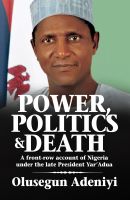
I so badly wanted to read Olusegun Adeniyi’s book, Power, Politics and Death detailing his alleged reflections on his days as a spokesman to Nigeria’s late President Umar Musa Yar’Adua, a man whose wholly ineffective tenure has now being glorified and lionized by the chic incompetence and buffoonery of the present occupant of Aso Rock, “President” Goodluck Ebele Jonathan.  I was fascinated; here was a man who had front row seats in those days when Nigeria was listing and drifting in the morbid hands of a dying or dead man (depending on who you were listening to in those tragicomic times). I badly wanted Adeniyi’s book. He was Yar’Adua’s press aide and I could be forgiven for believing that he saw and knew a lot of stuff and that he recorded them down as all good journalists do who find themselves caught in the grip of history. So my excitement was understandable. Getting books from Nigeria is becoming easier by the day thanks to the tenacity of technology and the resourcefulness of some Nigerian writers and publishers. Some folks are using the Internet to the maximum and I applaud all that. Still, the book was hard to come by but I ended up buying a copy from Abuja for over N5,000 and also acquiring an electronic copy which is my preferred mode of reading these days, for practical reasons.

Well, I managed to finish reading the book, an irresponsible act I will regret to my dying day. It was easy to read the book; there is nothing there, nothing, zero, zilch. Adeniyi’s book is innocent of substance; that is the most generous thing I can say about that placebo of a book. There is an enigmatic preface in there somewhere by the equally enigmatic Dele Olojede who manages to write a non-preface that avoids what he says between the lines; “there is nothing here to talk about but Adeniyi is my friend and if I keep writing long obtuse oblique sentences he will go away.” But then, I wholeheartedly recommend it. Every Nigerian thinker should own a copy. It is an important book that says a whole lot about what it does not say. It communicates volumes about the lack of vision, perfidy and collusion of our intellectual elite in the ongoing looting and pillage of Nigeria for their own and their families’ profits. It is only the lust for money and prestige that will make formerly decent people like Adeniyi, Dr. Reuben Abati and Mallam Nuhu Ribadu to work for odium and the scum of the earth. Shame on our intellectuals.

What we surmise from reading Adeniyi’s book is that he is perhaps a lazy idle civilian who spent most of his time drinking peppersoup and wallowing in denial about the massive corruption and ineptitude that was and remains  the hallmark of democratic governance in today’s Nigeria. At the end of his tenure, he escapes Aso Rock with reams of poorly written dog-eared memos and he proceeds to punish us with them. Mimicry is going to be the end of us. In the West, press aides write memoirs, so Nigeria’s “press aides” must write theirs, even if it kills us. American presidents have libraries for their papers, so former “president” Olusegun Obasanjo, “Father of modern Nigeria” must have one for his “papers.” Tell me, what has Obasanjo contributed intellectually and morally to our nation that cannot fit between the pages of a ten naira exercise book? Someone is mistaking moin-moin wraps for papers. By the way, the carcass of the “library” is now being used by our ever resourceful dispossessed to dry aso ebi dresses and egusi seeds.

You must read this book because I am telling you, misery loves company, let it not be that I am the only one who lost money buying this money waster of a book. Add the opportunity cost of the time it took me off my busy schedule, I should sue his sorry behind. There is absolutely zilch, zero, nothing that I read in this wretched book that I had not gleaned from reams of stuff freely available on the Internet, nothing, I repeat nothing. It was like reading typed minutes of the mind of Sahara Republic’s Omoyele Sowore. I did not need to go to Adeniyi to read Sowore’s mind, I have his cell phone number on Amebo my Blackberry. How is it possible that you are the press secretary of a nation’s president and at the end of your tenure you have nothing new to say that improves upon the silence? How is that possible? It is very possible because these characters are accountable to no one but themselves.

This book makes you really angry; you come to the sad realization that the past decade of “democracy” was wasted. This democracy has been worse in my honest opinion than even the dark days of that deadly buffoon, “General” Sani Abacha. I honestly do not wish the military back, a pox on their houses. But for the avoidance of doubt, just to be clear, I am 100 percent against what passes for “democracy” in Nigeria today. It is a plague on us. And yes, If I had to choose between the late “General” Sani Abacha and “President” Goodluck Jonathan, it would be a no contest; I would kiss Abacha on both evil striped cheeks and welcome him back to Aso Rock. I repeat: This democracy is the worst thing that ever happened to Nigeria – after the new Christianity of course. I said it. Sue me.

The prodemocracy war was between Abacha and the fools now ruining us, more specifically the leaders of the prodemocracy movement and their NADECO thugs in agbada. The ordinary people had no dog in the fight. Abacha never bothered my parents in the village. He only went after those who wanted what he had. Under Abacha, my father never saw the hell that he is enduring under “democracy.” My mother danced under starry skies and did not worry about safety and security. Today, my dad’s pension is unpaid, he is afraid of his shadow and some times when I send him money, it is like I am sending it to armed robbers. His grand children are trapped in bad schools and endure life without a communal municipality. We are in denial, folks. I will never ever fight for democracy again, never. This democracy is a plague on our country.

Yes, some very powerful and good people were murdered by Abacha and his goons. But then for every one of those murdered, hundreds have died in the hands of the incompetence and mimicry we now call democracy. If we are going to be miserable, we better have a good excuse. These thieving civilians in Aso Rock and NASS are worse than Abacha in every way. And of course, Adeniyi, Abati, Ribadu and Mallam el-Rufai make it abundantly clear that our intellectual elite are deeply unprincipled and irresponsible. Let us be honest with ourselves; these vagabonds in power are stealing Nigeria to the ground. At this rate nothing will be left. And they are incompetent to boot.

It is easy for us to say that things were dark in the Abacha days. But we were duped into this Animal Farm that they call democracy. Our political and intellectual elite are taking care of themselves and their families in Europe and America and telling Nigerians to go eat eba without meat. Where is the outrage? An entire generation of youths has been miseducated because the funds have been looted. It is summer time here in America, our political leaders and their thieving civil servants are all here celebrating the graduation of their children from choice Western schools and thanking “God” for his mercies, whatever. After ten years of this, education in Nigeria’s public schools is not fit for human consumption. I know because I pay the fees and I read the “sentences” of my grateful wards.  We are all sitting around pretending that all is well, watching other people’s children being mistreated by semi-illiterate teachers in pigsties and we say this is better than the military. Not by much, I say. I have nothing but contempt for what is going on in Nigeria today. That we have learnt to live without a government does not make it right.

The Nigerian military raised my generation and gave us a world class education. Left to these bloody civilians I’d be on an okada motorcycle to nowhere. What frightens and saddens me the most is the abuse of this generation of children in the name of education. We have teachers that cannot teach, lawyers that cannot write simple sentences, doctors that are glorified butchers and “poets” that write incomprehensible books and sell them to “universities” as required text. The cycle is vicious and unsustainable.

For Nigeria, the first order of business on the road to empowerment is to reject this pyramid scheme or “democracy.” Nigeria is Animal Farm. Oh yes, the book, Adeniyi’s book, buy the book, it is a good book! KMT.

The Niger Delta and the Lost Promise of Outrage

Reproduced here for archival purposes only. First published in December 2009.

Once upon a time in the Niger Delta, the seas were so beautiful they were celebrated. Once upon a time in the Niger Delta, the seas were fertile, and the farms pregnant with fat produce. And then oil came. It is a familiar story told by activists of the Niger Delta of Nigeria. The history of the Niger Delta is the truth, nothing but the sad truth. The Niger Delta of Nigeria has been a fiery hell since 1956 when someone started drilling for oil in Oloibiri. A once beautiful.

idyllic place of wonder has since been turned into a deadly eco-disaster thanks to successive armies of mis-rulers, multinational corporations and an apathetic docile people.

Today, what is happening in the Delta is black on black crime. Nigerian leaders are colluding with oil companies to do to the Delta what would not be allowed in the hog farms of America. It is an outrage. That is the point that the book Outrage by Ogochukwu Promise manages to mangle in about 340 very long pages. The writer Promise takes on the ambitious job of capturing the devastation of the Delta in prose and sometimes in poetry. It is truly an ambitious project that falls flat on its face and then crumbles from its own weight because it is built on a rickety anemic foundation. The book is a nightmare in terms of design and structure and there is ample evidence that no editor ever read this book. It could have been saved by a professional editor. Perhaps. Reading Outrage was an exercise in frustration. Here is a writer resident in Nigeria the scene of the crime, she has several rich stories to tell she has a booming poetic voice and she has the energy and the passion to go with her gifts. But then you read the book and wonder did an editor even as much as glance at this book? This book was obviously never edited.

Don’t get me wrong, Outrage was an ambitious project; a lot of sweat equity went into producing the book. And it has some promise in several parts. The book’s prologue that sets the stage for a story involving generations of fighters willing to fight for freedom for the people of the Niger Delta is almost worth the price of the book. It is a good short story in its own right. The poetry when Promise invokes it takes the reader right to the mysterious Delta of the poetry of Okogbule Wonodi, Ogaga Ifowodo, Gabriel Okara and Tanure Ojaide. It invokes incantations of our sisters and mothers of Africa gently pounding the earth in dance until the pain goes away for a bit.

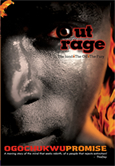
There is promise everywhere: The book’s cover is inviting – an angry young man, with bloodshot eyes glowers at the world, fire everywhere, red everywhere. Judge this book by its cover at your own peril. If you are trying to understand the problems of the Niger delta this book will not help you.  I really couldn’t tell you what the book was about and I read it a number of times. It is a busy book, cluttered with way too many characters; I needed a genealogical chart to trace the characters’ journeys. Ironically, plotting the chart of characters made the story even more improbable. Chronological ages were not lining up with the story’s trajectory. There was some good poetry wasted by bad editing and clichés. In the end, the story morphs into a deeply improbable tale made murky by the writer’s insistence on sticking to a certain plot, credibility and probability be damned.

The story speeds past huge swathes of time just to get to the writer’s anxieties. It is hard to tell what era one is in. Even though the story presumably starts in pristine times, there is a life-size Sony flat screen TV set early on in the book. Confusing.  These gaps are unforgiving in their constant reminder that the story is missing many ingredients despite its richness. Where for instance is the shame of Biafra in this story that started well before oil gushed out of Oloibiri?  The omission of the Nigerian civil war in this book is strange.. I would say that the book is too rich in seasonings, too poor in coherence. My advice? Read the prologue Sunrise, skip everything else and then read the epilogue. The story begins and ends there. Everything in between is sheer tedium. I would know; I read the book three times. This is unfortunate because Promise is a writer with obvious talents, poetic sensitivities and a prodigious industry. She has published by my count almost two dozen books, she is no slouch. I hope that her other books are not as sloppy as this.

The book Outrage is an abject lesson about the power of expression – of that which we know. The Niger Delta throbs like a viral phallus in every cell of Ogochukwu Promise’s consciousness. Hear her poetry, close your eyes and you can feel the salt sweetness of the Delta. Outrage also offers many lessons beyond the injustice and horrors that have invaded Nigeria since that wretched day in 1956 when someone attached a mean breast pump to Oloibiri’s breasts and started screwing the beautiful people of Nigeria’s Delta. The book tells the unintended story that what is happening to home grown literature in Nigeria should alarm lovers of Nigeria. There are bright spots but the publishing industry is barely struggling, producing sub-par works. Outrage is an exercise in carelessness; there are all these misused metaphors and grammatical errors galore litter several pages of the book. Words are frequently used inappropriately – hens “quacking”, goats “blithering.” It is my fervent hope that this book is not being used somewhere in Nigeria to guide instruction. No editor read this book, indeed, I wonder if a spell checker was turned on as the manuscript was being written and that is a big shame. There ought to be some standards-based process for allowing a book to be published.

In fairness to an editor, the book would have been a challenge to edit. It is not enough that words are often used inappropriately; “weather” instead of “whether” etc, the book was an overly ambitious attempt at writing an epic. It ends up, by poor design, being merely an epic tome. The story drags on and on over many (I mean, many) decades and gamely hangs on to the story and the main characters until it is mathematically possible for a human character to mercifully die off at a biologically impossible age (I calculated!). Part of the problem lies in the strong will of an author who is grimly determined to tell a story, plausibility be damned. An editor would have helped to chop up the story to a manageable, delightful edible size. Sometimes, the book races blatantly to a desired point by merely short-circuiting all credibility. For example, Arogo, one of the main characters does not see the inside of, presumably a primary school until he is 14, he attends this school for just four years, after which he is admitted to presumably a university in England. He leaves behind his wife (that he conveniently married in the village before he leaves) returns 15 years later to the waiting arms of his wife and son and proceeds to basically picks life up from where he left it and his family. Possible but improbable.

It is sad that fully five decades after Things Fall Apart was published, the Nigerian publishing industry is still virtually inchoate as the environment that drove Things Fall Apart to be published abroad. In many ways when you adjust for all the enormous resources available to today’s writers, one could argue that the publishing industry has gotten worse since then. Sure there are incredibly bright spots, like Cassava Republic, blogs and websites, etc, etc, but these are sadly outliers. There are many reasons why things are in near disarray; it  is not all the fault of our writers. To say for instance that successive Nigerian governments have been irresponsible is to engage in polite understatement. There is not a shortage of passionate, talented writers like Ogochukwu Promise in Nigeria. But the sad quality of the production mirrors the sad quality of virtually every production from virtually every Nigerian institution. Art imitates life’s reality. The frustration with all of this is that there is a beautiful story in the book Outrage. In the undisciplined hands of vanity printing, the result is a tedious disaster. It is a rich but inchoate tale told by a talented story-teller whose voice has been garroted by a communal mediocrity largely beyond her control.

On Michael Peel’s A Swamp Full of Dollars

Reproduced here for archival purposes only. First published October 2009 on the Internet.

Given the opportunity to read Michael Peel’s new book about Nigeria A Swamp Full of Dollars I groaned inwardly. Oh no, not another condescending, smirking tome written by a white man about Nigeria, corruption, decay, injustice, crude oil, blah, blah, blah.  I remembered painfully reading Karl Maier’s This House Has Fallen and that was the best of them. As I held the book, wondering whether to toss it into the heap of “I go read am” books, inside me, Esu-Elegbara, the god of my impish spirit roared, “Man Up! Read the book! If you don’t like it drop it like the dozens of other books littering your life!” I give thanks to Esu for making me read the book. I could not drop this book. It was written with respect, and it turned out to be a purposeful book written by a focused, purposeful journalist. Before you die, please read this book. A Swamp Full of Dollars is the definitive book about the ravages of the Niger Delta written by a man who actually prowled the delta with the best and the worst of us. Let me put it this way, I am still recovering from a harrowing 17 day mostly road trip through the ruins of Nigeria. This man spent years there. He deserves whatever prize they give to journalists that brave, or some would say, that reckless.
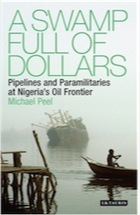
I love this book. In A Swamp Full of Dollars, Peel reexamines a familiar tale of the devastation of Nigeria’s Niger Delta by oil conglomerates and thieving Nigerian leaders. Fortunately, in Peel’s expert hands, it is reborn and told with fierce courage and gentle but damning conviction. The narrative is delivered in fresh, brilliant prose, shorn of clichés. This is not Karl Maier’s This House Has Fallen. You do not suffer the exhaustion of listening to drumbeats of despair. It is a sermon, but not in a sententious way. I appreciate that Peel writes a really sad story with respect and compassion for those at the receiving end of multiple pipes of greed. If you don’t read anything else, please read the prologue, Trigger Point. It is easily one of the best essays I have read in decades. Focused, disciplined, lush and crisp, this is great, data-driven prose. Bereft of the narcissism of messianic African writers, it is at once instructive and entertaining. We need to read this. And the world needs to hear this. Someone is getting away with genocide in Nigeria’s Niger Delta.

This book is not merely a clinical rendering of the tale of a catastrophe. The rendering is impressive in its delivery. In the prologue, talking about an encounter with a peasant in the island of São Tomé and Príncípe, Peel makes this observation: “When I give her dobras worth about £1.50, she grips my hand with a strength unnerving in one apparently so frail. The intensity of her gratitude fills me with loathing, both for the economic gulf from which it springs and for the feeling of power it awakens in me.” (xiv) How many of us Nigerians have not felt the rush of power from giving our crumbs to our dispossessed? It is a great shame that such haunting, evocative words about the suffering of our own people come from an outsider looking in. Here is fresh prose neatly describing decay, despair, and dilapidation: “Around the corner, at the Royal Niger Company’s old headquarters, the corrugated metal walls of the ground floor were corroded beyond repair and the upper floor had disintegrated. A once sturdy safe in the corner was a mess of stone and mangled metal. The building’s only occupant was a bare-breasted old woman, made pitifully thin by age and deprivation. She sat eating from an orange plastic bowl and begging visitors for food and money.” (p 33)

A Swamp Full of Dollars is a neatly compiled, carefully documented history coated in appealing prose. It is chock full of current statistics about Nigeria. This one is a keeper. And some of the data is frightening. During Peel’s time living in Nigeria, “oil sales typically accounted for about three-quarters of government revenues and more than 95 percent of export earnings. In Britain, where production levels are similar, crude accounted until 2006 for less than one-tenth of exports.” (p 27) This book should be in every Nigerian classroom. Every Nigerian intellectual should own this book; the data between the covers is priceless. The book’s attention to detail seems fueled by Peel’s photographic memory. He captures every Nigerian drama as if it is a sad Vaudeville act. It is also an immensely readable tutorial on the oil and geo- politics of the region. He documents the grisly atrocities carried out on the people of the Delta in a “democracy” run by Mr. Olusegun Obasanjo. He outlines Shell’s role in the Nigerian Civil war and he argues that Shell’s and Western interests arose from the fact that the war was interrupting the flow of crude. He goes further to explain, with the help of really good data, why Nigerian oil is of strategic importance to the West especially the US. Peel’s analysis is refreshing on many levels. He constantly makes the connection between the suffering in the Delta and the material comfort in the West, In other words, our comfort in the West is paid for by the bloody suffering in the Niger Delta. Peel gets it.  “I could see the obscene asymmetry between the smoothness of my oil-fuelled life in Britain and the toxic impact of crude on one of its main source regions. Like other horrors that we tolerate in the West because they happen to people elsewhere, the disturbing story of Nigeria’s oil became harder to ignore once it was no longer abstract. What had been faraway and theoretical had now become up close and personal.” (p 14)

It is profound how Peel returns again and again to themes of connections between the West and Nigeria’s oil. He also attempts to make, in my view, unconvincing parallels between the oppression of the people of the Delta and the poor in the West: “Already I could see many common themes. The rich men’s houses in impoverished Oloibiri were no more obscene than their counterparts in London; their opulence was simply starker compared with the general standard of living. Nor were the Delta resource control disputes so different in essence from the campaign of the Scottish nationalists for dominion of the UK oil pumped off Scotland’s shores. That, too can be cast as a story of historical oppression and growing resistance to a nation state that some see as an unwanted fiction. In Nigeria, guns and deeper poverty have simply bolstered the polemic.”  (p31)  Nigeria’s poor would kill to be America’s destitute. Peel does offer a great point about the harmful effects of what he terms reverse racism – Westerners treating “progressive” but flawed African leaders like china that might shatter if subjected to the normal wear and tear of political debate. He points out for example that folks were dissuaded from asking hard questions about Obasanjo’s administration. Today, we are reeling in shock from the extent of that administration’s graft.

It is particularly telling that not one of the Nigerian leaders interviewed in the book had anything of substance to contribute to the discourse at hand. They sounded like hapless fools wondering what to do with the mantle in their hands. Indeed, Peel’s impressions of the Niger Delta activist Dokubo Asari reads like the making of a tragic-comedy. Asari comes across as a money grubbing opportunist whose “freedom fighters” have surreal, silly names like “KKK.”  Peel visits Asari’s military hide-out, and is witness to a theatre of the absurd: “A man dressed in an orange Shell jumpsuit, inseparable from his Kalashnikov caught my eye. He and some others started wrestling, sprawling in the mud. Some of the photos I took turned out to be hilarious: the scene looked more like a reality game show with guns than the training base of a militia movement.” (p 11) There is more of this farce: “A well-muscled young fighter, wearing nothing but tight black underpants, started to move around jerkily, like a Convent Garden mime artist. Water ran to the ground off his bare chest. The whole atmosphere, charged with testosterone and a certain homoerotic tension, seemed more camp militancy than militants’ camp. Whether I was watching spontaneous ecstasy or a performance for a foreign visitor was open to question, although I didn’t get the sense of being much noticed until I started taking photos.” (p 12) Peel sees in the military camp a strange, bizarre world “in which weapons, spiritual belief, ideology and mercantilism combined to such deadly effect.” (p13) Unfortunately, Peel provides no pictures in the book. I wonder what he is going to do with those pictures. Perhaps we should look forward to a coffee table book.

Peel points out this fact: “In 1886, the United Africa Company – by now a behemothic conglomeration of British manufacturing and trading interests – found a novel way of gaining extra competitive leverage. It won a royal charter from the British government, creating a trade protectorate reserved exclusively to the company.” (p 37) It is a little known but interesting form of governance by the private sector. Wal-Mart may end up ruling Africa.   Wal-Mart may need to govern Africa to keep commerce flowing. They may need to build the roads, power up the electricity plants and provide a functioning police force to protect their widgets. Sadly, it is not as far-fetched and silly as it sounds. There are some Nigerians who would welcome this re-colonization; I don’t blame them. Talking about governance, as an aside, Peel is a white witness to black days of election horrors under Olusegun Obasanjo: “In a day spent travelling in and around Port Harcourt, I did not see a single person cast their vote legitimately. Instead, I saw ballot-box stuffing and intimidation of electors by ruling-party agents, and heard accounts of voting materials being stolen by armed thugs. In one counting centre, I watched as returning officers leafed through a sheaf of results recording 100 percent turnouts and 100 percent votes for the president. In Port Harcourt, a group of young men identified by locals as ruling-party supporters tried to persuade me that a large street protest complaining about the non-distribution of ballot boxes was being staged by people who were mentally disturbed.” (p 17)

For an insightful look into Lagos, please read chapter 4, titled The Boys From the Bookshop. Precious little about Lagos escapes Peel in chapter 4; this is a delightful chapter. It is about Lagos in all of its glory and confusion. His is one of the most apt descriptions of Lagosian anarchy that has been penned in contemporary times. Peel dissects the anarchy of Lagos thus:, “Lagos life exemplifies how the modern state wrought by crude has become the kind of dysfunctional world depicted in Thomas Hobbes’ classic Leviathan written in the shadow of England’s Civil War. Hobbes argued that, in the absence of central autocratic control, societies were doomed to exist in a state of perpetual conflict pitting all against all… Hobbes described what he saw as the inevitable and frightening results of an absence of checks on people’s behaviour, when men live without other security, than what their own strength and their own invention shall furnish them withal.” (p 75) Lagos, aka Nigeria is ugly, as ceaseless materialism jostles for space with grinding poverty. It never ends, the quest for material wealth, this is a society gifting soulless materialism to its young: “Few of the structures, rich or poor, offer much to the aesthete. A British architect who has lived in Lagos for many years once gave me a sweeping assessment of the quality on offer.’ It’s all shite,’ he said.’ I know – I built some of it.’” (p 77) Peel does not waste any words in describing the systemic laying to waste of huge swaths of Nigeria, her potential and resources. For example he mines the food web of bottom feeders in a molue bus. Riveting is the relentless bottom feeding of preachers, motor touts, the police, etc, etc.

One is entertained and saddened by the endless cycle of ten-percenters and pay-offs. He documents with a telling eye Made-In-Nigeria farce, hiding incompetence behind a veil of pretend processes and titles: “A few yards away, behind a pile of wooden planks, a black-tiled monument commemorated the March 2001 visit of President Olusegun Obasanjo, The dedication announced the laying of the foundation stone of the Oloibiri Oil and gas Research Institute, ‘to the glory of God and service to the Niger Delta people of Nigeria’. The institute, like so many projects in this region of unfinished business, had been promised but not built. A local official who was with Obasanjo on the day of the dedication told me the president was much irritated when he found out he was to inaugurate a project for which no funds had been made available.” (p 24) Hello Graham Greene. V.S. Naipaul would love this.

Peel documents the complicity and duplicity of Shell and other multinational corporations. Sadder still, the alleged leaders of the aggrieved Delta subscribe to the Nigerian maxim “man wen dey cry dey see road!” It seems that some of the “community leaders” of the Delta are always walking around looking for an opportunity to line their own pockets. Peel recalls a conversation he once had with “a traditional chief from another Delta town, who after describing persuasively the damage oil had done to his community, grumbled that Shell had not even given him a mobile phone for Christmas.” As a result, Peel states understandably that he often found it hard to tell with local leaders “where their ambitions for their communities ended and where their personal desires began.” (p 26) The kleptomania of the governors of the oil producing state is distressing and described in heartbreaking detail. Shell seems happy to trot out the proverbial “token Nigerian” before Peel to play defense. That person is Basil Omiyi, Shell’s managing director for Nigeria. Peel’s interview of this civil servant is an exercise in obfuscation. Omiyi’s bureaucratic parsing of words and the cloying insincerity of his remarks do little to mask Shell’s shameful conduct in the Niger Delta.  All in all, Peel carefully maps out the food web or chain of relationships among the MNC’s, the “activists” and the government. Sadly, except for the people, it is perversely symbiotic. The suffering people of the Niger Delta are treated with the indifference reserved for the dispossessed protesting their humanity.

The saddest chapter by far is chapter 8, Things Are Looking Up. Hear Peel: “As the Nigerian government celebrated the debt relief in late 2005, I spent a depressing day in Rivers State, one of Shell’s biggest areas of operation. In Port Harcourt, I visited Community Primary School One on the Rumueme district, where head teacher M.C. Anwuri showed me her dilapidated empire. Many of the children didn’t have desks and had to defecate on waste ground because of the lack of a working toilet. In the centre of the courtyard, three girls of about 13 were using bricks to bash charcoal against a patch of concrete; the end product was to be smeared on the wall of the classroom, to serve as a makeshift blackboard. In Anwuri’s office, a calendar produced at no little expense by the state government told – or taunted – her that she had the good fortune to be living in the ‘Treasure base of the Nation’.”  (p 173) This chapter, if read aloud to the people would cause a bloody revolt.

Peel does tend to overly romanticize the under-dog. He seems taken by the aura of Odumegwu Ojukwu. This leads him to drop his guard and desist from plumbing the depth of a most complex and polarizing figure. As a result his image and depiction of Ojukwu comes across as inchoate. Ojukwu is no saint. The Ogoni and Saro Wiwa are a footnote to the story. I think that is an unfortunate omission; he could have explored the complex relationship between the Eastern minorities and the Igbo and their ambivalence about Biafra. Peel talks about the difficulty of buying an air ticket in Lagos. Maybe in 2003. Today you can go online in Nigeria and buy an airline ticket in minutes. My experience this year (2009) with Aero airlines was very pleasant. I wonder why he did not interview certain other major players: Yakubu Gowon, Shagari, Obasanjo, etc. Chimamanda Ngozi Adichie is interviewed but the source is not quoted (*Interview by Charlie Kimber, October 2006, in the Socialist Review) (p 44). Not to worry, Thank Google! The drink Ogogoro is not made from the leaves of the palm tree; rather it is distilled from the tree’s sap. And palm oil is not only a lubricant, it is an important source of cooking oil. These glitches do little to diminish what is in my opinion a great book.

Finally, as Peel is careful to point out, Nigeria is not without hope. Technology in the form of cell phones and the Internet is becoming a muscular force in restructuring relationships and transforming the dispossessed from helpless to self-dependent. The private sector is inspiring; what Nigerian entrepreneurs are able to do with the virtual absence of an infrastructure is miraculous.  The ebullient spirit of the people is a huge factor in the ability of the society to absorb bone-crushing dysfunction. Peel’s focus is on the miseries of the people of the Delta but this does not blind him to the sprouts of hope germinating in places. It is not all despair in Nigeria; there are hints of hope, but admittedly hardly visible. All in all a memorable tome-documentary of the hell-farce that Nigeria is fast becoming. Buy this book, shut off your generator and weep for the new Nigeria.

#Caineprize – The Thirteenth Caine Prize Shortlist: Love on Trial

This is the third installment of my thoughts on the stories on the Caine Prize’s shortlist – an activity my readers are gamely enduring as part of a collaborative effort with the blogger Aaron Bady.  I have previously blogged my thoughts on Rotimi Babatunde’s Bombay’s Republic here and Billy Kahora’s Urban Zoning here. What do I think of Stanley Kenani’s story, Love on Trial? Well, I must start on a sincere and positive note:   I must thank the Caine Prize and Aaron Bady for fostering an exciting discussion of literature by African writers this year. It has been great fun so far; it has also forced me to think hard about why things are the way they are about the stories written by African writers. As for Kenani’s story, Stephen Derwent Partington, blogging his thoughts  here, speaks my mind down to the last full stop including all the gracious things he said about Stanley Kenani. You should read it and perhaps not read my post. What follows does not really improve upon the silence, but I am too opinionated not to burden the world with my obnoxious views. So here goes.

In this story a drunk stumbles upon two men making love in the latrines of a certain village in Malawi. One escapes, leaving the other (a young law student) to face the ridicule of the villagers and a homophobic press, and the wrath of the law.  Under cross –examination, the young man is defiant and haughtily lectures the bemused village and the press about sexuality and prejudice. His utterances are laced liberally with quotes from Plato and the bible to assure the peasants of his higher intellectual and moral ground. He is convicted and he goes to prison flashing the V-sign. The wrath of Karma is visited on his accuser, who is saved from his alcoholism by the ravages of AIDS. The West, enraged by the audacity of this uppity homophobic country declares it an economic no-fly zone by stopping all economic aid. It is a farce of course a variant of the same one playing in black Africa – all knowing African intellectual comfortable with his sexuality and taken by his superior intellect thanks to Western education, pitted against a community of ignorant savages.

It is a cringe-worthy tale; preachy social commentary roaring into town wearing the unctuous toga of a short story: Let’s call it Culture clash goes to Malawi. For those not following Africa’s new obsession with homophobia, here is the context for Kenani’s story: In 2010, a Malawian gay couple, Steven Monjeza and Tiwonge Chimbalanga were sentenced to 14 years in prison for being lovers. Thanks to an international outcry and threats of cuts to international aid, they were eventually pardoned.  The new president of Malawi has rightly and wisely agreed to repeal the obnoxious anti-gay laws enacted by her predecessor.

In Kenani’s re-telling of this mad saga, a drunken tale-bearer and witness to the deed (Mr. Lapani Kachingwe) extorts drinks from an eager audience to tell a story over and over again of what his eyes saw. With each telling and with increasing inebriation, stuff gets lost in the translation:

“Mr Kachingwe prefers to begin from the beginning. He does not remember what he must have eaten, he says, but he was coming from Mr Nashoni’s, naturally not very sober, when his stomach was terribly upset beyond what he could bear. He saw a line of toilets outside the Chipiri Primary School, those brick iron-sheet-roofed pit latrines, about ten or so of them, right at the beginning of the school compound if you were coming from the western side. It was a Saturday, so there were no pupils at school. He ran for the toilets, burst into the first he came to and had relieved his stomach of its burden in one monumental effort when he realised he had company. Charles and a boy Mr Kachingwe failed to recognise were so engrossed in their act it took some time for them to become aware somebody had entered the toilet, by which time Mr Kachingwe had seen ‘everything’.”

The “everything” is two men furtively loving themselves away from prying eyes. Kenani unwittingly brings all of my anxieties together in those lines, which happen to be my favorite lines in this story. Welcome to Africa. Everything stinks. Subtext: In the West gays come out of the closet, in Africa, they are outed screaming and kicking from stinking latrines. How an undergraduate law student ended up making love in a stinking latrine (never mind the voyeurism and the poor judgment) can only be explained by a need to contrive a plot ahead of a morality tale. The awkwardness of the position strikes me, pun intended.

There really is not much to this story that I like, there are many structural issues with the story starting with the strange assertion that it is not technically a story. For one thing, the medical research on AIDS was poorly done. The tale bearer suffers the debilitating effect of AIDS within a few pages, it’s a perverse miracle. The bad guy had to be killed off in a rush as the story canters off like a diseased horse galloping to an ungainly full stop. My pet peeve: Why italicize Malawian words? Let the reader google it. Nsima is a word. Google it! By the way, who writes love letters in 2010? How quaint, who remembers those? What happened to texts, chats, etc.? In 2010, how would two law students have communicated? Definitely not via love letters.

The story’s preachy, condescending tone got on my wrong side. It bears strong hints in style, tone, and proselytizing to Lauri Kubuitsile’s In the Spirit of McPhineas Lata shortlisted for the Caine Prize in 2011. There must be a formula out there somewhere for writing preachy tales; Kenani almost bursts with the excitement and overzealousness of a crusading evangelist, the story’s eyes twinkling gentle mischief, out to get unbelievers. The protagonist captures his derision for alternative views in lush patronizing condescending lectures to the amusement of lowly peasants. This is an engaging story for all the wrong reasons.

Kenani deploys  a predictable formula; demonize the opposition (make them simpletons, in this case Malawian villagers are simple savages cheering and jeering at what they don’t want to see) glorify the victim with a halo, and the resulting clarity in conflict becomes the burden of a short story. The story could have used more sophistication in the analysis. The hypocrisy, the curiosity and disbelief are shocking. But then this unsophisticated analysis fails to explore cultural aspects deeply. Kenani sets up a conflict and attempts sharp contrasts to make his points. The nexus with the new Christianity is touched upon but not robustly explored, by which I mean that this hatred is not in these people, what little is there is exaggerated by the Christian right and their odious laws.

It is predictable, there are no twists, we know where this story is going. It is written from a particular viewpoint, sympathetic to the protagonist’s circumstances. I would have loved more complex narrative that allows the reader to ponder the nature, consequences and implications of the culture clashes playing out in much of today’s Black Africa. It is also about the politics of advocacy and literature. Would this story have made the shortlist if it was written by someone with the opposite view point?

The unintended brilliance of Kenani’s story is to out the mediocrity and lack of vision of the African intellectual and political elite misruling much of today’s Black Africa. They are bungling change with spectacularly devastating results. It is their self-love, their narcissism that is on trial here. As with everything engaging the passions of many African intellectuals these days, the advocacy is pure mimicry – of the West. It is also an eloquent testimony to the skills of Africa’s intellectual and political elite in deploying the avuncular strength of the West to execute a no-fly zone over the poor of Africa just to get their needs met. The blatant looting going on today in Nigeria’s government circles for instance would be impossible, if it was not declared a “democracy.” The vagabonds in power and their intellectual friends are protected by the pretense of civil governance – sanctioned by an avuncular West. Meanwhile, in most of these societies the structures are not even robust enough to protect the thieving rich, not to talk of the poor, children and women and vulnerable minorities like gays and lesbians. That is where we should start from; you don’t build a house from the roof down when you lack the technology. In many parts of Africa, gay rights activists are now racing through broken communities armed with NGO dollars demanding same sex marriages, and other accommodations, because this is what obtains in the West. The result has been tragic in a few instances.

I am a passionate civil rights activist, one who believes that we are what we are; our sexuality is genetically determined and we should celebrate and nurture each other and reject the bigotry that we see in our communities and temples against those whose only crime is that they were born different from us The issue I am worried about lately is the increasingly reckless and uncritical militancy of many gay rights activists in Africa. The gay rights movement is moving its axis of battle to Africa and I am all for that because in many communities, the prejudice against homosexuals in Africa is beginning to rival the savagery we witness in the West. We should be careful however that we do not goad people into coming out in societies that do not have the structures and laws to protect the vulnerable. There is no week that passes when I don’t think about David Kato who was brutally murdered in Uganda. The struggle for rights must be strategic. We should fight for good laws, seek sanctions against evil leaders and priests who preach and legislate hate. The way we are going about the struggle needs a re-appraisal. For now, this comes across a middle-class battle for privilege, just like what passes for “democracy” in many African countries.

There is a curious parable at the end about what happens to mute witnesses too indifferent or cowardly to address an injustice:  A rat was caught in a trap; he asked various animals for help and they would not help because they did not see it as their business. Their indifference ends up having tragic consequences for each of them. I would be very interested in the origin of this parable. It bears an uncanny resemblance to the statement by German Pastor Martin Niemöller on the world’s indifference to the holocaust, First they came for the Jews

 First they came for the Socialists, and I did not speak out–
Because I was not a Socialist.

Then they came for the Trade Unionists, and I did not speak out–
Because I was not a Trade Unionist.

Then they came for the Jews, and I did not speak out–
Because I was not a Jew.

Then they came for me–and there was no one left to speak for me.

There is a good analysis of the origin of the statement here. I wonder if Niemöller was inspired by Kenani’s parable. Niemöller died in 1984.

Stop the music please

Reproduced here for archival purposes. First published on Next and elsewhere, July 2011.

In my youth, my favourite cartoon character was a musician called appropriately, Cacofonix in the comic Asterix. Cacofonix was so awful, each time he threatened to play music, he was quickly tied to a tree and his mouth sealed to ensure no instrument met his lips. Most of today’s Nigerian musicians remind me of Cacofonix. From D’banj on down, they should all be tied to mango trees and their mouths plugged with fake Naira notes, never ever to play music again ever. Nigerian music is undergoing a major crisis and we should be concerned. Mimicry is the word; mimicry of the worst sort. Just like our jheri-curled accented pastors, Nigerian musicians seem to have figured out that mimicking anything Western pays. And so just as Nigerian pastors are climaxing to the beat of dollars in the pulpit, overdressed characters with contrived accents are shuffling about like drunks on stage, grabbing crotches and convincing the world that there is perhaps not a single musical talent in Nigeria. The lyrics appear to be repetitious odes to materialism, and more troubling, an open invitation to misogyny. The untalented should not profit from their mediocrity.

Nigeria has never been this afflicted by a horde of horrible musicians. One might as well be listening to the symphony of nails on the blackboard. All day. There are bright spots, like the goddess Asa, but today’s music is mostly united by a lack of originality, and a distinct lack of talent. It just seems like anyone with access to a laptop and the Internet can go to a “studio” in Ajegunle and “release” something. If art imitates life, then Nigeria must be on life support judging from what passes for our music these days. I do not understand why I would waste my time on these wretched offerings when I can simply gouge on the better produced, better written and infinitely more interesting Western originals that they are plagiarised from.

We are better than this. I am quite sure that in the crush of these crotch-grabbing trash-talking wannabe musicians, there is talent there. The first thing they need to acquire is some self-confidence. Fela Anikulapo Kuti came back from the West and started a group called the Koola Lobitos. He was mimicking all sorts of Western prattle. He probably would have been successful at it if he had stayed in white shadows; but he had the common sense to strike out in an original direction. Bad ideas don’t need visas to go to Nigeria; they are welcomed wholeheartedly and uncritically where our people toil daily to turn our beautiful nation into a cultural rubbish dump.

When I complained on Facebook, my concerns were met with howls of outrage by friends that I admire for their good taste. One urged me to look past the illiteracy, the faux swagger, the gaudy clothes, the buxom ladies, the misogyny, the trash talking, the off-key singing, and just listen to the messages in the lyrics. I was given a helpful list of musicians to go study: MiI, Sound Sultan, Modenine Terry G, D’Banj, Ill Bliss, Six-Foot Plus, RuleClean ObiWon, Rule Clean. Polymath, Terry tha Rapman Flavour, Whizkid, Mi, Seun Kuti, Duncan Mighty, etc. Besides Kuti, these contrived monikers read like cheap booze labels blighting urban America. One conscientious objector made my point excellently, something like this: Ikhide, here is a dinner of stones with a few rice seeds in it. Em, ignore the stones, look really hard, you will see some rice in it. Haba, the late Saro-Wiwa once said, dem slap you, take your shirt, give you back one button, you say tank you sah! Forgive me, if I am not impressed. To be fair to these alleged musicians, mimicry is a real problem in everything we do these days in Nigeria – democracy, the new Christianity, etc. So, what I am complaining about is not unique to the music industry. I actually started studying the music in earnest after being drawn in by the poetry of Vocal Slender of the BBC’s ‘Welcome to Lagos’ fame. Let us be honest; the music is awful for the most part. And I don’t have to pine for the music of my generation, whatever that means. I am so glad I have an iPhone filled with Old School music. I would be depressed all day if I had to watch all these musicians mumbling into cheap microphones. Someone give them a real job, please.

On Facebook, a pained young man was so upset that I had sullied the reputation of an entire generation of musicians he expressed the fervent hope that I should be stoned to death. Actually, listening to today’s music feels like being stoned to death in instalments. Maybe I am an old man and this is all a generational thing. My father Papalolo and I both enjoyed music, period. Well he once chased me down the street for daring to wake him up to the blare of Marvin Gaye’s ‘Let’s Get it On’. Papalolo was always prone to unnecessary drama.

#Caineprize – The Thirteenth Caine Prize Shortlist: Urban Zoning

I am enjoying sharing my thoughts on the stories on the Caine Prize’s shortlist as part of a collaborative effort with the blogger Aaron Bady.  Last week, I offered my thoughts on Rotimi Babatunde’s Bombay’s Republic. So, what do I think of Billy Kahora’s Urban Zoning? I can understand why it made the shortlist; it tries to be different, and features some good writing and a lot of promise. Indeed, this story speaks to the vision articulated by Bernadine Evaristo, outspoken chair of the prize’s judges, in her essay on the Caine Prize. Evaristo’s essay astutely acknowledges the reality – that Africa faces new wars, and, yes, triumphs, issues that should be addressed in addition to the conventional anxieties and trauma that seem to define Africa as a sad cliché:

“I’m looking for stories about Africa that enlarge our concept of the continent beyond the familiar images that dominate the media: War-torn Africa, Starving Africa, Corrupt Africa – in short: The Tragic Continent. I’ve been banging on about this for years because while we are all aware of these negative realities, and some African writers have written great novels along these lines (as was necessary, crucial), isn’t it time now to move on? Or rather, for other kinds of African novels to be internationally celebrated. What other aspects of this most heterogeneous of continents are being explored through the imaginations of writers?”

In Urban Zoning Kahora explores urban life in Nairobi, Kenya through the drunken eyes of a protagonist called Kandle. Kahora throws a lot of issues into the stewpot – dysfunctions birthed by little people in ill-fitting suits living furtive lives in dusty nightmares. There is petty corruption, alcoholism, rape, misogyny, same-sex sexual abuse, etc.  It is ugly, Nairobi is a haven of depravity, fueled by Africa’s new wars, he documents the emptiness of a displaced generation and the reader detects whiffs of sweaty incompetence, day-old used tea bags, sex and shit.

When Kahora is good, prose poetry trots jauntily with the ease of a good rapper’s rhythm:

“A philosopher of the Kenyan calendar, Kandle associated all months of the year with different colors and hues in his head. August he saw as bright yellow, a time when the year had turned a corner; responsibilities would be left behind or pushed to the next January, a white month. March was purple-blue. December was red.”

Kahora can be funny – and dark as sin:

“After completing third form he had dropped rugby and effaced the memory of those clutching hands on his balls with a concentrated horniness. He became a regular visitor to Riruta, looking for peri-urban pussy. One day, during the school holidays when he was still in form three, he had walked into his room and found Atieno, the maid, trying on his jeans. They were only halfway up, her dress lifted and exposing her thighs. The rest of those holidays were spent on top of Atieno. He would never forget her cries of “Maiyo! Maiyo! Maiyo!” carrying throughout the house. God! God! God! After that he approached sex with a manic single-mindedness. It wasn’t hard. Girls considered him cute. When he came back home again in December, Atieno wasn’t there; instead there was an older, motherly Kikuyu woman, ugly as sin.”

Sadly, it is not only the protagonist that has alcohol abuse issues, Kahora’s sentences are all drunk, staggering in the streets, drunken lisping sentences drained of spirit, waving at strangers:

“In a city–village rumor circuit full of outlandish tales of ministers’ sons who drove Benzes with trunks full of cash, of a character called Jimmy X who was unbeaten in about five hundred bar fights going back to the late ’80s; in a place where sixty-year-old tycoons bedded teenagers and kept their panties as souvenirs; in a town where the daughter of one of Kenya’s richest businessmen held parties that were so exclusive that Janet Jackson had flown down for her birthday—Kandle, self-styled master of The Art of Seventy-Two-Hour Drinking, had achieved a footnote.”

My pet peeve: Kahora carefully italicizes and explains indigenous words – murram, mjengo, nundu. Word to the African writer, do not italicize our way of life, and stop explaining us to the world, that is what Google is for!

I must say that it is hard to date the era in this flat one-dimensional plot – to use the term loosely. This makes the setting incomplete. The writing is supercilious, cynical to the hilt. There is no joy in this droning semi-autobiographical, self-absorbed piece. It is slathered with rank cynicism which mushrooms into self-loathing, mocking an existence already bereft of purpose, defined by dark drunken labels: Smirnoff. Red label. Vodka.

Reading Urban Zoning is like walking into a cavernous hall only to be entertained by the sleepy insistent drone of indifferent echoes. Cute at first, it gets old soon enough. The reader wants to bang the head on a mjengo truck. There are all these inchoate character sketches of human beings who never rise above the indignity of caricatures or cartoon characters: “Mr. Koigi, a rounded youth with a round belly and hips that belied his industry. He had had an accident as a child, and was given to tilting his head to the right like a small bird at the most unlikely moments.”

Kahora showcases a lot of talent here, most of it misdirected. For once, I wished he’d gone to an MFA diploma mill to learn the elements of a conventional short story; setting, plot, conflict, etc. The good thing about Urban Zoning is that the story makes me pine for Binyavanga Wainaina’s genius. Kahora is no Wainaina. Wainaina’s book, One Day I Will Write About This Place features lush undisciplined prose, Nairobi comes alive, and the reader falls in love with Nairobi, sex, shit and all (read my review here).

My best lines are at the end but first you will have to wade through thickets of self-absorption to enjoy them:

“They both laughed from deep within their bellies, that laughter of Kenyan men that comes from a special knowledge. The laughter was a language in itself, used to climb from a national quiet desperation.”

What did I learn from this story? Well, Kahora is a good writer, he is going places, but not with this story.

Related blogs and resources:

Interview with Billy Kahora on his nomination for the Caine Prize
Black Balloon
Stephen Derwent Partington
The Reading Life

Loomnie
ndinda
City of Lions


#Caineprize – The Thirteenth Caine Prize Shortlist: Bombay’s Republic

The thirteenth Caine Prize shortlist is here and already the stories are generating some buzz. The blogger Aaron Bady has urged some writers to blog and tweet (#Caineprize) thoughts about the shortlist (see his post here). I am not sure I will have time to devote to this worthy activity but I will try to chime in when I can.

I have read Bombay’s Republic on the shortlist by Rotimi Babatunde. Nice. Babatunde is the first writer ever that has ever made me gaze awestruck at an 89-word sentence. Yes, 89 words, that is his opening paragraph. And it is one gorgeous lumbering sentence rolling past the eyes with an enchanting attitude that reeks of confidence, like a train of colorful, pretty cars:

“The old jailhouse on the hilltop had remained uninhabited for many decades, through the construction of the town’s first grammar school and the beginning of house-to-house harassment from the affliction called sanitary inspectors, through the laying of the railway tracks by navvies who likewise succeeded in laying pregnancies in the bellies of several lovestruck girls, but fortunes changed for the building with the return of Colour Sergeant Bombay, the veteran who went off with the recruitment officers to Hitler’s War as a man and came back a spotted leopard.”

Babatunde displays a good mastery of his craft and shows that he has a distinct voice even as his prose offers lovely hints of VS Naipaul. He coolly ignores traditional conventions of writing even as they yell at him (“Use short sentences!” “Where are your quotes, young man?”). I was pleasantly surprised by his audacity and creativity. For the main character, Bombay the Nigerian, going to Burma, war is the beginning of change:

“Bombay had seen a lot in the war. Diarrhoeic Europeans pestered by irreverent flies while the men shat like domestic livestock in the open. Blue eyes rolling in mortal fear as another enemy shell whistled past. But never before had he imagined one of his imperial masters degenerating into a state so wretched. He found it good to know that was also possible.”

The story takes us on a trip to Burma and World War II as told through the eyes of one of thousands of West Africans that fought that war and endured prejudice and racism from Whites and Asians alike. Exile bears a tart, unique taste in his mouth, and pops out of unlikely places (Babatunde describes homesick soldiers feeding “on wild bananas lined with pawpaw-like seeds but tasting like detergent”). Beyond the banalities of exile, dislocation and the push and pull of physical boundaries, war is also about the politics of power, race being a major subtheme:

“A man was still a man and a leopard a leopard while the old jailhouse was a forsaken place not fit for human habitation. A white man was the District Officer who went by in an impressive white jacket and a black man was the Native Police constable who saluted as the white man passed. This was how the world was and there was no reason to think it could be otherwise.”

Bombay, the major protagonist does not overwhelm; listening to the recruits drawn from distant places on the continent of Africa, speaking a plethora of languages, the bedlam of dizzying change makes for a delightful reading stew. Here, you can see Ceylon the island, you can smell the ambience. His illustration of racism is quirky, clever and effective.

“Reports had come that the pants of the African soldiers were sewn three-quarter length to conceal their tails and the headman was bringing his villagers to confirm if this was the case. Bombay was not angry. He simply found it interesting people could assume he had a tail. The chance of anyone having such a belief was something he had not considered possible.”

Like a good storyteller, Babatunde makes you think. I thought of reading Henry Rider Haggard’s books as a little boy and learning now, understanding now that his novels that I read were neatly bound reams of racism, misogyny, with some anti-Semitism thrown in. Also, Babatunde introduces a clever parallel with Okonkwo of Chinua Achebe’s Things Fall Apart and affirms to me my passionate belief that Things Fall Apart is evergreen in its universality and vision. Themes of nationhood, independence and change are cleverly addressed through the lunatic antics of Bombay returned from war to a Nigeria that has changed without him; Okonkwo returning from exile and finding that yes, things have fallen apart.

Unlike Biyi Bandele’s novel, Burma Boy (see my review here), the English language is not contrived, is not in the way; as a vehicle it carries the weight of the story nicely. I must say however, that despite the experimentation, the story is a bit too long and has whiffs of orthodoxy.  It is a carefully designed story, too meticulous. Babatunde made sure, like an MFA student, that all the elements of a short story were present; it’s as if he checked them all off: setting, plot, conflict, character, point of view, theme, etc. Still, I love this story. Please read it for yourself right here.

On Twitter, #caineprize will give you access to other bloggers’ thoughts, some of whom are:

Method to the Madness
The Oncoming Hope
Bookshy
Stephen Derwent Partington
Backslash Scott
Zunguzungu
aaahfooey
The Mumpsimus
Loomnie

In the name of our sisters: Everything Good Will Come

Reproduced for archival purposes. First published in 2008

So she called me the other day, fruit of the loins of the son of my grandpa’s brother. And she said, you must come visit us, you must bring your family to Chicago to come see us. We are family, she said, it is good to do these things, she said, peering past the tattered curtains of our fraying relationships. And my heart said, go to Chicago and rest a bit. What kind of life is this that you are living? Every day you go to the same place and you talk to the same people who have the same ideas and the same opinions on the same things. And every day you go home exhausted from this madness. And my heart said; go to Chicago with your family and rest. The salt mines will be waiting for you.

 And so, we went all of us, to Chicago, armed with the hope of rest and communion with our blood. And I went to Chicago with Sefi Atta’s book, Everything Good Will Come. One week is a long time to be away from the salt mines of my daily existence. What would I do with myself for a week; I am not used to the pleasures of doing nothing. And so I thought, the book would keep me company as I await the return to the salt mines of my condition.

 Everything Good Will Come was a delicious choice. Atta’s book is about relationships. We follow Enitan, the main character as she celebrates the passages of life with a delightful cast of relationships, a colorful spectrum that includes her constantly feuding parents, her friend Sheri, and her boyfriends. The issues that the book addresses are refreshingly universal and Western readers who have overdosed on horrific stories about Africa may cure their hangover with this book. The book throbs with lyrical prose:

 “Hot were the days as I remember them, with runny-egg sunshine and brief breezes. The early afternoons were for eat and sleep breaks: eat a heavy lunch, sleep like a drunk.” (p7).

 It would be hard to imagine laconic words like these used to describe any part of Africa. Refreshing. Nice.

 Inside the plane to Chicago, we passed the book around and read enchanting nuggets of prose that spoke to us. My daughters gleefully read the following passage to two white ladies seated by them:

“I smiled at my father. He was always miserable after work, especially when he returned from court. He was skinny with a voice that cracked and I pitied him whenever he complained: “I’m working all day, to put clothes on your back, food in your stomach, pay your school fees. All I ask is for peace when I get home. Instead, you give me wahala. Daddy can I buy ice cream. Daddy can I buy Enid Blyton. Daddy my jeans are torn. Daddy, Daddy, Daddy. You want me dead?”” (p20).

 The entire row of daughters and ladies rocked with laughter; and the universality of the passage made the meaning of wahala obvious. Now, that is good writing!

 Sefi Atta’s book gently throws up a lot of troubling issues and one learns to admire the dark intelligence that plotted these chapters. And she can play with words in the manner of a sister flirting with her brother. The words pop up and hide again and reappear in delightfully strange places. Hear this:

 “The wind popped my umbrella inside out, flipped my skirt almost to my waist. It ripped tears from my eyes and knocked my braids backward into my face.” (p78).

 Sweet, like biting into a juicy, free-range, truly organic mango.  Sweet.

 In the beginning there were walls. Atta’s book reminds me of the beginning of the end, perhaps. Anyone nostalgic for the Lagos and Nigeria of the 70’s and 80’s should hurry and go get this book. The book says to me: There are walls but they are coming down, slowly on everything that we hold dear. Atta assures the reader gently, ever so gently, that we stand on the shoulders of giant nightmares. And our anxieties drink deep and long from the well of our fears. The book gently joins the debate on the impact of globalization on our communities. We see with startling clarity the impact of the new religion on Nigeria, the flight of deep introspection by the intellectual class and the slow birth of a society without soul, wrapped in the filthy color of money – green. As we move from traditional notions of nation states to the individualism foisted on us by the scourge that is capitalism, we can only hope that, just as the cell phone rescued us from the feckless tyranny of land based, state-owned telephone systems, the new dispensation will lift us from the debris of our current condition. But first you must go read Atta’s book. The sister can write.

 Yes, the sister can write. She weaves a beautiful story of courage with unrelenting insistence. She says out loud to a jaded world: We come from a land of incredible beauty and unspeakable sadness. The reader never gets over the shock of witnessing enormous waste of potential and resources. And I am not talking about crude oil. Atta writes in the grand tradition of the writers before her. And she says to me that language is all in the mind. When t listen to the poets and writers of my childhood, they are speaking and writing in English but I smell the earth of my ancestors, I smell the musty sweat of my ancestors’ masquerades speaking to me from across the Atlantic, comforting me, soothing me. And in these books, they tell me that this earth also belongs to me. Atta has taken a rightful place in that pantheon of greats.

 The book wears its frailties gently on its sleeve and we are drawn to the writer’s humanity. The book is not without its weaknesses; in its unnecessary explanation of Nigerian terms, one senses a yearning to reach out to a mass market. Why would anyone bother to explain that eba is “a meal made from ground cassava?” When next you read about pasta, remind the author to footnote its explanation.

 Sister Atta, you speak to me in your book. You speak to me from deep in the bowels of my ancestors’ coven. You speak to me howling, bawling, and soaking me in the song of our mothers’ grief. In the feverish insistence of your voice, in the feverish insistence of your rhythm, in the pounding of your feet on the earth of our mothers, you speak to me. And joy rides our senses going places in the heart where fear still clings to life. Our sister, look at joy bounding up and down the streets of happy memories. Our sister, in your book, joy takes me by the hand and sets me free to dream of the way things used to be. I don’t remember much of Chicago. I will never forget Everything Good Will Come.