For Mali: Hurrah to the French!

We were sent the wrong people. We asked for statesmen and we were sent executioners. – Wole Soyinka

I salute the French for rescuing Mali from her oppressors. A pox on the houses of those African intellectuals muttering into their navels about imperialism, prattle, prattle, prattle. I wish the French would land Nigeria and come and rescue my mother from this perversion called “democracy.” Actually, a “No Fly Zone” over her village would be very nice, thank you. Any African intellectual who doesn’t like my attitude should go find the largest rock in Olumo and hit it repeatedly with the head.

There is something profoundly hypocritical about today’s African intellectual. The African intellectual most probably lives in the West, is funded by Western largesse and structures, children and family members are far away from the scene of the crime, attending good schools and hospitals in the West, yes, receiving good Western education, protected by Western structures and processes of Western civilization, in effect living a lush life of Western colonization, yet, insisting that the liberation of less fortunate Africans, those who have no voices must be from within Africa. How hypocritical is that?

You are protected day and night in the cafes of Europe and America by unmanned drones and you rail against unmanned drones liberating your people from their people? You and your family are in effect luxuriating in the laps of the imperialist, enjoying the trappings of your capture and you deny your siblings the same privilege? How hypocritical is that? If your child cannot attend the primary school in this video, please do not come talk to me about “imperialism.” I pray every day that the French, anyone comes to rescue these children from the war they found themselves in. Someone should chase you from that Starbucks. Go get your own WiFi, free-loader. I said it. Sue me. *cycles away slowly*

Barrack Boy

The hottest places in hell are reserved for those who, in times of great moral crisis, maintain their neutrality. – Dante Alighieri, Inferno

 All thinking Nigerians should watch Channels Television’s video clip of the dilapidation and national embarrassment euphemistically called Ikeja Police Academy or Ikeja Police College. It bears repeating: These images of Nigerian police “trainees” in quarters unfit for hogs should break each of our hearts. What you have seen of the Police College is just the tip of the iceberg of the life that I survived in Nigeria as a “barrack boy” and as a ward of various public institutions.  If you don’t believe me, here is a video clip that documents the horrid state of public education in Anambra State. Anambra state is Nigeria, what you will watch is what obtains pretty much anywhere in Nigeria where the dispossessed cannot buy their way out of hell with stolen dollars. Forget the decrepit infrastructure and listen to the bald-faced bullshit of the “commissioner for education,” the “governor,” etc. They stand before decayed buildings, remnants of what was gifted us by the colonialists and the first military governments and they shamelessly reel off insincere words like “collaboration,” “empowerment,” etc. Meanwhile, not one of their kids attends these pigsties and hovels. Chew on this: When you calculate the cost per policeman, the cost per pupil in those public schools, I can bet you that the figures are competitive with the same figures in the West, the only difference being that much of the funds are looted in Nigeria.

The state of Ikeja Police Academy is the state of most police barracks in the urban areas of Nigeria. I should know. My dad is an alumnus of Ikeja Police Academy (1955). He also attended a number of training programs there over the course of his long career as a policeman. I am what Nigerians call a “barrack boy.” I grew up in the barracks, born in what was then known as Ikeja General Hospital. My parents took me home to Ikeja Police Barracks and then Falomo Police Barracks.  Our Yoruba neighbors nicknamed me “Babatunde” in the barracks because I was born three weeks after the death of my paternal grandfather. When I was not in Boarding school, I lived in various police barracks all my life. I remember Moor plantation Ibadan; we used to get a supply of fresh milk delivered to our home daily. We were at Eileyele Barracks in Ibadan, where my father was part of the first set of the elite “Kill and Go” Mobile Police Force (Mopol 4).

Around 1966, we moved to Sapele Road Benin City, where my father helped to start the Mobile Police unit (Mopol 5). My childhood memories are of a blur of barracks  all over the then Western Region – Lagos, Ibadan, Moor Plantation, Benin City, Igarra, Sabongida Ora, Agenebode, etc, etc. My dad is a real Nigerian hero if there ever was one. He never tires of telling me that when the Queen of England visited Nigeria in the late 50’s, he was one of 100 hand-selected “handsome” police officers that performed parades for her wherever she went. He claims that the Queen stopped by him at one of the parades and asked a question about his uniform but by protocol his commanding officer had to respond to the question. My dad was always a fantastic but unreliable historian.

Some are of the opinion that police officers and their families should also bear responsibility for the squalid mess that we see in the barracks.  Well, in the cities, the living quarters in the barracks we lived in were cramped and squalid. It is a structural problem, they were not meant for our way of life.  The extended family was an integral part of our existence and if you lived in the cities as we did, there was a constant flow of relatives from the village wanting to try their luck in the cities; get an education, get a job, start a business, or in a few cases, hit my dad up for money. I do not remember any time that someone took a paint brush to the walls of any barracks that we lived in. I do not remember any maintenance. Not that there was much to maintain. There were walls and space, nothing else.

In the police barracks of my childhood, “rank and file” policemen lived in two rooms per family, a room and a parlor. There was typically a shared latrine and bathing quarters. They were filthy because they were not enough for the hordes of people cramped into the rooms. I hated taking baths and I doubly hated using the latrines. In Benin City, the latrine was a hole that led to a bucket. Each night, night soil removers or agbepo (as they were called) would come and take away the buckets and replace them with fresh buckets. Filthy work. For some strange reason these men were ill-tempered and if they caught you doing your business when they were visiting, you were in big trouble. Some kids would fool around with them, put “kaun” or potash in the buckets and watch the feces foam and pour all over them. Sometimes the agbepo would chase the kids to their homes and pour buckets of excrement on their parents’ doorsteps. As a “barrack boy” nothing shocks me. If you’ve never used a barracks “latrine”, never been chased down the street by an agbepo, you are lucky. Life was fun in the barracks.

I have said the living quarters were cramped. They were. I remember rats, lots of them – in the kitchen, in the rooms, everywhere. I remember them, because my father, a trained killer and warrior, was deathly afraid of them. We derived pleasure from watching him jump on our “center table” and giggle nervously as the rats taunted him.  At any time, “t”, there were always at least a dozen people in our “room and parlor.” The kids would sleep in mats on the floor and we would pee over each other. One cousin was particularly bad; he would pee on our mat each night. Many rituals were performed to exorcise his peeing demons.  One, I remember: He was required to pee on a burning log each night before bedtime. The babalawo said at night each time he needed to relieve himself, he would have a burning sensation and he would wake up and go outside to pee. Yes, at night, we simply went outside to the yard to relieve ourselves. The sensation did not burn him enough, he kept peeing on us. There are many things I witnessed as a child that I should not talk about. My aunt ate shit right before my eyes because her toddler daughter who lived with us had eaten shit and it was taboo. To save the child, she had to eat the shit also. In the barracks. Yes. Savagery.

In the barracks, my job was to sweep the verandah and yard with a long broom made of twigs. I hated the job. I would hold the broom and stare at tomorrow. Literally. My mother would yell at me and say if I stared long enough I would see the spirit world.  At the Mobile Police barracks in Benin City, there were “house inspections.” The police officer in charge of the barracks would conduct an “inspection” of the living quarters. That meant we had to clean our quarters, make the beds, take our baths and look wholesome behind our dad as he stood ramrod straight while the “inspections” went on. It was usually invasive and in some instances humiliating. If the inspector found filth, he would berate your dad who would in turn berate your mom who would in turn berate all the kids.

The Mobile Police Barracks in Sapele Road is no longer in use. My point is that the design and implementation of these quarters are colonial. Built in the fifties, these are colonial structures that have not been improved upon since Independence.  The colonial masters did not imagine that they would be permanent structures lasting well into the 21st century. You should see the “kitchen” my mother slaved in day in and day out. We used firewood. It is a wonder she did not die of smoke inhalation. My mother is a saint. It bears repeating: Life in the barracks of the cities was dysfunctional and sometimes terrifying for women and children. Marital and child abuse of the physical and emotional sort was common. Alcohol abuse was prevalent and women and children bore the brunt of these men’s rage. By the way, I know of a few families that were polygamous in the two-room quarters of the police barracks.

The police barracks in the rural areas were way better than those in the cities. There was more space. And they seemed to have been better built for our way of life. Things were more hygienic. To be fair, by the time my dad was making the rounds in the rural areas, (Sabongida Ora, Igarra, Agenebode) he was now an officer, qualified for more spacious quarters, away from the more spartan “rank and file” barracks. Still, water was hard to come by. We fought over water in Sabongida Ora. As kids we would traipse a couple of miles down the hill to the streams under the hills of Igarra to get buckets of water. We would be woken up at the crack of dawn by our dad and we would go to get the water from the streams under the hills of Igarra. We all developed bilharziasis as a result, a disease that I remembered because each time I peed I would pee blood.

These barracks are an embarrassment. There is no reason today for them to be in existence. I would demolish all of them, adjust police salaries to allow for accommodation expenses and require them to show up for work when they should. By the way, life in the barracks wasn’t all bad. There was music. We danced hell away. I learned a lot and inherited a joy for the arts in the beautiful men and women that endured the hell I have described. In their songs, I met Rex Lawson, Celestine Ukwu Ebenezer Obey, Sunny Adey, and Victor Uwaifo’s spirits. I met lovely men like Corporal Ohanugo who went to Biafra and never returned to us.

Today, Nigerian policemen and women are reviled and ridiculed as the face of official corruption. It is more complicated than that. My dad was one of the first set of Mobile Police,an elite force of men trained to die for Nigeria. Today, in the winter of his life, Nigeria will not pay him his pension. The mobile police force that my father was part of was designed as a rapid deployment force. They were kept in barracks because they were often needed for emergencies. Whenever there was a riot, like the Tiv riots, or the uprisings in Western Nigeria, or when they had to protect “liberated areas” during the civil war, the police bugler would blow the horn for an “emergency” and the men would be assembled within hours, racing in long convoys to the scene. My dad was missing from home a lot. In Asaba, his team was ambushed by Biafran forces and they got the beating of their lives. My father’s bones still hurt to this day. As a little boy, I always worried that he would not come back alive. Many mornings, I would wake up to see he had disappeared in the night. Many mornings, he would be there at home, stern warrior, Okonkwo, fussing about why I did not go to school. I took to sleeping, clutching his singlet. His smell, embedded in the singlet, was comforting. He always came back. Some of my friends were not that lucky, their dads did not come back.

Every living Police Inspector General since Independence should be hauled before the EFCC and asked to explain the decay at the Police College Ikeja. But then, the truth is that since inception, resources belonging to the Nigeria Police Force have been allocated and systematically looted – by policemen and women of all ranks, from the lowliest recruit to the Inspector General of Police. As a child of the police barracks, I can say I do not know of any living police officer that is not corrupt. They could not afford to be honest. Even as children, we knew the policemen and women who had plum assignments. If you went to “road-block” your family would feast. The officer in charge of assignments expected his kickback and so the kickbacks went up the chain of command. Many police officers built mansions and sent their kids to good schools abroad with the loot. There is a half-joke about this police sergeant in charge of road blocks who was in the habit of keeping the loot all to himself. His superiors, angry at his greed promoted him to a desk job so he would have to rely on his monthly salary. Corruption is a perverse form of revenue allocation.  We have been looting from each other since the white man taught us how to be civil servants. Go and read Chinua Achebe’s No longer at Ease. Na today?

One last word. I was a student at the University of Benin in the 70’s and witnessed and enjoyed the good life as an undergraduate: heavily subsidized meals and beverages, staff to clean our rooms, dress our beds, iron our clothes, going to classes in air-conditioned buses, etc. I also witnessed the deterioration and decay as the administration battled to manage a burgeoning student enrollment that they were clearly unprepared for. The university administration did not plan for the phenomenal demand for tertiary education. The university that I entered in 1976 was a shadow of its self in 1979. Within three years I saw how a campus could decay from lack of maintenance. Today, largely thanks to looting and incompetence, just like the Nigerian Police Force, it is laughable to compare even the best of Nigeria’s public tertiary institutions with the worst in the West. We deceive ourselves if we think all is well with our country, Nigeria. And yes, I have no solution to this mess. I have come to believe that we are undergoing Darwinism, the survival of the fittest. The rich are eating the poor. God help you in Nigeria if you are not rich. I should have a tee-shirt: I SURVIVED NIGERIA.

For Sam Loco Efe: Do not blame the gods

In August 2011, I wrote this piece for my mentor and teacher Sam Loco Efe who passed away on Saturday, August 7, 2011.

sam locoSam Loco is dead. King Odewale is dead. The gods are not to blame. It is what it is. Sam Loco was my mentor and teacher. My friends and I were impressionable teenagers when we first met him in the late 70s at the Nigerian Television (NTV) Benin City in the then Bendel State. Sam Loco raised us and we studied drama under him for close to a year. With the professional theatre company he formed, we travelled the entire State with Ola Rotimi’s epic play ‘The Gods Are Not To Blame’. He was a fine actor, producer, and director. He was funny, brilliant and just plain fun. He spoke like a thespian – and in all the major languages of Nigeria.

His lifestyle seemed glamorous; the alcohol, the cigarettes, and the women. Many of us took to wearing berets and mimicking the lifestyle of the artists of his generation. He led a Bohemian existence and in today’s era, his attitude to women would be viewed as sexist, perhaps misogynistic. It is interesting, very few of that generation of artists are alive today. Sam Loco has gone to join many legends gone to the final pantheon before him: Ray O’Slater, Emmanuel Oni, Matt Imerion, Pat “Finn” Okonjo, etc. Given the absence of a robust medical infrastructure in Nigeria, it is a miracle Sam Loco lived this long.

In our youth, we were drawn to acting by a mysterious force. There was this compulsive need for self-expression, for connecting with kindred spirits. As students at Edo College in Benin City, we studied Drama and Acting under Segun Bankole, a colourful, mercurial, hard-charging, hard-living, brilliant director, producer and dramatist. I don’t remember much of my classes at the time; I do remember trailing Bankole everywhere he went, along with several other boys. We learnt a lot about Yoruba and Benin mythology in the plays that Bankole brought with him, written by playwrights like Jimi Solanke, Zulu Sofola and Wole Soyinka.

Being apprenticed to Sam Loco after Bankole was a treat. We were in awe of Sam Loco. We would hang around the TV station watching him and all the other stars and beg for parts. Every now and then, they would reward us with a bit part. We soon became regulars on television. We relished the attention we were getting from appearing on NTV Playhouse and Youth Forum. We fell in love with him from simply watching him strut his stuff in Jonathan Ihonde’s classic TV programme ‘Hotel De Jordan’. We were mesmerised by the ease with which he dominated the stage. Before ‘Hotel De Jordan’, Sam Loco had gained lasting fame by playing the lead character in the late Wale Ogunyemi’s award-winning ‘Langbodo’, the play that stole the show during FESTAC 77.

Sam Loco always walked into a room like he owned it. When you walked into his space, you sensed that he was the master. As I remember him, he was of slight build but he managed to tower over everyone. He also had the gift of the gab; he could charm the pants off anyone he desired. The ingredients he used to placate his demons were kolanuts, cigarettes, beer and sex. Whenever we were with him, those accompanied him everywhere. Our parents worried incessantly about what they saw as the unwholesome influence of the older men and they had every reason to be concerned. But young men need men in their lives also. I understand now that he recently swore off cigarettes and alcohol as a result of a death scare.

Sam Loco did not have much formal education but he ended up bagging a diploma in Theatre Arts from the University of Ibadan. His life was a hard scrabble story of survival on the rough streets of penury, clawing his way up to success. In the process, he taught himself to the equivalent of any of the most learned dramatists out there. And he had guts. He walked away from ‘Hotel De Jordan’ when he was at the top of his game and at a time when the series was the rage of the land. We wanted to be on television, but he convinced us youngsters that the bigger world out there was a better place to play big.

We are witnessing a renaissance in the arts despite the disgraceful conduct of successive rogue governments. We see the bright promises, the possibilities today because of the vision and the resilience of warriors like Sam Loco willing to ride the waves of change to push things to the next level while at the same time battling their demons. Sam Loco is the visual face for the fate of those who did what they had to do for our world with all the passion, brains and brawns in them. Every day as they pass away from preventable diseases, an indifferent nation is diminished. We love you, Sam Loco. Good night.

[Guest Blog Post – Ken Harrow] For Pius Adesanmi: Do We Still Have Postcolonialism?

Kenneth W. Harrow, distinguished professor of English at Michigan State University pays homage to Professor Pius Adesanmi’s muse – and delivers a rigorous examination of Binyavanga Wainaina’s book, One Day I Will Write About This Place.  He may be reached at harrow@msu.edu.

        About a year ago Biodun Jeyifo told me of a conversation he had with one of his Ph.D. students. She had come to his office in a panic, informing him that her advisor had told her that retaining postcolonialism in her project would only hinder her job search, and that it ought not to play a significant role in her dissertation. We were in the throes of asking where the profession was going, how global studies have now become sine qua non for those seeking to teach non-Western literatures. The fragile place of African literary studies was once again called into question: what would it belong to now? And for those wishing to study and teach it, where would it figure in a job application? BJ straightened out the student and her advisor, but we remain confronted with the issue as “World Literature” has become widely adopted as the rubric under which the students of non-Western literatures are asked to become “expert.”

       The study of African literature within the academy has moved from an original Areas Studies approach to a contemporary World Literature approach. We should begin by asserting that both approaches are so seriously flawed as to call into question the very inclusion of African literature in the curriculum, if that is the only way it is to be taught.

      For Area Studies, the risk lies in imposing a vision of Africa created by an underlying anthropology of the early 20th century. It called for understandings generated by experts in indigenous cultures and languages, and which identified native values which informed cultural texts and gave them meaning. This is the true curse not only of Orientalism in African dress, but of authenticity detectives who prescribe the attributes of what is essentially frozen cultural truths for people viewed as natives, that is, objects for experts, rather than as subjects with subjectivity.

        For Global Studies, the notion is equally pernicious. World Literature flattens out all cultures in the quest to find universal patterns of thought and creativity, and even more, to accept as representative texts those whose self-reflexive, postmodern postcolonial markers are highlighted within the stylistics of the current Creative Writing University Curriculum.

       The former approach dignifies its knowledge under that heading of Objectivity as the quality that provides it with its claims to truth. The latter dignifies its value under the heading of Subjectivity as the value that enhances its aesthetic claims to universal worth. The former can be said to sell the value of education; the latter to sell books and movies. Both ultimately displace a global south perspective by privileging the dominant flows of global north ethnoscapes and financescapes.

       Figures that give us access to the issues involved in moving toward our contemporary situation might be seen in the cell phone of Pius Adesanmi’s palm winner tapper. In Binyavanga Wainaina’s memoir it is his use of the term kimay and a disk of benga music.

        Wainaina ends his recent, hot memoir, One Day I Will Write about This Place (2011) by referring to the creation of a new Anglo-Kenyan culture, and to a noteworthy CD and documentary on benga music. He evokes how it corresponds to what he calls the sounds of languages without the languages; how it relates to a new world context for Kenyans of today, one without the past.

        World literature and world music are now manifestations of Jameson’s definition of postmodernism as a cultural moment so fixated on the present as to erase any grounding in the past, occluding history from our readings, and resulting in what he calls pastiche. It is a view of culture as reduced to the bits and tracks of a video and cd.

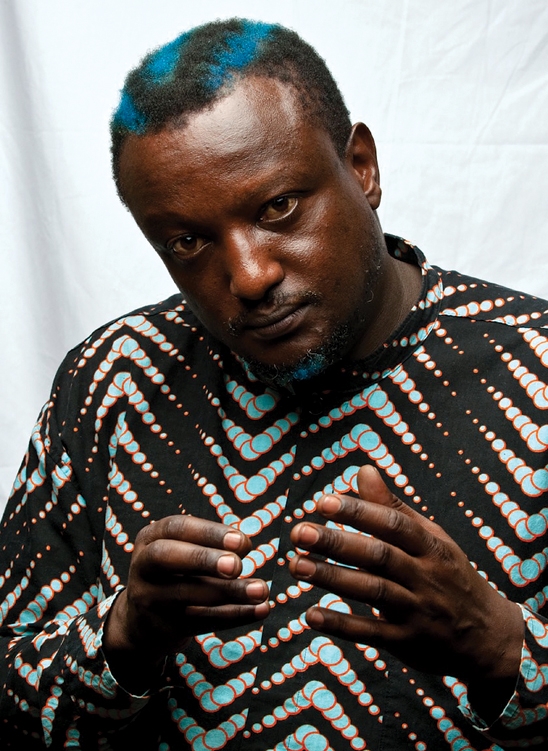
binyavanga        Wainaina speaks English, and sees Anglo-Kenyan as the new identity being created at independence. He also speaks Swahili, and thus fits with the audiences of the two Kenyan radio stations he had when growing up. General Service is anglicized, like the Muslim singer Abdul Kadir Mohammed who changes his name to Kelly Brown and sings world pop. The other station, at the bottom of the dial, is National Service which is reserved for local languages. English is the official language of Kenya. Swahili is the national language, the less prestigious one. Wainaina speaks both these, but not his father’s language, Gikuyu, nor his mother’s Bufumbira. He doesn’t speak any ethnic language, any local language—only a world language and a world pop language.

        Wainaina has a term for incomprehensible Kenyan languages, languages the sound of which hurt his head when he was young, and that is kimay. Now that he has become a world literature author, teaching at Bard, he returns to the term kimay at the end of the book to find in it something new: a language that subtends all Kenyan languages. He calls it “people talking without words, exact languages, the guitar sounds of all Kenya speaking Kenya’s languages” (253).

         Adesanmi has a figure that subtends all Nigerian communication as well, and it is the cell phone, the one his palm-wine tapper uses to call him from his tree, early in the morning. Like kimay the cell phone speaks to all Nigerians, and in fact, reaches across the bush to the village to the worldweary author whose English has brought him to Carleton University in Canada where he is a professor. He is also winner of the Penguin Prize for African Writing in non-fiction.

         Wainaina, too, occupies a privileged position as director of the Chinua Achebe Center for Writers and Artists at Bard College and has won the Caine Prize for African Writing. Both are writers whose works occupy the spaces of World Literature, and whose points of subjective reference are often local, that is, with local music, local languages.

          This takes us to the global, whose relationship to the local has now supplanted the earlier area studies grounding in the regional, in the “area” to be studied. Studying an area implied learning the language and customs of the people, staying there long enough to become expert in the culture, and returning to write the book about them. This remains the dominant form of scholarship still today.

         The rule of experts, as Timothy Mitchell termed it, produced orientalism and area studies forms of knowledge. The rule of the global airwaves, of Appadurai’s technoscapes and ethnoscapes is now inseparable from capital’s financescapes, with the result being not simply a global culture, but more especially global pop cultures.

          The global pop has two sides to it: the close and the distant. I will characterize the former as marked by global pop subjectivity and the latter by global pop objectivity. For the global pop subject, it is necessary to bring the reader close to the intimate spaces of the writer. For Wainaina this is not as easy as it would seem since his home languages are English and Swahili. He has termed the current pop scene Anglo-Kenyan, and identifies the music on General Service radio as “ageless and ours” (247), the “ours” referring to the Anglo-Kenyan scene. National Service radio, with “all those songs in so many languages that suggest some other pungent reality,” is marked by the two defining characteristics of the personal and subjective in his book, “mess and history” (247).  He distinguishes the two types of music by their look, stating that the “Anglo-Kenyan garden does not look like that music [National Service music] sounds” (sic 248).

        Thus the General Service example of the pop global singer whom he cites is Kelly Brown, aka Abdul Kadir Mohammed. If Michael Jackson could change his nose and his look, as a global pop icon, Kelly Brown could change his ethnic and religious name, as well as his home language from Mombasan Swahili to global English, with lyrics that go, “Me and my baby to-nite-ah, we hold each other tite-ah,” with the appropriate global spellings “nite” and “tite,” punctuated with ah.

        We are at the objective distance needed for the pop song to be played on the world market labels now, far from the young Wainaina’s libidinal, intimate spaces. When his writing is on a roll, he jump-cuts from the recollection of those earlier times, to his present memories, where the earlier inhibitions that would have kept his masturbations secret have now yielded to the exigencies of Caine Prize writing. We are treated to the close confidences that focus on his “hard-on” and need to “LOOK AWAY from all breasts” (248), before he returns his to his reminiscences on National Service music, which he identified as having “kimay sounds” that he tried his best to avoid.

       This binary replicates the familiar global paradigm of global/local that is replicated throughout the academy. And it is oriented completely from the perspective of the global north. Pop means different things in the global north and south; ethnic and local have totally different meanings. For instance, when the U.S. State Department presents its annual report on human rights in all countries around the world, among the topics the desk officers have to address is Anti-Semitism. Even for countries that have no Jews. The agenda crafted in the economies of the global north are for a global village constructed in an imaginary that utilizes a certain notion of diversity, constructing global slots for universalscapes that make no sense in a world where one is raised on National Radio music, speaking any of the local languages. Appiah’s cosmopolitan and Wainaina’s Anglo-Kenyan don’t speak of being divided, say between a mother tongue and a fatherland, but rather of joining them in hybrid fashion. Where does Anglo squeeze into the local paradigms of benga music? The global will find a way.

       So Wainaina posits a third human being—one that exists in some sense beyond the scope of the radio station perspectives. He identifies that third type with people who exist in “books,” by which he means, those whom we identify with through written words instead of visual images. He says they don’t have an actual voice, and that “you cannot see them” (249), but they “move around your head” (249)

        No sooner has he given us those figures of imaginary substance than he evokes his youthful vision that someday the dungeons will be open and the truth will emerge. That truth he could only sense as they played Michael Jackson’s “Human Nature,” brimming “in compassion for his sensitivity”– the beautiful Michael Jackson, he calls him,” where “the nose has not yet fallen.” His world was inhabited by viewings of Dallas, Dynasty, and Fallen Crest, a postmodern world with “a perpetual present tense: no lineage, no history” (249). In that world, one that simultaneously gives us “shoulder pad dreams” and prisoners whose “testicles are crushed,” we are given to understand that the Anglo-Kenyan subject is formed– emergent into the eruption of late modernity that is marked by the global writer as having occurred yesterday in his memoir.

         Wainaina is the other to those whose call their  “father’s house” home, Appiah’s notion being something Wainaina and his sister Ciru never knew. In referring to pop lyrics in the song calling out to the people of Taita, he writes, “These short lyrics are a call home that I don’t know, that Ciru does not know. We do not know how to be from two nations: home home (home squared, we call it, your clan, your home, the nation of your origin), and the home away from home—the home of the future, a not yet place called Kenya. We are Milimani kids [from a well-to-do neighborhood], speaking English and Swahili” (51).

        Everything comes into focus when considering this dual temporal track of then and now. Global pop objectivity is crafted by the writer who situates us alongside him in a room in Red Hook where he writes his memoir. We learn all we need to know when he evokes his tears in recounting his experience at a reading at Williams College. We know, too; we were there. Bard, Williams, where are we now– Philadelphia or is it New Haven? Tomorrow it will be Amherst or maybe Berkeley. The New Kenya of today that he describes belongs to all of us now, especially as we have access to his emotions when he observes voting for a new constitution in a Kenya that is “suddenly all soft and gooey. People smiling, looking you in the eye and saying mushy things like ‘as a Kenyan …’ or ‘in this New Kenya’” (251). We move with complete ease between the objective world of that New Age Globe and the writer’s evocation of his own years of “soft-focus trash” (251) when he tells us that he has learned he will need an operation to correct his vagueness!

        The trope on which this figure of the global will coalesce is, ironically, world music. Here it is called benga, a music he can now access, like a music video, on CD, and whose meaning he can grasp with the documents that accompany the disk. Benga, the original, authentic, World Music tape of what had once been pre-colonial Kenyan nyatiti and orutu music, uses stringed musical instruments that Wainaina, our guide now, identifies as having “a wooden bow and string rubbing a fiddle made from a gourd” (251). It was in the absence of those instruments that Kenyan soldiers during World War II fashioned a substitute with the use of a Spanish acoustic guitar.

       He tells us the guitar recreated the sounds of home, but did so by subordinating the music to the language, and most of all by ignoring the original qualities of the instrument, using it “with impunity,” so as to express, in poor simulation, the “noble nyatiti and the noble  orutu” (252). Using these new, reterritorialized global sounds, Olima Anditi and John Ogara created “a whole new idea” (253).[i]

        Tracking the musical instrument back to the nyatiti and orutu would be the work of the area specialist. Transforming it into the final and central trope of this memoir is to refigure the instrument in World Literary terms. It is to situate kimay and Michael Jackson in the same breath as figurations of a global subjectivity that is marked by its contemporary worlding. There is no more ethnicity in its language; it is Youssou Ndour singing in English; Fela recreated on Broadway; Soyinka and Achebe monumentalized before their passing to the point that Things Fall Apart and Death and the King’s Horseman have become so completely integrated into the current curriculum that their original language, which we might as well call African, has become reinscribed into that most powerful marker of the economy in culture, World Literature.  That is now a language without native speakers: it is called a global language, and its speakers reproduce the sounds of all languages in its form.

       Wainaina calls that language kimay, that is, people talking without words or exact languages, “the guitar sounds of all of Kenya speaking Kenya’s languages” (253). His memoir speaks the language of all world languages, situated as it is in the context of the global, and it functions exactly as he sees the function of kimay as inserting its speakers into a globalized world. “For kimay was part of a project to make people like us certain of our place in the world, to make us unable to see the past and our place in it. To make us a sort of Anglo-Kenyan” (253). [ii]

        This is where we have come from the original explorers who discovered the Dark Continent, who gave us its mysteries, and whose authentic language of expression Ngugi tried to protect with his famous injunction to write in African languages. The only problem now is how to locate that language when everything has become kimay.[iii]

*             *             *

  padesanmi_large-carleton-u      Pius  Adesanmi’s hot new essay is called “Face Me, I Book You: Writing Africa’s Agency in the Age of the Netizen.” Pius speaks English, Nigeria’s official and national language; he also speaks pidgin, its world pop language. In his essays he often utilizes Yoruba terms and sayings, and grounds his approach in Yorubaness, as in the local. He says, “we say this,” and cites a Yoruba term and concept.

        In order to evoke his sense of the global world order within which we now live, he evokes, in hilarious terms, the figure of his palm-wine tapper with a cell phone. Not wishing to overdo the immodesty of proclaiming his relationship with the palm-wine tapper in too proprietary a fashion, he informs us that it is actually his father’s palm-wine tapper, but that with the passing of his father the tapper has continued his family relationship by providing the son with the bubbly brew.

        One early morning before dawn Pius is awakened by the sound of his cell phone ringing.  In a semi-awakened fog he imagines it is some friend from Stateside or Canada who has lost track of the time difference, and has inadvertently disturbed his sleep. To his great surprise, it is his palm-wine tapper who is calling to inform him that someone had gotten to the tree before him and tapped out the desired brew. He is called Akowe, book man, by the tapper, whose call is described thus:

“Akowe!”

“Akowe!”

That was my palmwine tapper phoning me – wait for this – from the bush! As I later found out when he returned from that morning’s sortie, he was calling me from the neck of one of his trees. He wanted to let me know that delivery would be delayed that morning and I may not get my regular quantity of “the usual”. Funny things had happened to his gourds. I understood. In the village, strange spirits disguised as villagers sometimes climbed trees to help themselves to the fruit of another man’s labour. It was all part of the territory. I told him not to worry. I would accept whatever he was able to supply.

      From there we go into the bush of Pius’s imagination. Tongue in cheek, crossing the postmodern image with the Tutuolan imaginary, we arrive someplace close to the now eternalized television-handed ghost of My Life in the Bush of Ghost fame where the television has become the cell phone:

Then it hit me like a thunderbolt! The familiar and the strange. The uncanny. Try to imagine an elderly palm wine tapper atop a palm tree in the village, reaching for his pocket to fish out his blackberry in order to discuss the laws of supply and demand with a customer whose father he had also served decades earlier under a totally different economy of meanings and you will understand why that event, in the summer of 2008, marked a turning point in my attempts to fashion new ways of listening to so many new things Africa seems to be saying about her historical quest for agency – a quest that has lasted the better part of the last five centuries.

       The fitful leap of the “irruption into modernity” that Glissant famously described as marking the Caribbean’s entry into the Twentieth Century is reconfigured by Pius as he rewrites Benjamin’s equivalently famous phrasing describing his own continent’s entry into an age of modern technology:

The Age of Mechanical Reproduction? That’s so dinosaur now! Perhaps you will agree with me that until a blackberry joined the arsenal of tools and implements that my palm wine tapper took atop his trees every morning in Isanlu, he belonged in a habitus of tradition governed by those mytho-ritualisms of existence which has led to tensions in the arena of historical discourses and counter-discourses about Africa’s agency.

       From there we are to go to the unimaginable digital age where the tapper, now able to represent himself perfectly well with a click of his Blackberry might simply turn the phone around and take a picture of himself atop the tree, at the moment his young client receives the call informing him his favored consumer commodity is not in stock; the proof would be that he has the photos to show this. The unhinged imagination of Tutuola now grafts itself onto Pius’s rambling cogitations where he wanders over colonial and anti-colonial notions of agency, the inadequacies of formulations about “speaking for” that have run dry in this new coeval age of blackberry self-representation. Even before the slaughter of the cock at dawn, Pius’s disturbed sleep turns nightmarish:

From the top of his palm tree, my palmwine tapper was articulating his own agency and self-representing in ways that are miles ahead of the imaginaries which underwrite my work as a writer and critic. That, I posit, is the problem of African art in the current age of social media and MAC, my acronym for mutually assured communication. The fact that he phoned me from the top of a tree in the bush rattled and unsettled me. What if, God forbid, my Baba Elemu had also recorded videos of himself at work and posted it on youtube as these new possibilities of agency now afford him? What if he tweets his conversation with me from the top of that tree? What if he makes a photo of himself at work the cover of a Facebook page dedicated to tapping? What if… questions, questions, questions.

          Here Pius has definitively entered into Wainaina’s madness of kimay, first with the child’s bewilderment at the cacophony of incomprehensible tongues, to the later gestures toward an agency defined outside the scope of national languages. The global tongue of the tweet, the youtube video, the digitally altered image, bring together the repackaged world of benga with the viral possibilities of a Kony 2012 video.

         It is almost impossible to write now about world literature and globalized flows of communication without lapsing into the parody of texting—a babble that communicates not a fatigue with the familiar tropes of theory, half-forgotten with each passing year, but the technology of half-lives burning out quickly as the dissertation advisers seek desperately to keep up with their latest apps. There is no reason whatsoever for this emergent modernist age, clearly one where the threshold of post-globalization has been reached, not to deploy that same set of tropes as we might encounter in any ordinary manga or anime. The spray cans are out, graffiti has supplanted classical art in the latest doctoral research, and there is the newest apple has appropriated the old garden.

         The postcolonial? Oh, yes, I remember it.

         So, in answer to the question, do we still have postcolonialism in an age of post-globalization, I turn to Pius’s latest essay, one he wrote about the division between the worlds of humor in the west and in Africa. Appropriately enough, the essay is titled “Ode to the Bottle—For Ken Harrow Who Laughed

         As in his other blog-site essays Pius begins with an anecdote. This one concerns pissing. Here he provides a recap of the joke:

A policeman arrests a guy for urinating in a place displaying the commonplace “Do Not Urinate Here” sign in Nigeria. The cop fines the offender five hundred naira. The guy brings out one thousand naira and asks for his change. Says the policeman to the offender: “urinate again. I no get change.”  I wrote “The ABC of a Nigerian Joke” to explore the postcolonial cultural locatedness of this and other jokes. I made the case that humour is the most difficult thing to translate; it’s very untranslatability making it one of the most reliable ways of gauging cultural integration in immigrant and diasporic communities.

          But as Pius enters into the convoluted spaces that separate the postcolonial world, and its inimitable powers to laugh at the powers that devastate it, he finds himself moving to the edges of that spatialized division, wondering how a figure like Ken Harrow, a stand-in for the author of this essay, might have not understood the humor of a world he purported to have occupied since ages dating back to the period of antiquity in its national liberationist époque:

           Something would be seriously wrong, I thought further, if Ken Harrow, a vieux routier of Africa, encountered an African proverb and didn’t find it funny. After all, he got to Africa before me and has never really left. I thought he had forgotten his own African insiderhood, earned over decades of meticulous and thorough scholarly labour in the cultural vineyards of the continent. Ken, it should be obvious to you why you laughed, why you found that joke funny, I thought, as I made a mental note of waiting for an inspired moment to pen a follow-up essay – this essay – in his honour.

         To consecrate the dedication of the essay, Pius sought the precise location of difference that would enable the crossing of one gene of humor to another to be enabled. However, like Eshu, he discovered that his center was precisely neither here nor there, there being, perhaps, nothing to enable an objective global consciousness to deploy a gps signal. Instead, global subjectivity, placed within the local simultaneously with the macroworld of indefinite space, came to inform his discovery, one as old as Walcott. Pius’s bedbug, the little critter that bites the ass of power, where humor can be located:

        Beyond the earned cultural insiderhood which would open up Nigerian, nay African humour to an Africanist vieux routier like Ken, making him laugh at the joke about a Nigerian policeman and the politics of “change collection” in the postcolonial atmospherics of the checkpoint, there are contact zones and meeting points of the collectively human which, in hindsight, my initial essay, focused on cultural particulars, does not adequately address. As culturally hermetic as humour is, such sites, zones, and spaces of the universally human offer many opportunities for her to cross borders without passport and visa requirements.

         And it is there, in that space above the ground, in the palm tree where the tapper is working in early dawn, at the crossroads where Soyinka finds the traveler, like the cock,  impaled; at the conjuncture of cellphone and palmwine that the figure appears to our essayist. For Walcott it was the bedbug, of course, fitting for the satires of Martial, Juvenal, and Pope, whom he invokes in his “The Spoiler’s Return.” Pius’s bedbug, the little critter that bites the ass of power, is the bottle. Spirits of inebriation spurt forth as every conceivable trope of the bottle is invoked, from Tom Paxton (Bottle of wine, fruit of the vine/ When you gonna let me get sober), to Kollington Ayinla:

A f’owo mu oti ki ku s’ode
Gere gere, ng o dele mi o

(He who pays for his own booze
Is not condemned to the outdoors
Somehow, I’ll stagger drunkenly all the way home).

         Walcott’s impersonation of the postcolonial critique is grounded in the eloquence of humor that laughs at what Mbembe would call the autocrat and his minions, the ones with dark glasses and shark fin suits. The poet clears his ground, proclaiming his high post as ruling wit: “So crown and mitre me Bedbug the First—/ the gift of mockery with which I’m cursed/ is just an insect biting Fame behind,/ a vermin swimming in a glass of wine,/ that, dipped out with a finger, bound to bite/ its saving host, ungrateful parasite…”

         The answer to the question of the location of the postcolonial, somewhere between the poor slob caught urinating by the policeman, and the buttcrack of power where the bug chooses to bite at power’s pretensions, can only be in these far-ranging discourses of Wainaina and Adesanmi for whom there are no more stringent contingencies of agency or authenticity. If we can use their figures of kimay and the bottle, we can say that postcolonialism has been preloaded into the insider/outsider spaces of African postglobal writing. It permits itself to range, like the bottle, over all the registers from which humor can be heard—at least if one permits oneself a glass or two. Here is how Pius ends his satire, citing Elizabeth Renzetti who writes of drunkenness in Canada’s Globe and Mail newspaper:

On a given night, you might be bladdered, legless, paralytic or rotten with drink…I thought I’d heard them all until British Home Secretary Theresa May used the phrase “preloaded” on Friday to announce her government’s war on binge drinking. Preloading refers to the act of getting hammered before you go out to get hammered – that is stocking up on cheap booze from the grocery store in order to be good and wobbly by the time you hit the bars.”

      Pius then returns to his intermediary spaces rented to global postcolonial inhabitants:

 Now, why am I in stitches reading Renzetti’s description of the English? The Canadian is making this Nigerian laugh by describing the English in registers that are brokered by the universal signifyin’ of the bottle. If she makes me laugh, I am sure she is immensely capable of making Ken Harrow, the American, laugh with precisely the same registers. American, Canadian, French, English, Nigerian: the bottle speaks only one language but we can all understand it in our respective languages. The bottle is not Babel. She is Pentecost. We all hear her speak in our respective languages.

      Of course I would let Wainaina give us the last word on that host of postcolonial global languages: not Babel or Pentecost, but kimay, the one Wainaina identifies with a phantom limb.

Notes


[i] In his initial evocation of nyatiti music, as a child he played on the rhyming between “nyatiti” and “titties.” The child’s distance and asberger-like reactions to stress or nervous overload is reflected in his hyper-wordplay and association of indigenous terms and sounds as painful. Kimay and nyatiti exemplify this: When the radio announces, “A nyatiti is a traditional Luo instrument,” the children respond with “Matiti. Ciru giggles. I giggle. Titi Titties” (24).

[ii] As we can see, when we compare his use of the term at the outset of the memoir, it is associated with the chaotic, almost autistic, subject he identifies as his earlier self.

When he has arrived to his successful state as writer, this attitude toward national cultures has changed:

When the national day of mourning Kenyatta comes, he learns to riff on kimay:

In school we were taught that all music comes from eight sounds: do, re, mi, fa sol, la ti do—but what those people are singing and playing cannot fit those sounds. Gibberish. Kenyatta is dead. Those red blowtorch eyes in the dining room pulling together all those fathered harambee sounds of people in the many costumes of Kenya, singing and dancing in no choir, many unrelated sounds and languages and styles and costumes, and facial expressions.

They have nothing to do with each other.

This is my new word, my secret. Ki-may.Ki. Maay. I let my jaw fall slack, with the second syllable, like a cartoon man with a cash register jaw. Ki-maaay….” 25).

Kimay is the talking jazz trumpet: sneering, skewing sounds, squeaks and strains, heavy sweat, and giant puffed up cheeks, hot and sweating; bursting to say something, and then not saying anything at all; the hemming and hawing clarinet. Kimay is yodeling Gikuyu women, …

Ki-may is any language that I cannot speak, but I hear every day in Nakuru…” (25)

[iii] In another riff on kimay and Kenyan identity, Wainaina writes:

“Urban Kenya is a split personality: authority, trajectory, international citizen in English; national brother in Kiswahili; and content villager or nostalgic urbanite in our mother tongues. It seems so clear to me here and now, after South Africa, which is so different. There, there is a political battle to resolve embattled selves. Every language fights for space in all politics. In this part of town, all three Kenyas live: city people who work in English making their way home; the village and its produce and languages on the streets; and the crowds and crowds of people being gentle to each other in Kiswahili. Kiswahili is where we meet each other with brotherhood.

It is an aspect of Kenya I am always acutely aware of—and crave, because I don’t have it all. My third language, Gikuyu, is nearly non-existent; I can’t speak it. It is a phantom limb, kimay…” (125)

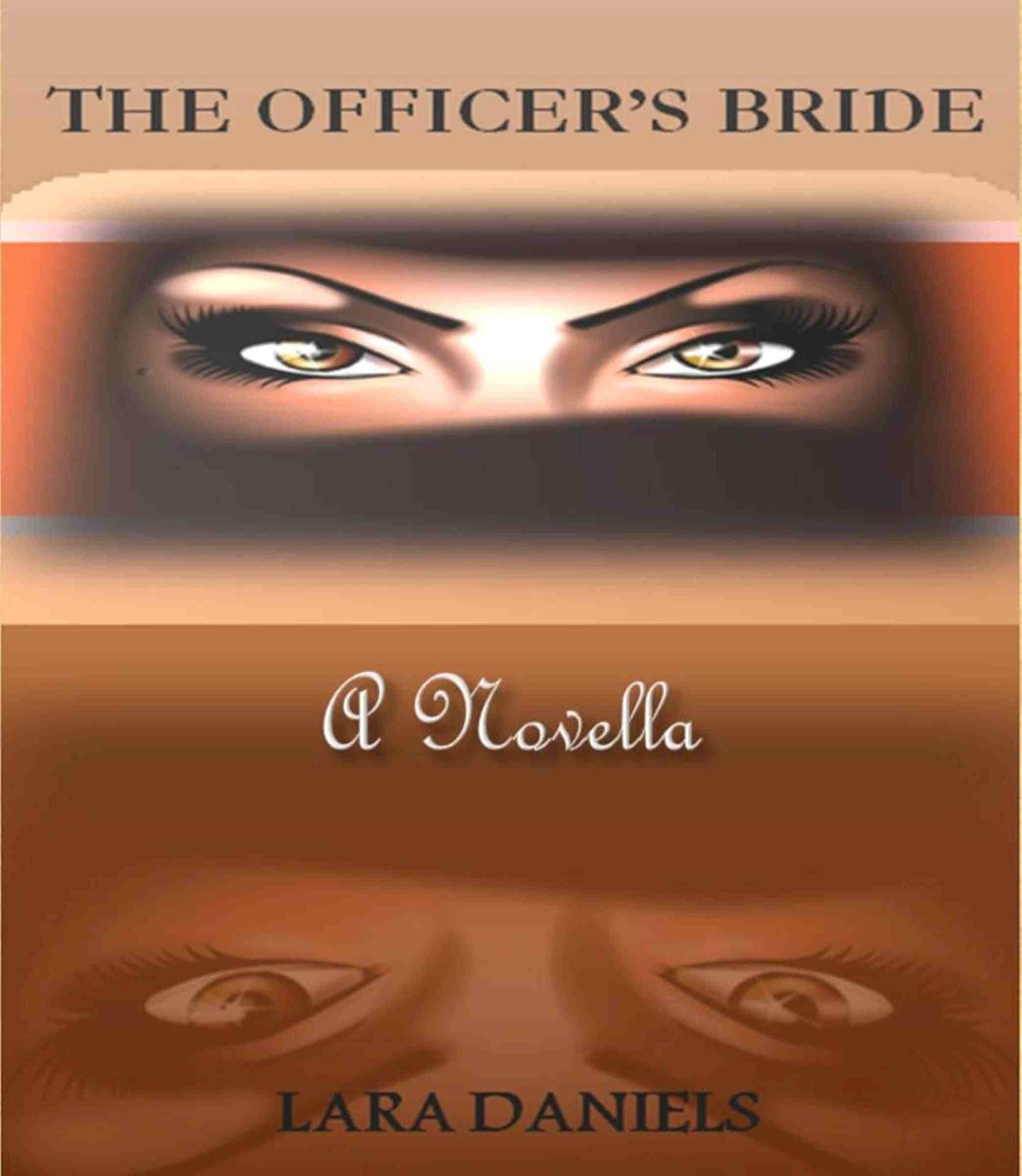
Lara Daniels: The Officer’s Bride

The other day I read Lara Daniels’ romance novella, The Officer’s Bride. What do I think? I must confess that I am not a fan of romance literature. It is not my thing. I generally restrict myself to reading mainstream fiction, preferring for the romance to creep into my subconscious as part of a story, not as the story. Chalk that up to my warped upbringing; I was fed a steady diet of “serious literature”, groaning with heavy burdens. The writers of my generation were mostly male brooding gods of letters too pre-occupied with social issues to worry about  romance and sex.

So, what is The Officer’s Bride all about? The setting is Nigeria in the mid- to late-nineties. General Sani Abacha rules the nation with several iron fists, there is fear and lawlessness in the land as people are killed for flimsy reasons. Nafisah, the chief protagonist, lives in near penury with her family. Things are dire, her father is ailing, there is no money, she is illiterate and there doesn’t seem to be any other pastime other than living wretchedly and waiting to die.

Things soon heat up, Nafisah is abducted by Musa, a most despicable and murderous military officer who, enraged that her dad would not repay a debt, slaughters everyone except Nafisah, and takes off with her, ostensibly to make her his mistress. Things don’t go quite as he planned; Musa is implicated in a military coup and eliminated, and Nafisah somehow finds herself living with Officer Edward (Eddy), an officer, scholar and gentleman. The next five years is like a dream for Nafisah. Eddy home schools her and remarkably, she turns out to be a great student who has a voracious appetite for books and eventually a hunger for Eddy’s love. It takes five years of intrigue; much of it not helped by the fact that Eddy seems obsessed with getting rid of General Abacha – all in the interest of Nigeria. A starry-eyed idealist does not have much patience for the banality of love. How does all this end? Well, no spoilers for you, you’ll have to read the novella.

This is only the second African romance novella I have read and reviewed, the first being Kiru Taye’s His Treasure (Men of Valor). It is interesting, the styles and offerings are similar, and I had trouble differentiating between their works. Much of what I had to say about Kiru Taye’s novella (here) applies to Daniel’s novella. Romance writers like Lara Daniels and Kiru Taye work hard to customize contemporary notions of romance to suit notions of African culture and customs. I applaud Daniels for working hard to create a setting that many Nigerians can relate to. The novella is readable, thanks to Daniels’ accessible enthusiastic prose. I enjoyed peeking into a subculture, getting my feel of what Nigerians consider contemporary romance.

However, I found The Officer’s Bride only moderately entertaining because Daniels worked exceedingly hard to keep the story tame. The sex scenes are lame rip-offs of Western chick lit. It was improbable in several places. It is hard to believe that a Nigerian living in the nineties had never seen a television before. I had trouble imagining an educated middle-class Nigerian in the late nineties without a personal computer. Nafisah must be a quick study, getting an education and a cultural education in the space of five years. The dialogue was sometimes stilted. The novella reads like a contrived formulaic imposition of Western practices on contemporary Nigerian life. But then, many would argue that mimicry defines authentic Nigerian life today. Many of the conflicts are clearly contrived to tell a story and in a few cases the scenes are so hastily manufactured they are remarkable only in how improbable they are.  There are some editing issues, the plot is far from complex; many would call it inchoate and formulaic. It bears restating, the most substantive criticism I would level against this novella is that it is not very original; it is derivative of Western fare and notions of romance, etc. This is clearly not serious literature and it shows, however, this does not diminish the important contributions of writers like Daniels in pushing the frontiers of African literature in various directions. For one thing, they are exploring sensuality and sexuality from a female perspective, something that was missing in my youth. Without these writers, African literature would be even more defined by its narrowness of range.

There is a potential market for this niche even as it struggles for market share with movies, and hard core porn, blogs and social media. Readers might be reluctant to pay for tame offerings when they can go to a blog like Ramblingsofadiva (follow her on Twitter @Reine_LaGlace) and feast on something delectable like this – for free. Many writers on the Internet and social media are writing some steamy – and pretty good stuff while at the same time making important observations about how we currently live our lives. I read the other day, a pretty ambitious story about e-relationships and it was very good – and, yes, free. So, Daniels and Taye have competition – and it is free. In my youth, things were much easier for writers. I have pleasant memories of my mother reading magazines like True Romance, Sadness and Joy, Drum, etc. I was a very voracious and curious reader as a young boy and I always read these rags because I wanted to know what was in them that lit a fire in my mother’s eyes. I can report that they were very engaging but there was hardly any explicit sex in them, certainly not fellatio, however they sold like hot cakes. I wonder where my mother’s magazines are. I’d like to read them again. I know, I am a cave man, I live in the past. Please pass the bowl of termites and ukwa. Belch.

And oh, follow Lara Daniels on Twitter @LDParables.

Guest Blog Post – Professor Pius Adesanmi: What Does (Nigerian) Literature Secure?

By Professor Pius Adesanmi

Winner, the Penguin Prize for African Writing

Author of  You’re Not a Country, Africa!

 Keynote lecture delivered at the National Convention of the Association of Nigerian Authors

Uyo, Akwa Ibom State

November 9, 2012

Protocols!

When I first received the theme of this conference in a somber email from the soon-to-be-Dean, Faculty of Arts, University of Ibadan, I wondered what writerly demons took possession of my great friend, Professor Remi Raji, Richard Ali, Denja Abdulahi, D.M. Dzukogi, and other members of the National Executive of the Association of Nigerian Authors, and made them settle on a theme advertising such apparently incompatible terms as literature and security in the same sentence. Being a very active member of literary Cyberia (my neologistic contraction of Cyber and Nigeria), I could understand and relate to the social media part of the theme but security? National security? Was it the demons of audacity? Was it the demons of limitless and unbounded imagination, a sine qua non of our trade as writers?

Being traffickers in what Vaclav Havel, our Czech literary kindred spirit, calls “the art of the impossible”, I guess it is not too difficult to imagine a group of Nigerian writers, gathered somewhere (perhaps at abe igi in the National Theatre), struggling to hear each other above the thunderclap of Boko Haram’s bombs, the threnodic rat-a-tat of armed robbers’ machine guns, the riotous skid of kidnappers’ getaway vehicles, the boom of petrol tankers exploding daily on our roads or passenger buses suddenly thinking themselves cruise ships and taking a plunge in the river, especially in a country where setting forth at dawn is no longer an act of self-preserving prescience, our roads, skies, waterways, and half-existent railways being permanently famished; no, it is not too difficult to imagine that writers thus assaulted by the choric banality of mass deaths in this nation-space would exclaim at some point: what can we do? What is our role in all this? What can literature secure? Does literature secure?

But the assault on the senses is not merely auditory. It is also visual for our Republic of Noise – the noise of death – also offers a generous daily quota of crimson contemplation, of morbid ugliness to the eye of the citizen-beholder. Increasingly, our ways of seeing (apologies to John Berger) are clouded by the unavoidable contortions of human forms whose body fat feeds the flames consuming them, victims of the latest madness of necklacing mobs. The victims come younger and younger. You take your eyes off the raging inferno fed by the body fat of a mad country’s youth only to confront a spectacle common in the land, radically different from what Léopold Sédar Senghor of Négritude fame had in mind when he penned one of the most memorable poetic paeans to the naked body of the black woman in these lines: “naked woman, black woman/clothed with your colour which is life/with your form which is beauty!”

No, the naked body on visual offer in our Nigerian case is not the stuff of poetic jouissance and Négritude aestheticization. It is the body of the latest victim of the mob. It is the eponymous body of the pubescent or post-pubescent Nigerian female, stripped naked on campus, at the bus stop, in a mall or in any other imaginable space of quotidian errands; stripped naked by her male compatriots for stealing a blackberry, an iPad, or even a recharge card. In essence, were it even remotely possible for our putative “abe igi” group of writers to escape the auditory evidence of national insecurity all around them, they must still contend with the interpellative authority of the visual, especially in the age of social media, where violence and the desecration of the human  effectively belong in the economy of viral dissemination made possible by Youtube, Facebook, and Twitter. Sooner or later, these assembled writers must confront the question: what can we do? What is our role in all this madness? Can literature help?

If I am mapping a possible route taken by ANA EXCO to theme and sub-themes that shall exercise us in this convention, “Literature and Security”, it is because I am mindful of a certain Aristotelian dilemma in framing the very purpose of Nigerian literature. It is true, this dilemma has always been with us insofar as project nationhood has been one bloody trajectory from colonial dehumanization to the deadlier afterlives of colonialism but the Kafkaesque nature of our postcolonial present makes it all the more urgent for us to interrogate it. And the dilemma is this: if one of the key thematic strands of Aristotle’s theory of Art, especially in Poetics, is the much-bandied about notion that art imitates life, I believe we have reached that moment in our national unraveling when writers can legitimately begin to exclaim: Art we see and know but, pray, where is life?  Where death in its physical, spiritual, and metaphorical actuations dragoons a nation into what Frantz Fanon famously calls “the zone of nonbeing”, and life is marked more by its absence – or its painful emptiness when present – how does art fulfill that Aristotelian imperative of imitating life?

Although he comes into this argument from the standpoint of his philosophical engagements with religious fundamentalism, one of the postcolonial discontents emptying Nigeria of life, of too many lives too quickly, followers of Wole Soyinka’s various attempts at a Cartesian engagement with the national spectre of insecurity and death would agree that his discursive move has a double entendre. In other words, Soyinka’s various appropriations of the Cartesian cogito in his public intellection – “I am right, therefore you are dead”; “I am dead, therefore I exist” – serve as pointers to the intractable nature of this particular form of national death and prefigure the perplexity of the artist. The said perplexity brings the artist to a fundamental question: in a nihilistic national context, where death increasingly boasts its own ubiquitous ontology, when is art? Alternatively, as I am framing it here, what does or what can literature secure?

These dilemmas about literature, art, and security would be a non-starter if Africa, and Nigeria in particular, had been able to reach a Platonic nirvana which is said to be the desire of states and political entities. You may not remember many things about Aristotle but I am sure you recall that, in certain ways, he was a rebellious student who bothered little with gerontocracy. To put it in Nigerian parlance, Aristotle nor get respect for elders. This explains why the said Aristotle would exercise his intellect developing a workable theory of art imitating life while his great, illustrious teacher, Plato, preferred the easier option of banishing art and the artist from his own ideal Republic. Indeed, were Plato a Nigerian, he would by now have been rewarded with a GCON, keeping the illustrious company of Aliko Dangote and Mike Adenuga, for evincing a situation in which the state wouldn’t have to worry about art and artists.

In essence, the proper place to begin to problematize the intermesh between literature and security is the physical and corporeal integrity of the artist, the writer in our case. After all, a Yoruba adage says that when a man proposes to adorn you with rich new clothes, perhaps the most expensive lace material in town, it is proper to pause and examine what he himself is wearing. In the build-up to this conference, the moment word got out that I would be your keynote speaker, I received a number of interview requests from journalists on the ground here in Nigeria. Alas, I was only able to grant one. One of the questions that I was asked pertains to the journalist’s conceptualization of the theme of this conference. “How can writers help in solving the socio-political, economic, and security problems that Nigeria is mired in”, the literary journalist, Awaal Gaata, asked me. This question evokes the proverb I only just deployed about a stranger’s promise of new clothing. When writers in a nation under siege are forced to confront the incubus of insecurity from the standpoint of a possible Aesculapian role for their art in society, we must pause to ask whether literature has ever secured the writer himself.

Of the three national solitudes evoked in the interview question above – i.e. the role of literature in socio-political, economic, and security problems – I believe we can pass quickly, even if somewhat superficially, on number two – economic problems. Even if you are a Chika Unigwe, and you published a fantastic novel, On Black Sisters Street, which has just earned you ten million naira in prize money, there is only so much you can do to contribute meaningfully to solving Nigeria’s economic woes as a writer. In fact, if I may throw in some yabbis into this discourse, speaking of writers and economics or economic security, I must confess that I nearly changed my mind about answering the call of the Muses when I got to Ibadan in the early 1990s and saw Odia Ofeimun’s beaten and battered 17th century Volkswagen Beetle!

The second solitude, literature and socio-political issues, has a longer and stronger purchase tied to the modes of emergence and the ideological contexts of modern African literatures, related as they are to the epochal highpoints of what Okwui Enwezor has aptly called Africa’s “short century”. The charged, recovery-of-the-self atmosphere of the 20th century, which nurtured such ideological signposts as pan-Africanism, Négritude, cultural nationalism, and decolonization, and produced radical discourses of African/black agency typified by Frantz Fanon, Amilcar Cabral, Walter Rodney, and our own Chinweizu, produced a deontology which linked our literature to socio-political issues. What Achille Mbembe famously calls African modes of self-writing connects our literatures, especially Nigerian literature, with the praxis of political and cultural agency in very significant ways.

In other words, ours was mainly a literature of protest and commitment to struggles framed on the socio-political front. Art, we said, was not for art’s sake in Africa. You need not go farther than the literary-essayistic careers of Chinua Achebe and Ngugi wa Thiong’o in the last four decades for affirmation of this point. Similarly, the art and essayistic interventions of Nigeria’s radical generation of writers in the 1970s and 1980s also point to this vision of art as socio-political praxis. I am thinking here of Odia Ofeimun, Niyi Osundare, Femi Osofisan, Bode Sowande, Olu Obafemi, Tunde Fatunde, Abubakar Gimba, Wale Okediran, and Festus Iyayi, amongst others.

The third solitude, literature and security, is the most slippery. I have proposed that we start that excursus by examining the writer’s own clothes. Tying the idea of literature and security to the corporeal integrity of the Nigerian writer is not an epistemic move I am proposing just because the realities of the age of transnational terrorism, defined by what the radical leftist thinker, Tariq Ali, has called “the clash of fundamentalisms”, have forced nation-states such as America to shift the meaning of national security from its neoclassical roots in the survival of the state to the survival and personal security of the individual citizen. This is no egg and chick conundrum. The modern nation state understands that the personal security of the citizen precedes and gives birth to national security. The formation of an American Department of Homeland Security, with its focus more on securing the life of citizen on the American homeland, is emblematic of this shift towards the personal in contemporary understandings of national security.

More than this shift, however, I am proposing this move because the personal security of the writer in a nation-space that does not just see the writer as a threat to its Platonic utopia but has also completely demissioned from its sacred mandate of guaranteeing the security of the individual is a subject which cuts painfully close to the bone for Nigerian writers. The discontents of nationhood and the self-inflicted madnesses of the Nigerian project have cost us the precious lives of three writers, including a former National President of this esteemed association. We lost Christopher Okigbo. Then we lost Maman Jiya Vatsa – I remember him every time Richard Ali posts something about ANA’s Abuja plot of land in the Facebook publicity desk he runs for ANA. Then we lost Ken Saro-Wiwa.

No, poetry did not save these three writers. Literature did not secure them. It did not secure Wole Soyinka either. The only consolation art offered Soyinka, as it has done for every writer jailed for his or her art or activism, is to be an exutoire, an outlet. Africa’s prison narratives, from Soyinka’s to Jack Mapanje’s and Ngugi’s, bear testimony to this paltry consolation. The recent kidnapping of Hope Eghagha, one of our notable poets and novelists, is Nigerian insecurity’s way of reminding our literary family that even if she is no longer killing or jailing us, she is still infinitely capable of terrorizing us by whizzing the cap off our creative heads.

However, which artist has art really saved and secured in this direct sense? When has literature literally stood between the writer and the gallows? We can count the examples on the tip of our fingers. The abundance, sadly, lies in those who have perished for art’s sake. The abundance lies in writers who have been endangered, imperiled, hounded, silenced, or simply rendered irrelevant for art’s sake. Odia Ofeimun’s opening paragraph in his essay, “Postmodernism and the Impossible Death of the African Author”, is instructive:

“In 1968”, writes Ofeimun, “the year Roland Barthes, the French philosopher announced the ‘Death of the Author’, Wole Soyinka was in detention for opposing the prosecutors of the Nigerian civil war. The poet, Christopher Okigbo, had been killed in the early skirmishes of the war. Chinua Achebe was in exile, engaged in matters as distant from the literary as raising funds for and campaigning for the rise of the Biafran Sun. Mongo Beti was in Paris on a contested visa, his book soon due for banning in both his Camerounian homeland and France. Naguib Mahfouz’s book, Children of Gebelawi, was banned in his country. Camara Laye was on the run from Sékou Touré’s gendarmes. Can Themba had drunk himself to death in a Joburg shebeen. Bloke Modisane, overwhelmed by the depression of exile, was reported to have jumped down from a New York Skyscrapper, Alex la Guma was still incarcerated on Robben Island. And Dennis Brutus, freed from Robben island, was in exile as was Ezekiel Mpahlele and many other South African writers. One case parodied the other. The fortunes of the producers of African literature was evidently in such dire straits that it would not have required a stretch of the imagination to grasp what the French philosopher was talking about.”

The point must be made that just as Soyinka took on French poststructuralist critique and a certain strand of Nigerian literary criticism it engendered in his essay, “Barthes, Leftocracy, and other Mythologies”, Ofeimun in his own essay is confronting the hegemon of postmodernist theorizing and its attempts to deconstruct the writer into extinction. In the mad rush to detotalize and atomize master narratives by a Europe that had fallen into intellectual ennui after two disastrous wars, the author in postmodernist canard became a location, a text that had exhausted its own possibilities of regeneration. Ofeimun is trying to show that the latest European theoretical fad has little or no meaning for African literature. However, by painting such a graphically gory tableau, the author of The Poet Lied inadvertently raises the question of literature and security in the African context.

With Ofeimun’s essay, my questions return with all their deliberative force: whither art in the security of the artist? What guarantees the corporeal integrity of the writer? Does literature secure? If so, what does literature, Nigerian literature, secure? When, faced with Nigeria’s quotidian threats to life, the Christian sings, “only Jesus can save, only Jesus can save, alleluia”; and the Moslem responds with a similar affirmation of the Holy Prophet’s ability to save him, what is the writer’s recourse? Does he declare himself the “god of poetry” and crawl with Uzor Maxim Uzoatu into “the shadow of pagan poverty”, hoping that the violence and insecurity across this land shall consider him too poor and economically unviable for elimination? Does he acknowledge the obvious fact that art is not law enforcement and does not save in a literal sense?

Perhaps that last point – art does not save – is not entirely true? Art saved Scheherazade or, more
precisely, literature saved her life. That’s perhaps the most famous evidence we have of literature’s direct intervention in the business of security, the business of preserving life, instead of merely farming metaphors and other figures of speech to imitate or represent it. However, Scheherazade’s journey to life via the instrumentality of literature comes with a severe warning to the lazy writer. To live, Scheherazade had to enter the history books as one of the most prodigious – if not the most prodigious – storytellers of all time. She had to spend one thousand and one nights telling one thousand stories at the rate of one story per night. She could not afford boring stories laced with tired metaphors and worn clichés. She had to invest her stories with what André Breton and his fellow French surrealists call the poet’s ability to take the familiar and divest it of every trace of its familiarity. Yet she had to sustain this imaginative flow for a thousand and one nights. Excuse me, folks, but that’s like asking Toni Kan, the author of the fascinating volume of short stories, Nights of the Creaking Bed, to make that creative bed creak every night for one thousand and one nights or else…

Closer to us in time and space, art saved life or deferred death during the Zulu wars. Of the many narratives of the Zulu wars, I particularly like one that comes more from the street stories that have crystallized into myths about that war. For instance, in an interview clip in the documentary movie, Amandla, Hugh Masekela reminds us that the Zulu warriors also had their own Scheherazade moments. They would sing so beautifully, so melodiously, that the advancing imperialist armies would temporarily lay down their arms to enjoy the singing. “Wait, wait, let them finish that beautiful song before we kill them”, the imperialists would exclaim, “we can’t kill them while they sing so beautifully”! Although Professors Toyin Falola and Moses Ochonu, two of Nigeria’s brightest gifts to the discipline of history, warned me as I prepared this lecture that the claim of art intervening to save lives or to put death in temporary abeyance belongs more in the province of legend and mythologies that war inevitably generates than in the archives, I kind of like the sound of that myth all the same!

I don’t just like the fact the Zulus created a lore in which their soldiers resorted to art, musical aesthetics to be precise, to freeze the enemy like the gaze of the medusa. I also like the fact that two eminent Nigerian historians reminded me that war creates lore, legend, and mythology. In other words, wars generate narratives. The phases of existential crisis through which a people pass in the historical trajectory towards nationhood also generate accompanying narratives. By mapping these narratives, through time and space, we begin to get a handle on what it is exactly that literature secures beyond the paltry examples of Scheherazade and Zulu warriors turned emergency artists. We begin to get a handle on what Nigerian literature has tried to secure ever since a literary corpus emerged, branded by that national identity.

Reflecting on the universal dimension and symbolism of the South African struggle during his recent Steve Biko memorial lecture, our brother, Ben Okri, provides a useful window into the form of security which literature and the arts guarantee. Okri conceptualizes a people’s historical march as an upward progression towards what he calls the mountain top. The hint of The Pilgrim’s Progress is unmistakable. So is the hint of the Ayi Kwei Armah of Two Thousand Seasons. Not every people is privileged to reach that mountain top, Okri alleges. In other words, most people crawl and crawl, fording the mythological seven rivers and seven mountains but ultimately still never reaching the mountaintop. This explains why Armah sums up Africa’s march to the mountain top as “a thousand seasons wasted wandering amazed along alien roads, another thousand spent finding paths to the living way.”

For societies lucky enough to reach the mountaintop, or to at least get close enough to catch a glimpse of it, here is what Okri believes they bequeath to humanity from that auspicious location: “the value of mountain-tops is not to live on them but to see from them. To see into the magic and difficult distances, to see something of the great journey still ahead; to see, in short, the seven mountains that are hidden when we climb. It may be only once that a people have such a vision. Maybe very, very great nations have such a vision a few times, and each time they do they affect a profound renewal in their history and take a quantum leap in their development. Most nations never glimpse the mountain-top at all; never sense the vastness and the greatness of the gritty glory that lies ahead of them in the seven mountains each concealed behind the other. Maybe Ancient Greece saw such a vision a few times and dreamed up its notion of a flawed democracy and left its lasting legacy in its architecture, its literature, but above all in its political structure for unleashing its genius upon the world. Maybe Ancient Rome saw such a vision a few times too and built straight roads through history, wresting with the idea of freedom and tyranny and conquered a sizeable portion of the known world, and left for us their ambiguous legacy of empire, literature and might.”

Witness the recurrence of literature in Okri’s account of the legacies which Ancient Greece and Ancient Rome have bequeathed humanity from the mountaintop. This recurrence, I must add, is not due to professional bias on Okri’s part. The author of The Famished Road is merely foregrounding one of the fundamental functions of literature. That function inheres in the terrible power of fictional truth to secure memories of not just the past but of a future foretold, and inscribe such narrativizations in trans-temporal dimensions, which come to determine how future generations encounter and engage a people’s march towards the mountaintop. In essence, a people’s march towards the mountaintop is also a function of the stories they tell to temporalize their epic struggles. Not every society reaches the mountaintop, warns Okri and that is true. Methinks, however, that every society tells and records the story of the march, of triumphs and travails, of failures and successes, of reversals and progress, of ups and downs, of heroism and betrayal, of war and peace, of love and hate.

Fictional truth secures these memories and acquires an authority superior to other modes of recording. This trans-temporal authority of fictional truth is the only reason why we view Ancient Greece today largely through her arts, mostly her literature and architecture. Think of the trials and tribulations of that society during the years of the Peloponnesian War. Think of The History of the Peloponnesian War, a magisterial account of that war written by the great historian, Thucydides, and ask yourselves why our civilization, looking back at Ancient Greece today, prefers memories of that war and era secured by the fictional truths of the Greek tragedians, especially Sophocles and Euripides. Why does our current civilization prefer to gaze at Ancient Rome through the fictional truths of a Virgil than the documentary accounts of an historian like Tacitus?

The answer to these questions is bad news for my earlier-mentioned professional historian friends, Professors Toyin Falola and Moses Ochonu. For, I am saying that a thousand, two thousand years from now, a future civilization will look beyond the archives constituted by disciplinary history and privilege the truths secured by Nigerian fiction today as a window into how we negotiated our march towards the mountaintop, the roads taken and the road not taken (apologies to Robert Frost), how we lived, laughed, loved, and hated. How we kidnapped. How we bombed. How we killed. How we pogromed. If, as it is tempting to predict, given our talent for self-inflicted national injuries, we somehow never make it to the mountaintop, we need not worry. Our literature will secure that failure against forgetting.

Why do people privilege the security offered against forgetting by literature and the arts? Does it have something to do with the aphorism that when the chips fall wherever they may, literature and the arts are the only evidence, the only trace that a civilization truly leaves behind? Civilizations whose skeletal remains defy even radio carbon dating have left us the marvel of rock paintings. When the artist, Victor Ekpuk, looks for what remains of his forbears, the only window he has left to reconnect with them is the scribal art that has defied time, Nsibidi. Does the privileging of the security offered by literature and the arts have something to do with man’s fundamental instinct of self-preservation? Does a civilization disappear, confident that evidence of its passage through time has been secured by the scribal talents of her writers and artists?

I got a near answer to these provocations sometime last year on a Nigerian listserv. More on internet listervs later but suffice it to say that listservs are part of the internet revolution which has extended the boundaries of the imagined in the imagined community that is project Nigerian nationhood. There are alternative imaginaries of nationhood going on in listservs, especially among Nigerians in the diaspora. Thus it was that somebody posted one of those grating, provocative commentaries of Wole Soyinka. We know that Soyinka’s essayistic interventions in Nigeriana do not fail to provoke passionate reactions.

That particular intervention of his considerably irked a respected Nigerian Professor of Mathematics in Canada. The Professor in question boasts a mouth-watering CV in his field. I cannot emphasize it enough that he is one of our very best. Yet, in a remarkable display of intellectual collapse, he rushed to the listservs lambasting Soyinka. Soyinka needs to be humble, says our Professor of Mathematics. Those who win the Nobel Prize in Literature should understand that theirs is inferior to the Nobel Prizes in the sciences. Where laureates in Mathematics, Physics, Chemistry, and Medicine are talking, Soyinka should be humble and keep quiet or he should hold a rapid dialogue with his legs. I am not making any of this up. It’s in the archives of Nigerian listservs. The mathematician was not done yet. What exactly is it that literature even contributes to society? Only the sciences, the hard sciences, have any bearing on human development, he enthused. Literature, writers, only tell stories to entertain us and we humour them by listening to them. Folks, imagine what would have happened if this Professor, who doesn’t think that literature offers much beyond storytelling and entertainment (he subsequently tried hard to do damage control while essentially not giving up his claims) had heard that the Association of Nigerian Authors had dared to gather to reflect on the role of literature in security! He would have had a heart attack.

On my own account, after miraculously escaping a cardiac arrest from reading the Professor’s reflections vis-a-vis the worthlessness of literature and the inferiority of the Nobel Prize for Literature compared to its illustrious elder brothers in Physics, Mathematics, Chemistry, and Medicine, I wanted to intervene in that thread. I was still contemplating where or how to begin when Oluwatoyin Adepoju, a ubiquitous literary presence on Nigerian listservs, recovered from his own shock and exclaimed, among his several responses to the subject matter, that literature and culture are the windows into how peoples across times have domesticated and applied science. He averred further that the security of the sciences depends on how they are imagined and narrativized by the civilizations they inhabit and such narrativizations are often the world’s and history’s window into a particular culture. I saved my breath after Mr. Adepoju’s intervention. He had said it all. I didn’t need to jump into the thread by pointing out Gyan Prakash’s work, Another Reason: Science and the Imagination of Modern India, on the role of science in colonial India and how imperial narratives of the native ultimately defined how science was applied to his body and environment in line with the overall objectives of Empire. Even almighty science is subject to narratives – a.k.a the art – of its own becoming.

Writers are the world’s window into a culture. That was a key aspect of Mr. Adepoju’s contribution to the discussion in question. In essence, those looking back at today’s Nigeria a thousand years from now will detect evidence of our literature’s attempts to offer the security of a predicted future. They will read Wole Soyinka’s A Dance of the Forests, Chinua Achebe’s A Man of the People, and the Menippean satires of T.M. Aluko, especially Chief The Honourable Minister, and glean evidence of the errors of the rendering. They will gain insights into how fictional truth imperils the artist ironically through its own vatic function. Let’s not forget the reaction to A Dance of the Forest by a political establishment which, like the dog, failed to hear the hunter’s whistle and perished in the forest of postcolonial anomie.

If it is clear from the foregoing that beyond Scheherazade, beyond Zulu warriors turned musical aesthetes, Nigerian literature offers the security of memory and the armour with which to shatter the carapace of forgetting, it is equally pertinent to add that the vatic essence of fictional truth is an attribute which makes it a very dangerous truth indeed. Although societies across time and civilizations have preferred to disdain the forms of mnemonic security a writer has to offer through his art, casting the writer as a Cassandra figure, often never believed until writerly prescience has become regrettable actuality down the road, the truth is that society has a fatal attraction to, a love-hate relationship with the writer’s truth. This truth places a double-edged sword in the hands of the writer. Tell the truth and be damned; don’t tell the truth and be damned.

In the attempt to secure memory and social history with this double-edged sword, the writer often discovers that the security, which his work guarantees for the social body, is hardly ever coterminous with the security of the writer. There is often a terrible opportunity cost: secure memory and forego your own security. This is true because society hardly accords the writer the privilege of value-free, personal remembering. Neither does the writer enjoy the privilege of exercising other forms of prose that are not deemed to carry the authority of fiction. Those of you who have read Salman Rushdie’s new memoir, Joseph Anton, would have followed that writer’s rude introduction to this double jeopardy. If he wrote fiction and entitled it The Satanic Verses, trouble! If he wrote non-fiction and entitled it Imaginary Homelands, wahala!

Chinua Achebe is, of course, currently caught up in these tensions between a writer’s prose, a writer’s security, and the security of public memory. I do not wish to rehash the arguments for and against Achebe but we are all aware of the current situation with There Was a Country. We may raise legitimate questions about the memory the book secures: is it the memory of Biafra? Is it the memory of Nigeria? Is it both memories in their overlapping, fractal, and fratricidal actuations? For my purposes here, that is not where the issue lies. The point, for me, is to try to understand why a writer’s act of remembering – among the mountains of scribal acts of remembering on all sides of our civil war tragedy – is the most susceptible to generating national hysteria. And of all the reactions to Achebe’s book, I am interested in knowing what seems to have conferred an extra authority on an act of counter-remembrance by another writer. I am talking of Odia Ofeimun’s extended treatise, “The Forgotten Documents of the Nigerian Civil War.”

I raise this point because Northrop Frye, perhaps the 20th century’s most significant critic of literature and prose, has a few things to say about memoirs and autobiography. According to Frye, “autobiography is another form which merges with the novel by a series of insensible gradations. Most autobiographies are inspired by a creative, and therefore fictional, impulse to select those events and experiences in the writer’s life that go to build up an integrated pattern. This pattern may be something larger than himself with which he has come to identify himself or simply the coherence of his character and attitudes.” Frye goes on to trace the mutations of this intensely personal form of prose to the confessional modes of St. Augustine and Jean-Jacques Rousseau.

If what Frye, and indeed, most theorists of creative non-fiction – the genre which houses memoir and autobiography – have to say above is true, it raises the question: why is Achebe not allowed to recollect or select aspects of his life in tranquility? And why are reactions to Ofeimun’s counter-remembering just as passionate, just as heated? The answer is simple. The non-fiction prose of both writers enjoys the symbolic authority of their fiction. There is such a thing as a symbolic capital that comes with the designation “writer” which makes ordinary things suddenly become extraordinary when touched by a writer. History and its scripting become extraordinary the moment two writers, Achebe and Ofeimun, enter into its domain, hence the passion.

If there is a generation of Nigerian writers whose relationship to project nationhood carries the burden of these tensions between social memory, public memory, and security, it is, undoubtedly, my generation. I don’t know why this is so but we sometimes use our friend, Harry Garuba, as the borderline between the generation of the seventies and the early eighties and my own generation. For critical convenience, the critic, Chris Dunton and myself have edited peer-reviewed international journals in which we called mine the third generation of Nigerian writing, a designation that has not come without controversy. Obu Udeozo prefers the expression, “third wave writing”. The publication of Harry Garuba’s Voices from the Fringe in 1988 effectively marked the coming out parade of this generation. Most of them are poets. We were still more than a decade away from the rise to dominance of prose fiction beginning from the 2000s, a rise enhanced no doubt by an avalanche of international literary prizes by members of my generation. But in the late-1980s to the early late 1990s, Nigeria’s social memory expressed itself mainly in the poetry of my generation.

If you examine the social memory inscribed in the poetics of my generation from the perspective of what it sought to secure it from – or against as the case may be – you will discover that the idea of which nation’s memory is being secured becomes quite fuzzy, quite uncertain, shorn of a unifying centre, such as ritual or mythopoeia, which had tied the works of earlier generations to project nationhood. No matter how expansive and how ambitiously itinerant the imagination is, it is always possible to detect a silhouette of either the national or the ethno-national centre in the poetics of Achebe, Soyinka, and Clark; in the restless social realism of Osundare, Osofisan, Obafemi, Okediran (what a succession of Os!) and Iyayi, whose novel, Violence, typifies this trend. To the question – was there a country? – the work and praxis of the generations before mine had an answer: yes, Nigeria.

With the poetry of Obu Udeozo, Uche Nduka, Idzzia Ahmad, Remi Raji, Obu Udeozor, Ogaga Ifowodo, Olu Oguibe, Afam Akeh, Chiedu Ezeanah, Obi Nwakanma, Amatoritsero Ede, Nduka Otiono, David Diai, Obi Iwuanyanwu, Nnorom Azuonye, Toyin Adewale, Nike Adesuyi, Angela Nwosu, and Unoma Azuah, the answer to that question becomes as tentative as it is contested. Harry Garuba has astutely used the poetry of Emman Shehu as an inroad to the loss of the unifying ethno-national centre in Nigerian literature with the advent of my generation.  Therefore, even if this poetry speaks to the socio-political problems of the world it inhabits, which Remi Raji tries to gather into bowls of laughter in A Harvest of Laughters – I suspect it is the bitter laughter that his people call “erin oyinbo” – we get the constant hint from this generation that a transnational imaginary is the only security against the atrophy of project nationhood.

Perhaps, it has something to do with the fact that this generation of writers is the literary contemporary of Andrew, that eponymous popular-cultural character who first offered flight as a praxilic response to generalized insecurity. So, Remi Raji, Olu Oguibe, Ogaga Ifowodo, Obu Udeozo and so many others went on to invest in an aesthetics of that-which-is-home-but-not-recognizable. While the body of the poet was willing to remain rooted as we see in Oguibe’s canonical poem, “I am Bound to this Land by Blood”, the spirit must free itself and roam to mine security and succor in a transnational world that is precariously claimed, as we see in Afam Akeh’s poems thematizing England, Uche Nduka’s “Aquacade in Amsterdam”, Amatoritsero Ede’s “Globe Trotter”, and the direction that Remi Raji’s creative sensibilities took in the collection, Shuttle Songs America, and a recent travelogue published on Facebook, dedicated to his Ukrainian poetic peregrination.

Speaking of Raji ‘publishing’ creative non-fiction on Facebook, the rise of Cyberia poses the question of border security in a very real, literal sense. The phase of Nigerian writing which houses writers I don’t even ever have to meet face to face to feel like I’ve known them my whole life, largely because they have social media personas, is an interesting phase indeed. It is an age where literature has been nervous about losing the book form as we know it – I first heard about this anxiety from Nadine Gordimer way back in 2000 at a conference I attended with Harry Garuba in Pretoria. It’s a long way now from the year 2000 and those intervening years have seen Nigerian literature gradually migrate to Cyberia, first as listserv discourse with the birth of Krazitivity in 1999, to the rise of Nnorom Azuonye’s Sentinel literary empire with its poetry bar, and now to the efflorescence of forms of literature associated with blogs, Facebook, and Twitter.

Richard Ali, Tolu Ogunlesi, A. Igoni Barrett, Ifedigbo Nze Sylva, Jumoke Verissimo, Chinyere Obi-Obasi, Egbosa Imasuen, Uche Peter Umez, Ukamaka Olisakwe, Paul T. Liam, Su’eddie Vershima Agema,Onyekachi Peter Onuoha, Rosemary Ede, Saddiq M. Dzukogi, and so many brilliant writer-citizens of Cyberia face border security problems beyond the simple threat to the book. There is a democracy that comes with social media and it has radically transformed the idea of the writer. Everybody with a blackberry and a blog is now a potential writer. We may wax puritanical here, declaring that we know who a writer is; the problem is with cultural shifts in the West that seem to validate the idea of a nomenclatural borderlessness when it comes to who is a writer in the age of social media. For instance, in Canada where I reside, Canada Writes organizes tweet challenges in which they ask writers and aspiring writers all over the country to condense creative writing into tweets. But the pressure for the writer to become a netizen increases by the day. Salman Rushdie and Paulo Coelho are social media celebrities. In our case, I sometimes fear that the fiery US-based literary and cultural critic, Ikhide Ikheloa, may soon require a certificate of social media occupancy to consider a Nigerian writer worthy of his attention.

It is in this expanded context, where literature is increasingly determined by very loose understandings and definitions, that our emergent crop of writers must try to secure not just the social memory of their own generation. This new cultural context challenges their very ability to own stories devolving from our national experiences, good and bad, in the global marketplace of creativity. What does it mean, for instance, that one of the most powerful accounts of South Africa’s attempt to exorcise the ghosts of Apartheid through the truth and reconciliation framework has been written by an American? I am sure you have heard of the blockbuster novel, Absolution, by Patrick Flanery? What does it mean that the novel that will probably settle the argument over the national origin of 419 is not Tricia Adaobi Nwaubani’s I do Not Come to You by Chance but a novel recently published by a Canadian writer, which has just been awarded Canada’s biggest literary Prize, the Giller Prize? The ownership of stories South African and Nigerian by an American and a Canadian writer has been facilitated largely by social media. We live in days and times when a Tibetan Monk can write an authentic Nigerian story, in an authentic Nigerian voice, after spending a year on Twitter and Facebook.

A generation owned the idea of a homeland and narrativized it in terms of unifying rituals of self-recovery from rape that was colonial. When the mourning after set in shortly after independence and disillusionment weighed heavy on the soul, another generation of Marxist and quasi-Marxist hotheads tried to press social realism into the service of a struggle against self-inflicted postcolonial injuries in the 1970s and the 1980s. A subsequent generation, mine, tried to secure forms of attachment to that homeland despite the inevitable pull of the transnational moment. Now, a new generation must deal – or is it cope? – with the existence of a parallel world which admits of no boundaries whatsoever, be it geographical or even the old boundaries that secured the identity of literature, differentiating creative prose from other forms of writing. It is also a world in which ownership of national imaginaries is no longer easy to determine as a piece of flash fiction could appear anywhere as a Facebook update, telling stories we thought we owned. When social media expands democratic access to the Other’s story and chanhes the dynamics of its onwership, what Nigerian stories will our vibrant new generation of netizen-writers own? On whose terms are they going to tell those stories? Mark Zuckerberg’s?

I thank you for your time and patience.

Who needs reparations? Not Africa!

Who needs reparations? Not Africa. Centuries from now, uncommon sense will return to African thinkers and there will be a new dawn of fresh thought: A deadly combination of black leadership kleptocracy and Western liberal guilt has harmed Africans more than slavery and colonialism.  Even in the face of overwhelming evidence that Western aid does nothing but enrich African kleptocrats, Western do-gooders continue to heap gobs of US dollars on the “dispossessed” of Africa in the hopeless hope that the problem will go away. Haiti is a problem that was caused by that “little” problem called slavery. Haiti the Problem has remained intractable despite billions of dollars of “aid” funneled through 10,000 NGOs allegedly helping the Haitians through the trauma of their slavery, oppression, poverty, etc. Today, Haiti is still so poor, it is a fourth world nation.

Serious attempts to address the horrible consequences of slavery have been undermined by the arrogance of Western liberals and some African intellectuals who vehemently deny that Africa should be responsible for her own sins. Dialogue is driven underground as new thought is met with the unnecessary roughness of the liberal left, led by black Africa’s self-styled uncle – the great white liberal hope. Ask David Brooks of the New York Times. Recently, he mused aloud about Haiti and responsibility (the personal type). He was heckled off the square of common sense and called all sorts of names, racist, being the most benign of all of them. Brooks will never reminisce aloud again on matters affecting black folks. Who needs the stress? A cat that has sat on a hot stove will never sit on a stove again, ever.

Take the reparations movement. The only thing striking or remotely unique about the reparations movement is its incoherence of thought and vision. What is the problem that its founders are trying to solve? It does not help that some of the leaders of the reparations movement in America have been famous for shamelessly forming lucrative liaisons with some of Africa’s deadliest buffoon-leaders starting with dead dolts like Idi Amin and Mobutu Sese Seko. Different strokes for different folks. It is not slavery when it is black folks doing it to poor black folks. And of course, white liberals, ever so patronizing and avuncular go tsk tsk and look the other way. Where is the outrage?

The reparations movement has attracted a self-selected group of black activists who tend to color their opinions to match the color of green – money. They are outraged by slavery and mark my words, like thieving pedestrians who run into a bus that has just been hit from behind, they are lining up for payback. It serves the white man right, he should never have gone fishing for slaves in West Africa in the first place- capitalism would have provided him all the slaves he needed at 40 percent interest per credit card.

How much are the reparationistas looking to harvest from the offspring of our odious slave owners? Who gets credit for the trillions of aid funneled into Africa and promptly stolen and repatriated to Swiss Banks by thieving African leaders? Who gets credit for the trillions in welfare programs and affirmative action set asides, etc, that have been expended all these years? Before you start yelling, I am a firm believer in affirmative action. I believe also that the state has a moral, if not legal responsibility to ensure the welfare and prosperity of the downtrodden. So there! I am a liberal. Confused enough? Let’s continue.

Don’t get me wrong: Africa needs help. However, thanks to the ineptitude and savage greed of African leaders, all attempts to infuse badly needed aid into Africa have been as useful as giving a hog in a latrine a bath. The trillions of dollars of aid that have been given to Africa have done nothing for anybody I know except the NGO pimps riding around Africa’s desolation in a convoy of tinted SUVs. How about this for reparations: Scour all of the banks in the West, find all of Africa’s stolen funds, load them onto airplanes and drop them on the long suffering peasants of Africa? Now, that would be reparations.

African Americans who have been wronged by African and white kingdoms in that shame called slavery deserve to have a real conversation about what shape, if any, reparations should take. And I agree wholeheartedly with Professor Skip Gates: The question of restitution should include African perpetrators. That we are destitute should not make us any less culpable. There is a new slavery going on today, black on black slavery. In the name of democracy and capitalism, black leaders of all stripes are busy raping, pillaging and carting away what is not welded to the ground. I say to the African, forget the white man, and turn your rage on your real oppressors. They are black. Like you. Now, if the white man is still rich and foolish enough to offer monetary reparations, I want mine, every penny of it. In hundred dollar bills. I said it. Sue me. I am too broke to care.

Guest Blog: Yemisi Ogbe on Nigeria and a culture of disrespect

A CULTURE OF DISRESPECT – Yemisi Ogbe

“…A governor in Lagos, is a governor in Sokoto, is a governor in Ebonyi and anywhere in Nigeria. He is entitled to the same courtesies and respect. Convoys are here with us for good or ill and reasonable people yield the way for a second to allow convoys and sirened vehicle right of way.” – Steve Osuji, Press Secretary to the Imo State governor.

IN 1935, an ambitious young man went to work for the Bata Shoe Company as an accounting clerk. It was a prestigious job. He had a head for figures, and was in fact quite precocious. He would work for Bata for some years, but he always had far-reaching plans, none of which, of course, included a slow climb in a Czechoslovakian company that was opening branches of shoe retail stores in Nigeria.

For many of his contemporaries, it might have been enough if one day they made Chief Clerk in Bata, or even Regional Manager. But times were changing. Nigerian Nationalism was gaining strength and as it did so, it was creating exciting possibilities for the Nigerian capitalist.

In 1948, he was sent on a training programme to Czechoslovakia. In 1949, Nnamdi Azikiwe gave a landmark speech on anti-colonial independence in Washington D.C. Owning the Bata shoe was a near-religious experience. It was a well-made shoe, not stylish, reliable, exclusive, sold in a store where the smell of leather and organised display, and professional sales-person gave the concrete impression of owning something very special.

The reality was that very few Nigerians could afford Bata shoes or the Bata experience, and this was especially clear to the enterprising young man who recognised his opportunity in the sale of second-hand shoes. It is alleged that it was through one major shipment of second hand shoes that his wealth was made, or shall we say, established.

Allegedly, once this shipment of second hand shoes had been successfully introduced to the Nigerian market, he gained the ability to reinvent his identity; an opportunity that only having the means could afford.

Choosing a public persona that made an impression was key. Like the monarch, the masquerade, the minister of the Roman Catholic or Anglican Church, he had not only to dress the part, but also harness the supernatural, to create the idea of something bigger than just a man, bigger than just a Mr. somebody.

He recreated his past, changed his last name; bought association to royalty; acquired titles and added appendages to his changed name. He married a White woman. He discarded the White woman, organised a rambling household with many superfluous servants and beautiful light skinned women.

He fathered many children. He promoted the image of the autonomous Nigerian; the New Nationalist, albeit a particularly flamboyant one, thumbing his nose at multi-national corporations and other small enterprises that were owned by foreigners, and had dominated the Black African economy for many years, and of course colonialism…a particularly aggressive Nigerian entrepreneur, able to define his own frontiers, rule his own people, choose his own moral boundaries. His timing seemed impeccable.

His wealth, his charisma, and his ambitions were employed at exactly the right time. He became a member of the first Nigerian National party, the NCNC. His contemporaries were Obafemi Awolowo, Nnamdi Azikiwe, Mallam Aminu Kano, Herbert Macaulay, Sir Abubakar Tafawa Balewa, Margaret Ekpo.

Basil Davidson notes that Nigerian Nationalists were not perfect. It is a superfluous observation. The critical thing was the body of ideas about self-governance and the future of a Nigeria that seemed held together by very loose threads.

So, this man was not perfect, but his flaws began to manifest themselves in the most dramatic ways, especially in the way that he dressed himself. His wrappers were 30 feet of cloth.

His hats were adorned with extravagant plumage. He wore black English bowler hats brushed till there was not a lint in sight; priceless corals and gold, and the ultimate finishing touch to the man of means wardrobe; the walking cane.

IT was problematic that he was a confirmed member of a political ruling class that had from the start been accused of elitism, and condescension, of thinking itself intellectually superior to the Nigerian people.

And now, here was this man with a god complex, a new nationalist, new royalty, whatever, with his wrapper tied around the commoner’s neck. What had changed? It was not what Nigerians had hoped for in their projections about the end of colonial rule, the indigenisation of foreign trading and manufacturing, the growth of home grown enterprise, and the emergence of the Nigerian capitalist.

As the promise of Nigerians governing Nigerians frayed, never mind if the expectations may have been overestimated, he began to look out of place, so much so that when 1966 came with all its violent disillusionment and strong tribal separations and the consequent coup d’etat, he was the only Minister murdered during the coup.

Again, it was alleged that he was bound up and put in a giant ant-hill in the evening of one day, and brought out dead the next morning. It was a particularly cruel and long-winded process of dying, and his screams were said to have been heard all night and into the early hours of the morning.

There are no official records of these allegations. The records show simply that he was shot. He died with foreign bank accounts bulging with money, rumours suggesting amounts far and above one hundred thousand pounds sterling in one account in the UK, and to this day, Nigerians express all the paradoxes of that time, and the life and myth of the man.

We say he died with “our” money in “his” bank account, that he was the only minister killed during that coup because he was greedy, and obscene in his flamboyance and in his elitism. Yet we never fully trusted these thoughts to the records. Our formal history of his life are ambiguous, his condescension is concrete only in our oral stories. It is as if we are still trying to decide for him, but we can’t completely fool ourselves.

Did he progress through hard work and shrewdness? Was he a true nationalist? Capitalist? Or was he just an opportunist? If we can agree on those questions, then the issue of the beautiful girl around whose neck his wrapper was tied may become irrelevant or be an indulgence we would readily forgive.

Where did I get my more interesting twists on this man’s history? Well, they were a gift from a septuagenarian living in Somerton, in 1999. He handed me a handful of Onini and with it, the story. We argued, and finally agreed to disagree. And it was right that I should be suspicious of him. He was a White man akin to White men whose land were seized in Mugabe’s Zimbabwe.

The times of which he spoke were unique; right and wrong had been successfully muddied. He was working for UAC Nigeria in the time of the new nationalists and so his history could not be impartial. If the story were true, the end of his ownership of Nigeria along with his kind had been heralded by the importation of second hand shoes. He was disdainful, a little too adamant about the genuineness of his twists.

The reader must decide for himself what he believes. I remain enduringly fascinated with the 30-foot train attached to the neck of a beautiful girl, and what the beautiful girl imagined her position in the world to be. Yoruba kings of antiquity were deified in the most extraordinary ways. The Yoruba king was required to keep a positional distance from his people in order to reinforce his authority and divinity.

It was the Yoruba kings who were accused of owning human spittoons. Reverend Samuel Johnson in The History of The Yorubas meticulously describes the institution of force necessary to give the Yoruba King’s authority a superlative quality: The human spittoon’s role was simple, yet profound. A king was too eminent to spit in an inanimate container, so the human spittoon was given a designated place in the kings court, daily, awaiting the king’s urge to spit.

Not only was the king not allowed to spit in any other container apart from the human container, he was also not allowed to purse his lips in preparation for spitting. So, the human spittoon would be informed that the king wished to spit, and then, he would be required to assist the king in pursing his lips, and then he would open his mouth to receive the king’s spittle. This role was one of honour.

The relevance of this historical accusation still referred to in present-day Yoruba adage… “O’n yo ayo fami l’ete tuto” might be that the girl tied to the end of a train of a man of great importance is important because he is important. The king’s spittle makes the commoner special.

I once saw the wife of a governor flick a complimentary card that she had been offered by someone, at his head. He picked up the card from the ground and walked away as if nothing out of the ordinary had happened. I wondered whether having a card rebound off his head was more acceptable than being ignored.

One of my first thoughts on a culture of disrespect was that all communities of the world own their own versions, and it may be taken for granted that wherever one finds anything elitist, it is built on the self-esteem of someone somewhere considered less important, less intelligent, less deserving of some exclusive toy.

AND so perhaps the Nigerian culture of disrespect is not remarkable. Yet, the stories that mark our peculiar culture are unique and fascinating.

They suggest that the Nigerian is daily, excruciatingly demeaned on all levels in Nigeria, but somehow also, remains forever optimistic that his lot in life will change, things will improve; his psyche is rarely ever completely demeaned. It will be criminal of me not to note that a betterment of lot means that one day, one will also find someone to demean as a necessary accessory of becoming elevated.

The environment itself is peculiar. Everything, including all opportunities for advancement, seem to be touched with some measure of illegality or compromise of the person, or fluidity of values.

It is better not to be too virtuous in Nigeria, some people say. The man who is paid N10,000 by his employer for keeping a garden, who sometimes sells some diesel taken from his employer’s house does so with the highest sense of justification. His employer is a rich man, he can afford the loss of 50 litres of diesel every other week.

And really, he knows that his employer knows that no one can really live on just N10,000 a month. His employer knows he is stealing his diesel, but looks the other way.

The mentality is that everyone steals in Nigeria, so the aim is to hire the most considerate of thieves; the one that steals from you with the greatest “show” of modesty and skill, and always pay a salary that takes theft into consideration. The things that are left unsaid in this relationship are the most important.

Why doesn’t the employer pay the employee well? The question seems almost too relative. So maybe the employer is also paying his employee’s children’s tuition fees and providing a roof over his head, but those things cannot be taken for granted, and for that reason, they give the employer a sense of paternity, and the employee, one of the wayward child.

There is nothing nearing equality in their relationship; also rarely is there a real sense of pride in the employee and in carrying out his work. If the employee’s work were valued highly, then his pay should indicate that value… in an ideal world. Sometimes, the employee’s self esteem is boosted by stealing from his employer. When he comes in the morning, he greets his employer by bowing himself to the floor.

He adds “sir” to the end of every sentence, never looks his employer in the eye, and doesn’t speak unless he is spoken to. Sometimes, he endures berating or verbal abuses from his employer, as if he were a child, but if he can steal from him, then he has somehow outwitted him, and this employer is not so smart after all or so elevated.

Nigerians love the rungs of the ladder. Love the fact that people are compelled to know their place, compelled to earn their place by whatever means to suit the context.

The equality of all Nigerians would be a hard sell on any level in Nigeria. If we were all equal, then something very valuable would be lost. The rungs need to be kept intact so that the top can remain as excruciatingly enjoyable as possible. If anyone can use the same crockery as I use, then my fork becomes completely functional, and I will lose the enjoyment of its curves and its reflection of light, and craftsmanship.

A Nigerian diplomat in the ’80s visited a Nigerian monarch’s house in London. The monarch’s wife had recently died, and a delegation had been sent to commiserate with him. The diplomat’s first observation, or confusion on entering the house arose from the pictures on the wall.

They were mostly of the revered political leader, Obafemi Awolowo and his wife. The diplomat wondered why a person would adorn the totality of his walls with pictures of another man and his wife.

This was odd enough, but then they were showed into a living room in which the monarch was receiving guests, and there at the feet of the monarch, playing with his toes, was a former governor of a South-Western state in Nigeria. It seemed also, to be the most natural thing that these monarch’s toes were being massaged by this man.

The incongruity of the whole picture was lost in the fact that no one seemed uncomfortable in the room. The man playing with the monarch’s toes had not only been a former state governor, he was a professional man. He was at that time, managing director of a Nigerian newspaper.

He sat on the floor in his suit and shoes, and it was the most natural thing in the world. And there were the levels, the deference of the monarch to the man on his walls, and the deference of the man sitting on the floor to the one on the throne. All the progressive Nigerians in that room on that day understood perfectly the political connotations of the setting.

The Nigerian mentality is not so straightforward. If every Nigerian knows his place, and understands when to get on and massage a monarch’s toes, why is it that so many Nigerians scramble for the top? Why are we not more laid back, as we say, like the Ghanaians or Cameroonians? Why don’t we let the elites alone and not try to be one of them.

Why are there so many Nigerian big men? In the 1980s, the British government was compelled to make up its own list of which Nigerians were truly worthy of diplomatic recognition, and this was necessitated by the fact that they were inundated with calls from Nigeria requesting that Honourable So and So be picked up from the airport and looked after for the duration of his visit. Nigerians were said to have the longest list ever of VIPs.

The issue is that in order for the elite in society to truly survive, a large group of people must agree to be otherwise. In Nigeria, there is some serious crowding at the top, and the result is the creation of a nation of posers. In a country where wealth is so ostentatiously paraded, where the poor are doubly demeaned, it perhaps makes sense that everyone wants to be rich in Nigeria, as a guarantee against our scorching kind of disrespect.

Everyone needs must have a title of some sort in Nigeria. One’s name is either prefixed with one’s choice of career such as “Engineer” or “Architect” or by one’s religious beliefs; “Elder” in the church or “JP” for Jerusalem Pilgrim. Married women are compelled to insist on their complimentary cards that they are Mrs. Sombody.

The titles Nigerians adopt border on the ridiculous, and the theatrical; titles like Honourable, Excellency… The peculiarities do not end there. I once worked at a pre-school as an administrator. Parents were encouraged to send in gifts one day in the year to appreciate their teachers.

The parents called a meeting the previous year on doing something special for teachers, like getting them manicures or taking them out to lunch. One parent registered her surprise at the suggestion by saying it was analogous to giving a manicure to her maid!

THE statement was bottomless: What was wrong with her maid getting a manicure? How demeaned is the role of a house maid? In comparison to that, how demeaned is that of a school teacher? How can one of the most important jobs in the world be even demeaned at all?

The job of teaching in Nigeria is undeniably one of the least esteemed. That of a maid or housegirl is not even worthy of discussion. Children are shushed if they even breathe the idea of becoming teachers when they grow up and choose a career path.

The gap between the rich and poor is eroding quickly and gnawing at people’s feet, so our response is always one of desperation. I went to that part of Lagos reverentially termed “Old Ikoyi” and stood in a penthouse apartment, looking down into manicured lawns, tennis courts, shimmering swimming pools and the lagoon. I was told that I was standing in rented premises, and that the rent had just been paid for two years: N34,000,000.

My mouth dropped to the floor, and I thought of our staff at home, who sometimes needed a loan to pay a yearly rent of N120,000. It was a shock to the system. How could one not help defining people by such discrepancies in rented accommodation?

There is the story of two women, friends, who would go for walks in the estate referred to as Lekki Peninsula phase I, along the Lagoon. One woman began to excuse herself from going on those walks. The other woman was puzzled but didn’t dwell on it.

She went on the walks by herself. Another friend later confided in the friend who still went on her walks, that the other lady had lost interest because she was a Northern aristocrat and did not like the way her friend greeted everyone they encountered on their walks; security guards, hawkers, building site workers, just any human being really…one had to show some restraint after all, some class consciousness, for God’s sake.

In Lagos especially, that model nucleus of posers, the elites are a pretty close set, and one is either in or out by virtue of such things as having a name, being a member of a family with old money, having one’s own money, having charisma and money and beautiful things, speaking well, living in the right place, owning prime property, etc. The fundamental requirement is having money and some taste and driving and dressing the part.

The layers of snobbery ensure that having money alone can never be enough, one has to speak the lingo, understand the passing of the trends, learn to both wave, and backup by pretending that one is swatting a fly. In 2007, when the elite in Lagos grew tired of being robbed of their watches, they declared swatch watches of necessity, fashionable.

Elizabeth Udoudo was on her way to church on a Sunday morning. Her sons were in the back of the car. It was 9:30 a.m. and the roads were clear of traffic. The Imo State governor’s convoy came up behind her car as she drove up the Falomo Bridge.

The convoy of cars might have driven behind her car for a few minutes and then deciding that she wasn’t moving fast enough, the driver of the lead car motioned for her to get off the road. In response, she said she changed lanes to make way for the cars. They were descending the bridge and coming up to the turning off Kingsway Road, known as Rumens Road.

The lead car of the convoy made as if to overtake hers, drove beside her, the window came down, and a gun came out motioning for her to either stop or get off the road. By this point, the process was confused and she was sandwiched between the lead car, slightly ahead, and the rest of the convoy. The second car, an SUV was a hair breath away from her, nudging her off the road.

A third car ran into her rear passenger side. She swerved sharply and ran clean into the side of another car in the convoy. Everyone, of necessity came to a stop. She attempted to get out her seat-belt. A man in a face cap, grey pants and a white shirt was the first to step out of one of the cars. He came out with his hand on the gun holder on his side.

He drew out his pistol and came towards Elizabeth’s car. Before he got to her, one of the other men was already by her side, and as she was stepping out of the car, and at the same time attempting to ask why she was being harassed, the man slapped her across the face.

She stood between her door and the driver’s seat. There was a saloon car in the convoy that had about four men in the backseat. About six to seven men in total had disembarked from the cars in the convoy. The man that slapped her, slammed her car door against her as she was attempting to step out from behind it. Her sons watched from the back of the car.

One of the mobile policemen kicked in the passenger door on the other side of the car. Another mobile policeman standing behind the man who slapped her, brought down the butt of his gun on her side mirror. The governor’s car drove parallel to hers.

She described it as owning tinted windows and a Nigerian flag. The back window came down momentarily, and she saw a head-rest with a cloth embroidered with the Nigerian coat of arms. She attempted to direct her protest at someone sitting with his back to that headrest, but the window went up quickly after the man addressed the men standing around.

The man’s words seemed to be an order that the men return to their cars. They got back into their cars and continued their journey.

I asked Elizabeth what it felt like to be slapped across the face; if she was humiliated? What was the anatomy of the slap? How much force was used?

The most concrete answer I received was that she was grateful that it was just “a” slap. It is common for people to be beaten, whipped and physically injured by men protecting dignitaries riding in convoys. She felt she had got off lightly by being slapped just once. She believed that if she were a man, it would have fared much worse for her.

Most people go home and nurse their bruises. Elizabeth sent an account of her experience to the Guardian Newspaper. It was written with the help of a friend, and they both thought it judicious to write the account under the name of a “Lateef Gbadamosi”.

The article was titled “Imo State convoy of death”. Then came the most interesting part of the whole affair: the Imo State Governor’s Press Secretary’s response to the Guardian article.

The Press Secretary reference to the incidence began:

“…We are surprised because the incident under reference which happened on the morning of Sunday February 10, 2008 along Alfred Rewane Road, Ikoyi between the convoy of His Excellency, Governor Ikedi Ohakim of Imo State and an unknown woman is better left unrecounted and out of the public arena because it paints a shameful picture of motherhood; of womanhood.”

He described the affair as a security breach, and then went on to clarify the motives of those men who had slapped Elizabeth, and vandalized her car:

“It was indeed a case of a woman feeling too big and couldn’t give a damn whether it was a governor or a god who was going in a convoy and raising all hoopla”.The thing that seemed to have brought out the worst in the men against a five foot two security breach was the fact that she felt too big to get out of the way of the governor’s convoy. She didn’t know her place.

This letter has become one of the most incredible admissions of guilt in recent years. Elizabeth’s incidence as well as others, brought up the necessity of drawing up a code of conduct for “Nigerian big men’s” convoys.

THE code of conduct might have to be extended to all kinds of arena of Nigerian life. It might have to be a code of conduct on how to treat anything that resembles a human being.

It is interesting that a culture of disrespect might be confused for one of respect. One might hear Nigerians making general comparisons with other cultures on how our children are taught to kneel down and greet elders, or how we defer to those older than us by referring to them with titles, how we consider a person’s name so sacred, that only those close to him, or equal to him can mention his name; how we say “Good morning” instead of “Hello”.

How icons of authority remain sacrosanct in our society; how age is highly esteemed. In England, Gordon Brown is Gordon Brown, is at the most elevated Mr. Gordon Brown.

Here, he would be His Excellency. True comparisons perhaps, side by side, with the culture of determining a person’s value by how much money they own, what they drive, how they speak, what sort of mobile phone they own, side by side with the culture of jumping queues and jumping red-lights and moving out of the way of convoys.

Again, the unexpressed things are the most profound. There are homes in which there are special drinking glasses for when the driver requests for a glass of water. The driver knows the glass is special, the lord of the home knows it, and the children know it.

In Calabar in 2007, Tahalia Barrett, a volunteer Business Development Advisor with the Cross River State government looked into the possibility of creating a Nigerian perspective on transatlantic slavery. The Calabar Slavery Museum was the perfect medium. It already owned a building, wax works depicting in oversimplified terms the journey of the slave from his home in Nigeria to the plantation in North America, and then on to emancipation.

The Calabar Slavery Museum in order to offer something more than all the thousands of slavery museums all over the world must have an original voice. Tahalia as an African-American, noted that the story of transatlantic slavery was one that was told and retold in her culture.

If she was standing on Nigerian soil, she could take it for granted that she would hear something new. The issue of reparations remain one of the hottest offshoots of discussions on transatlantic slavery. At the anti-racism conference in 2001, in Durban, then Nigerian President, Olusegun Obasanjo declared that Nigeria

“…stood firmly behind the demand for an explicit apology. The wider international community has consistently failed to appreciate the reality that is particularly painful for us Africans…Apology must be extended by states which practiced and benefited from slavery, the slave trade or colonialism…For us in Africa, an apology is a deep feeling of remorse, expressed with the commitment that never again will such acts be practised”.

Grand words that were somewhat shabbied by Abdoulaye Wade’s declaration that his ancestors owned slaves. In creating an original script for the Calabar museum, word was put out to discover anyone who had ancestors carried away as slaves, but more importantly, anyone who had ancestors who had protested slavery, or died in protest or just stood up in protest.

The first batch of responses came back, and no one in the latter categories could be found. Instead it was offered that most of the old prestigious families in Calabar had traded in slaves.

It was a profound discovery, and one that was sure to create problems. Could one effectively run a museum from a city where one was alleging that its oldest most elevated members were slave traders or children of slave traders? What would be one’s contribution to the dialogue on reparations and our demands for apologies?

One could argue that, yes Africans owned slaves from antiquity, but that we were always humane to them, but would the argument have integrity, especially in the light of our modern environment?

Again, the issue of the anatomy of the slap. For me it was important that Elizabeth Udoudo define what her feelings were in the clearest of terms. It had been months since the incident and there had been many commentaries on the internet and in newspapers about it; what did she hope to gain from keeping it alive in the press and talking about it? Did she want some form of financial compensation? Did she want her car repaired?

Why had she paid a lawyer to come up with formal terms of reference on the incident? What was the value of the apology if it were forced? I wanted to really understand what her motives were? Somehow I believed, possibly erroneously, that if money were the issue, then there was some loss of integrity.

I pushed Elizabeth, and she was clear that the physical slap meant little, but to term her an unknown woman…In her own words, it meant: “I don’t have any value. I am not important. If we were to put it in the most accurate of terms, I don’t exist. I am irrelevant”.

This was the issue. If she were a nobody, then anything could be done to her without fear of repercussions. She had to show her children that you just didn’t walk up to a woman, slap her in the face, and get away with it.

The apology would be landmark. It would mean that nobody has rights, and in turn no one has the right to whip people out of the way, even if he is the president of Nigeria. I was glad that I had met Elizabeth, unlike how the papers portrayed her, she was not a victim. She was clear that she had not acquiesced to carrying the end of anyone’s wrapper.

NOTE: Yemisi Ogbe, a former columnist at Next Newspapers and one of Nigeria’s finest writers maintains her own blog, a delectable offering appropriately called The Longthroat Memoirs that will make you hungry for authentic Nigerian cuisine – and her lovely prose poetry. She is on Twitter as herself @yemisiogbe. Follow her. Google her; you will be smitten.

Tales from the city of memories


The writer Richard Ali has a debut novel out, City of Memories. A digital native and an Internet warrior, Ali is a leader of a pack of young Turks actively promoting African literature on the Internet. A renaissance man, armed with a law degree and a way with words, he is currently the editor of the online magazine Sentinel Literary Movement of Nigeria. He also recently teamed up with friends to establish a publishing house in Nigeria, Parrésia Publishers Limited, also the publisher of his book.  I love his poetry; it is new, different and politely divorced from the poetry of protest, anguish and despair that used to be the hallmark of postcolonial African poetry. Ali is also a passionate youth activist, most notably one of the leaders of the highly successful but short-lived #OccupyNigeria that in January confronted the Nigerian government over its decision to eliminate the fuel subsidy and raise fuel prices.

Ali is the face of a generation of feisty writers that I admire immensely. I applaud their ingenuity and can do industry. For they are doing for African literature what the West did for the older generation – they are building their craft and their own publishing industry. The older generation had Heinemann and Fontana publishing houses. These writers have nothing but themselves and that wild frontier called the Internet. They are insistent on a mission whose mystery is beyond their understanding, the need to tell a story. Overall, Nigerian writers in the Diaspora have been good for Nigerian literature, pushing our stories beyond frontiers that were once unassailable. However, Ali’s book reminds me why I enjoy reading Made-Inside-Nigeria Nigerian literature. The language is distinctly homegrown and you can almost taste and feel every page, there is nothing like a home-cooked story. The tenderness is indigenous, not contrived. Ali excels at dialogue the way you would imagine two people actually conversing; the conversations between the lovers Rahila and Faruk are sensual and convincing.

With City of Memories, Richard Ali has established himself as perhaps the most important Nigerian writer at home or in the Diaspora writing about Nigeria from a Northern perspective, bar none. We have not had a Nigerian write about the North with such passion and intellect as Ali. Not since Cyprian Ekwensi.  Ali demonstrates a good mastery of prose, employing nuanced turns of phrases.

“Long stretches of road were poorly maintained and every now and then the highway broke up into vague stretches that threw up geysers of dust the minute the tyres touched them. On both sides of the road, dry savannah bore the intense heat without bursting into flames. Yet there were nomads all along the way in the heat, herding more cattle than he had ever seen.” (p 10

The book is mostly pretty prose-poetry, time periods swapping themselves in and out of the reader’s consciousness. It is confusing at first but the reader gets used to it.  Ali is good when there is no fancy footwork with the dialogue, when the language does not get in the way. He endows the reader with prose so dreamy and lyrical you forget that no one thinks and talks like that in today’s Nigeria where the dollar is the only ideology and deity in a political climate of pretend opposition. Here are my favorite lines:

“It was the very worst time of the year: November. In Bolewa, it was a time of wailing harmattan winds, blowing dust and dryness from the Sahara, which lay not two hundred kilometres away. Everywhere, the sparse grassland was being set afire and bare-chested young boys made game of the scurrying grasscutters and rodents. It was very cold. In the old calendar, it was called the month of Flames. For fire ruled side-by-side with the dry, Northwestern winds. At night, there was a cold chill and you could find no one in the streets if they could help it. If you looked hard enough, you could see Mr. Cold raging personally, menacingly, towards you, bristling and blowing his disdain across the fields. It was at such a time that Usman left me.” (p 71)

So, what is City of Memories all about? The book’s blurb says it all:

“City of Memories follows four characters [the lovers Faruk Ibrahim Rahila Pam, and the political adversaries Ibrahim Dibarama and Eunice Pam] negotiating the effect of various traumas. Towering above them is the story of Ummi Al-Qassim, a princess of Bolewa, and the feud that attended her love – first for a nobleman, then for a poet – a feud that bequeaths her with madness and death. All four are bracketed by the modern city of Jos in Central Nigeria, where political supremacy and perverse parental love become motives for an ethno-religious eruption. A thwarted love affair forces Faruk to flee to the Northeastern village of Bolewa, from where his parents emigrated three decades earlier. There, he unearths his mother’s tragic past and discovers the key that just might keep his country one – if he can make it back to Central Nigeria alive.”

There is plenty to like about the book. Ali does not waste his (and our) time on a gazillion characters; he invests his energies on a few well-built characters. He makes the point now universally known that the North is not monolithic, and he dissects the ethnic tensions and flare-ups between the Hausa and the indigenes in the North Central region. The book, Chapter 3 in particular, is a very thoughtful treatise on individual and communal identity. There are nice sections on campus life as Ali records the hell that is university education. The letters between Faruk and Rahila are adorable; they alone are worth the price of the book.

Ali tries and mostly succeeds to impress the reader as well read and deeply introspective. The beauty of the book’s prose however is often ruined by Ali’s desire to be seen as cerebral. The striving to be erudite grates like nails on a blackboard. All these alien influences and the contrived grandiloquence of the language give the book a phony feel. Ali has had more than his fair fill of Khalil Gibran, Friedrich Nietzsche and he is eager to share. One almost wearies of all these moody intellectuals roaming Nigeria muttering to the beat of Miles Davis’ 1959 Kind of Blue album.

The weaving in and out of time periods is awkwardly executed but it keeps the story alive. Ali is too self-conscious of his otherness; italicizing indigenous words. It would have been more helpful to provide a glossary at the end of the book. Many African writers are incredibly well read and worldly. I do wonder if they ever read other African writers. They quote Western thinkers with glee. To Ali’s credit, in the book, at the tail end, Faruk the protagonist is reading Jude Dibia’s book Unbridled. It was amateurish, Faruk couldn’t have read the book since it was published in 2007 and the book is set in the eighties and nineties. The reflections on feminism were not convincing although it is a nice quantum leap from the near misogynic indifference of the Soyinka and Achebe era.

A professional editor would have helped the book immensely, like many books published in Nigeria, the book is plagued by some editorial issues. The book’s plot seemed elaborately contrived but inchoate; it is not as elegant as his prose, the conflict is forced and the resulting conflagration seems out of proportion to the alleged crime. Also the book suffers a problem in many contemporary Nigerian works: Over-wrought self-absorbed hand-wringing by idealistic protagonists. Whole sections appear to be long running personal opinions wrapped in the gele of fiction.

Ali demonstrates a good grasp of oral history but how reliable is the narrative? Given the range of the numerous subjects he touched on it would have been useful to include references and a glossary. On the whole, the research was sloppy. As far as I can tell, the book is set in the 80s and 90s. However, early in the book, on page 77, there is a “lemon colored” Apple iMac. This is highly improbable since the first iMac was released in 1998, in just one color – blue. On page 70, Bolewa’s population was 80,000; however on page 82, it was a hundred thousand.  There is a large LCD television in the book (p 184). That would be highly improbable in the 90s. These are all editorial issues that could have been addressed by a professional editor.

The main protagonists are idealistic to the point of irrationality, what some would call an unrealistic moral absolutism. In that sense, the book is hewn from the Soyinka and Achebe tradition, starry eyed idealists complaining about everything and proceeding to out-do their oppressors once it is their turn to be oppressors. It is plausible though; the 90s housed the last of these idealists. They fled the dictator Sani Abacha and now live abroad where they write angry essays excoriating Nigeria. Those left behind now suck Nigeria dry at the breast pumps. In them we are confronted with the hypocrisy of moral absolutism, the power of empty words.

The protagonist Ibrahim Dibarama a veteran officer of the Nigerian civil war is a walking bag of personal opinions. He is angry about the so-called Igbo coup of 1966 and ignores the equally bloody counter-coup organized by Northern soldiers. He lionizes the Northern leaders. And seems to rationalize what happened in 1966:

“There was a breakdown in communication across the north following the coup and before anyone could get anything together, the myth of the Igbo coup had spread. Ironsi lacked guts, lacked vision, lacked everything, alienated everybody, could not impose his authority – and his wife didn’t help matters, promenading like a victor all over the place. Most of the political leaders simply folded their arms and let the first killings happen. And of course, we had yet another supreme egotist in Enugu seeking a place in history with a capital H. Well you know what happened after that.”  (p 52)

[Tafawa] Balewa was a believer in the country. He saw the northern region as a company of complementary people who could come together for mutual benefit. And it was the same way he saw Nigeria. Of all the Northern leaders, he was the most unafraid of the Southerners.” (p 51)

The character Hassan Abba in charge of Murtala Mohammed’s troops that carried out the ethnic cleansing in Asaba tries to confront the massacre but appears to be offering apologies and excuses at the same time. However, Murtala Mohammed is accurately depicted as a deadly Don Quixote:

“When I arrived on the 22nd, all I met were vultures and Biafran corpses, civilians. Henry, my handpicked battalion leader, what was he doing? Shooting Mid-Western civilians! It was a mess. A mess! Corpses all over the place. It was criminal. I reimposed a curfew. That, that was Barbaria right in the centre of my country – Sir Tafawa Balewa’s dreamed of country. I imagined a race of evil djinns had run rampant. Ah Hassan, it was just a mess. Some of the finest soldiers – yet, war had turned them mad. Whatever the rhetoric, I damned Murtala; nothing, no revenge, was worth what I saw that day. But who would believe me? And yet some at Supreme HQ honoured me for that fiasco. I am a soldier all that was unnecessary.” (p 60)

This is interesting considering that the General Officer Commanding (GOC) Two Division of the Army during the civil war, Major General Ibrahim Haruna said recently that he had no regret for his troops’ massacre of over 500 males in Asaba.

We are different people, separated by the blasts of the muezzin and the relentless thumping of Pastor Joe’s bible. However, the turbulent 60s was a time of fixed physical boundaries and homogenous groups glaring at each other. That provided the context then for the divisions at the time. Today history repeats itself for different reasons. I look to Ali and others to continue the debate and to offer innovative ways forward. Finally, let me observe that what limits most African literature is the monotony of its range. The “fiction” is actually a collection of observations and strongly held opinions about certain social conditions. It is a convenient foil and cop out; an author accused of bias points out coyly that the book is, well, fiction. But then, is the reader fooled? As an aside, I do think Nigerian male writers take themselves way too seriously. Sex rarely happens in their books. They must have arrived this earth by Immaculate Conception. Well, I learned a new dish – balangu  Google it 😉