#Caineprize – The Thirteenth Caine Prize Shortlist: Urban Zoning

I am enjoying sharing my thoughts on the stories on the Caine Prize’s shortlist as part of a collaborative effort with the blogger Aaron Bady.  Last week, I offered my thoughts on Rotimi Babatunde’s Bombay’s Republic. So, what do I think of Billy Kahora’s Urban Zoning? I can understand why it made the shortlist; it tries to be different, and features some good writing and a lot of promise. Indeed, this story speaks to the vision articulated by Bernadine Evaristo, outspoken chair of the prize’s judges, in her essay on the Caine Prize. Evaristo’s essay astutely acknowledges the reality – that Africa faces new wars, and, yes, triumphs, issues that should be addressed in addition to the conventional anxieties and trauma that seem to define Africa as a sad cliché:

“I’m looking for stories about Africa that enlarge our concept of the continent beyond the familiar images that dominate the media: War-torn Africa, Starving Africa, Corrupt Africa – in short: The Tragic Continent. I’ve been banging on about this for years because while we are all aware of these negative realities, and some African writers have written great novels along these lines (as was necessary, crucial), isn’t it time now to move on? Or rather, for other kinds of African novels to be internationally celebrated. What other aspects of this most heterogeneous of continents are being explored through the imaginations of writers?”

In Urban Zoning Kahora explores urban life in Nairobi, Kenya through the drunken eyes of a protagonist called Kandle. Kahora throws a lot of issues into the stewpot – dysfunctions birthed by little people in ill-fitting suits living furtive lives in dusty nightmares. There is petty corruption, alcoholism, rape, misogyny, same-sex sexual abuse, etc.  It is ugly, Nairobi is a haven of depravity, fueled by Africa’s new wars, he documents the emptiness of a displaced generation and the reader detects whiffs of sweaty incompetence, day-old used tea bags, sex and shit.

When Kahora is good, prose poetry trots jauntily with the ease of a good rapper’s rhythm:

“A philosopher of the Kenyan calendar, Kandle associated all months of the year with different colors and hues in his head. August he saw as bright yellow, a time when the year had turned a corner; responsibilities would be left behind or pushed to the next January, a white month. March was purple-blue. December was red.”

Kahora can be funny – and dark as sin:

“After completing third form he had dropped rugby and effaced the memory of those clutching hands on his balls with a concentrated horniness. He became a regular visitor to Riruta, looking for peri-urban pussy. One day, during the school holidays when he was still in form three, he had walked into his room and found Atieno, the maid, trying on his jeans. They were only halfway up, her dress lifted and exposing her thighs. The rest of those holidays were spent on top of Atieno. He would never forget her cries of “Maiyo! Maiyo! Maiyo!” carrying throughout the house. God! God! God! After that he approached sex with a manic single-mindedness. It wasn’t hard. Girls considered him cute. When he came back home again in December, Atieno wasn’t there; instead there was an older, motherly Kikuyu woman, ugly as sin.”

Sadly, it is not only the protagonist that has alcohol abuse issues, Kahora’s sentences are all drunk, staggering in the streets, drunken lisping sentences drained of spirit, waving at strangers:

“In a city–village rumor circuit full of outlandish tales of ministers’ sons who drove Benzes with trunks full of cash, of a character called Jimmy X who was unbeaten in about five hundred bar fights going back to the late ’80s; in a place where sixty-year-old tycoons bedded teenagers and kept their panties as souvenirs; in a town where the daughter of one of Kenya’s richest businessmen held parties that were so exclusive that Janet Jackson had flown down for her birthday—Kandle, self-styled master of The Art of Seventy-Two-Hour Drinking, had achieved a footnote.”

My pet peeve: Kahora carefully italicizes and explains indigenous words – murram, mjengo, nundu. Word to the African writer, do not italicize our way of life, and stop explaining us to the world, that is what Google is for!

I must say that it is hard to date the era in this flat one-dimensional plot – to use the term loosely. This makes the setting incomplete. The writing is supercilious, cynical to the hilt. There is no joy in this droning semi-autobiographical, self-absorbed piece. It is slathered with rank cynicism which mushrooms into self-loathing, mocking an existence already bereft of purpose, defined by dark drunken labels: Smirnoff. Red label. Vodka.

Reading Urban Zoning is like walking into a cavernous hall only to be entertained by the sleepy insistent drone of indifferent echoes. Cute at first, it gets old soon enough. The reader wants to bang the head on a mjengo truck. There are all these inchoate character sketches of human beings who never rise above the indignity of caricatures or cartoon characters: “Mr. Koigi, a rounded youth with a round belly and hips that belied his industry. He had had an accident as a child, and was given to tilting his head to the right like a small bird at the most unlikely moments.”

Kahora showcases a lot of talent here, most of it misdirected. For once, I wished he’d gone to an MFA diploma mill to learn the elements of a conventional short story; setting, plot, conflict, etc. The good thing about Urban Zoning is that the story makes me pine for Binyavanga Wainaina’s genius. Kahora is no Wainaina. Wainaina’s book, One Day I Will Write About This Place features lush undisciplined prose, Nairobi comes alive, and the reader falls in love with Nairobi, sex, shit and all (read my review here).

My best lines are at the end but first you will have to wade through thickets of self-absorption to enjoy them:

“They both laughed from deep within their bellies, that laughter of Kenyan men that comes from a special knowledge. The laughter was a language in itself, used to climb from a national quiet desperation.”

What did I learn from this story? Well, Kahora is a good writer, he is going places, but not with this story.

Related blogs and resources:

Interview with Billy Kahora on his nomination for the Caine Prize
Black Balloon
Stephen Derwent Partington
The Reading Life

Loomnie
ndinda
City of Lions


#Caineprize – The Thirteenth Caine Prize Shortlist: Bombay’s Republic

The thirteenth Caine Prize shortlist is here and already the stories are generating some buzz. The blogger Aaron Bady has urged some writers to blog and tweet (#Caineprize) thoughts about the shortlist (see his post here). I am not sure I will have time to devote to this worthy activity but I will try to chime in when I can.

I have read Bombay’s Republic on the shortlist by Rotimi Babatunde. Nice. Babatunde is the first writer ever that has ever made me gaze awestruck at an 89-word sentence. Yes, 89 words, that is his opening paragraph. And it is one gorgeous lumbering sentence rolling past the eyes with an enchanting attitude that reeks of confidence, like a train of colorful, pretty cars:

“The old jailhouse on the hilltop had remained uninhabited for many decades, through the construction of the town’s first grammar school and the beginning of house-to-house harassment from the affliction called sanitary inspectors, through the laying of the railway tracks by navvies who likewise succeeded in laying pregnancies in the bellies of several lovestruck girls, but fortunes changed for the building with the return of Colour Sergeant Bombay, the veteran who went off with the recruitment officers to Hitler’s War as a man and came back a spotted leopard.”

Babatunde displays a good mastery of his craft and shows that he has a distinct voice even as his prose offers lovely hints of VS Naipaul. He coolly ignores traditional conventions of writing even as they yell at him (“Use short sentences!” “Where are your quotes, young man?”). I was pleasantly surprised by his audacity and creativity. For the main character, Bombay the Nigerian, going to Burma, war is the beginning of change:

“Bombay had seen a lot in the war. Diarrhoeic Europeans pestered by irreverent flies while the men shat like domestic livestock in the open. Blue eyes rolling in mortal fear as another enemy shell whistled past. But never before had he imagined one of his imperial masters degenerating into a state so wretched. He found it good to know that was also possible.”

The story takes us on a trip to Burma and World War II as told through the eyes of one of thousands of West Africans that fought that war and endured prejudice and racism from Whites and Asians alike. Exile bears a tart, unique taste in his mouth, and pops out of unlikely places (Babatunde describes homesick soldiers feeding “on wild bananas lined with pawpaw-like seeds but tasting like detergent”). Beyond the banalities of exile, dislocation and the push and pull of physical boundaries, war is also about the politics of power, race being a major subtheme:

“A man was still a man and a leopard a leopard while the old jailhouse was a forsaken place not fit for human habitation. A white man was the District Officer who went by in an impressive white jacket and a black man was the Native Police constable who saluted as the white man passed. This was how the world was and there was no reason to think it could be otherwise.”

Bombay, the major protagonist does not overwhelm; listening to the recruits drawn from distant places on the continent of Africa, speaking a plethora of languages, the bedlam of dizzying change makes for a delightful reading stew. Here, you can see Ceylon the island, you can smell the ambience. His illustration of racism is quirky, clever and effective.

“Reports had come that the pants of the African soldiers were sewn three-quarter length to conceal their tails and the headman was bringing his villagers to confirm if this was the case. Bombay was not angry. He simply found it interesting people could assume he had a tail. The chance of anyone having such a belief was something he had not considered possible.”

Like a good storyteller, Babatunde makes you think. I thought of reading Henry Rider Haggard’s books as a little boy and learning now, understanding now that his novels that I read were neatly bound reams of racism, misogyny, with some anti-Semitism thrown in. Also, Babatunde introduces a clever parallel with Okonkwo of Chinua Achebe’s Things Fall Apart and affirms to me my passionate belief that Things Fall Apart is evergreen in its universality and vision. Themes of nationhood, independence and change are cleverly addressed through the lunatic antics of Bombay returned from war to a Nigeria that has changed without him; Okonkwo returning from exile and finding that yes, things have fallen apart.

Unlike Biyi Bandele’s novel, Burma Boy (see my review here), the English language is not contrived, is not in the way; as a vehicle it carries the weight of the story nicely. I must say however, that despite the experimentation, the story is a bit too long and has whiffs of orthodoxy.  It is a carefully designed story, too meticulous. Babatunde made sure, like an MFA student, that all the elements of a short story were present; it’s as if he checked them all off: setting, plot, conflict, character, point of view, theme, etc. Still, I love this story. Please read it for yourself right here.

On Twitter, #caineprize will give you access to other bloggers’ thoughts, some of whom are:

Method to the Madness
The Oncoming Hope
Bookshy
Stephen Derwent Partington
Backslash Scott
Zunguzungu
aaahfooey
The Mumpsimus
Loomnie

Christopher Okigbo’s Voice

First published in Next newspapers, March 13, 2011. Reproduced for archival purposes only.

The late great Christopher Okigbo once said of his poems’ similarities to other people’s works: “It is surprising how many lines of my Limits I am not sure are mine and yet do not know whose lines they were originally. But does it matter?” I think it matters. A while back on Next, the poet Chimalum Nwankwo offered evidence that Okigbo had plagiarized some of his poems. He quoted Carl Sandberg’s poem, For You: “The peace of great doors be for you./Wait at the knobs, at the panel oblongs./Wait for the great hinges.//The peace of great churches be for you./Where the players of loft pipe organs/Practice old lovely fragments, alone//The peace of great books be for you,/Stains of pressed clover leaves on pages,/Bleach of the light of years held in leather.//The peace of great prairies be for you./Listen among windplayers in cornfields./The wind learning over its oldest music.”

He contrasted it with Okigbo’s The Passage: “O Anna at the knobs of the panel oblong,/Hear us at the crossroads at the great hinges/Where the players of loft pipe organs/Rehearse old lovely fragments, alone-//Strains of pressed orange leaves on pages/Bleach of the light of years held in leather://For we are listening in cornfields/Among the windplayers,/Listening to the wind leaning over/Its loveliest fragment….”

Nwankwo has been harshly criticized for his views, but he has a point. Many Nigerian thinkers that I greatly respect and admire point out Okigbo’s youth and observe that “derivation” of others’ works was common practice at the time. But then if someone had shown me Sandburg’s lines without attribution, I would have sworn that it was Okigbo’s voice. Which begs the question: How much of Okigbo’s voice is borrowed or “derived”? Derivation is nothing new. The late Ola Rotimi made it very clear that his play The Gods Are Not To Blame was an adaptation of the Greek mythology Oedipus Rex. Wole Soyinka has been careful to make the connections between his plays and external influences. So is Okigbo guilty of plagiarism? Yes, I agree with Nwankwo There is no attribution as far as I can tell; if there had been notes explaining this, it would be reasonable to see this as an experiment.

A poem is a spiritual journey undertaken by the poet-priest, a deeply personal journey that finds voice in poetry. If I was to take a renowned writer’s work and incorporate it into mine, I would be required by traditional conventions to cite the source. If I was to come up with a copy of it, using most of the language, without attribution, it is possible that it would speak to a reader as the original spoke to me. If the reader was to find out that indeed, this new story used language and themes virtually lifted (in Okigbo’s case, about 80 percent) from the original, the reader would feel a certain sense of disappointment. There would also be questions as to whether indeed the writer undertook that journey personally. There is a software out there that determines how much of a student’s work is similar to work out there. Okigbo’s piece would have been unacceptable today were it to have been submitted as original work, no ifs, no buts about it. More importantly, it raises reasonable questions in my mind about how much of the spiritual journeys in his works were his journeys. I think that is an important question.

Donatus Nwoga wrote an excellent paper on the subject titled Plagiarism and Authentic Creativity in West Africa. The paper showcases several other instances of plagiarism by Okigbo. Take this piece by Miguel Hernandez, the Spanish author of “El amor ascendia entre nosotros“: “ Love ascended between us like the/moon between two palms/that have never embraced;/Love passed like a moon between/us and ate our solitary bodies/ And we are two ghosts who seek one another/And meet afar off.

Here is Okigbo’s “Lament of the Lavender Mist”: “The moon has ascended between us—/Between two pines/That bow to each other;/Love with the moon has ascended,/Has fed on our solitary stem;/And we are now shadows/That cling to each other/But kiss the air only.

Here are lines from Alberto Quintero Alvarez: “What departs leaves on the shore/Gazing seawards at the star foreseen;/What arrives announces its farewell/Before a coming-and going that goes on for ever.

Here is Okigbo: “An old star departs, leaves us here on the shore/Gazing heavenward for a new star approaching;/The new star appears, foreshadows its going/Before a going and coming that goes on forever…”

These pieces and several other instances in Nwoga’s excellent paper offer evidence of plagiarism; if it is “derivation”, it is actually poorly done, with little attempt at creativity. I believe my friends who assert that these forms of imitation were common practice at the time but it would be impossible to defend this conduct today. I am in awe of Okigbo and I doubt that the day will come when someone would convince me that he was anything less than a genius. But let’s call what he did by the real name: Plagiarism. And it matters, because it was wrong.

The Poet Lives in Us

As someone who thoroughly enjoys reading Nigerian poetry, let me just observe that several of our new poets are timid holdovers from the Soyinka-Okigbo era; that era that Chinweizu famously derided as unreadable and obscurantist. Such an uncritical adherence to that era ignores the fact that even as oblique as their works were, Wole Soyinka and Christopher Okigbo were truly relevant to the times in at least one sense. They spoke in decipherable code to their fellow intellectuals (some of them in military uniform) and the intended audience listened closely. Soyinka has many seasons of incarceration to show for the effectiveness of his poetic rage. Okigbo died carrying his message.

An uncritical adherence to a Euro-centric approach has the unintended consequence of isolating our best voices, and assigning their songs to a pantheon of obscure mediocrity. On behalf of our long-suffering people, I would like to urge a return of voices to the true songs of our people. Africa cannot afford the consignment of its griots to the barracks of the unreadable. How does the poet become truly relevant to the yearnings and anxieties of our people?

Soyinka, Gabriel Okara, Okigbo, these poets spoke to the oppressors in the language they understood. Our new oppressors do not understand the complex nuance of the type of poetry that many of our poets seem to favor, that pass the smell test in the West. And if therefore they do not read our poetry, when will they hear the clanging of the chains around our people’s necks? Which begs the question again: What are our poets living for today? It is about seizing opportunities. Our lands lie devastated, enduring rape upon rape. Our poets stare stunned, in disbelief and in shame, because, this time, their voices have been drowned in shallow pools of self-absorption. Word to the poet: turn your poems into songs of freedom, and let your songs morph into weapons of war. We are at war, what are you doing stringing together incoherent sentences?

The poet lives, breathes in all of us. And as Soyinka would probably say it, the poet dies in all who keep silent in the face of tyranny. Let us honestly divine the difference between poetry and unadulterated drivel. The consumer is the ultimate arbiter of what good poetry is and what is painful to the eyes. But I miss the haunting lyricism and imagery of poets like Okogbule Wonodi. Hear him sing to me: “But we have poured more wine/than the gods can drink/more than the soil can drink/and have become outcasts/dispersing the fishes/for which the baskets are laid/and the fisherman did not like us.” [Okogbule Wonodi, Icheke: IV]

Is Wonodi a bad poet? I would never know. I hope that there are many more bad poets where he came from. I come from a land of simple people who hide deep meanings inside simple words. One has to listen carefully to my people to get the insult or the accolade. I look for those kinds of poems to enjoy. Freed from the stifling confines of classrooms, I have taught myself to only pay for that which my heart seeks. If a poem turns out to be what the acerbic reviewer Randall Jarrell refers to as giving “the impression of having been written on a typewriter by a typewriter,” I will simply move on quietly to a more worthy pursuit. Our poetry is not dead; it just needs packaging.

Thriving societies of thinkers and doers look at their world and they see visions of possibilities and they say, why not? We have inherited a culture that celebrates customs as sacrosanct, and the past poses as the present tense. The great societies take their best thinkers and exhort them to think, no, dream of a better world, and worry about the constraints later. Every day, we lose our tenuous grip on our continent; I think we are going to drown in the syrupy fluid of Western customs and traditions.

In the beginning there were walls. And in the beginning walls defined every being and everything. The Berlin Wall is no more and poets lament the coming of the new dispensation. Except that the new dispensation is not new; it is here. Books are dying, poetry as we know it is limping on life support and prose is hawking her wares in obscure literary journals like a junkie in need of a fix.  But the world lives, life goes on and ideas continue to rock our foundations. In the seeming irrelevance of the written word, the poet lives. Poet, do not cripple your voice with silly little sentences that make sense only to the terminally drunk. I say, speak up, don’t stutter. Straighten up and lift our people’s dreams on the strong backs of your strong voices, and carry them through to the deaf myrmidons of darkness who live beyond the valley of darkness, past the hills of decadence. And sing it; sing it for a people long used to the silence of her priests. The poet lives. The poet lives in all of us.

Of Writers, Writing on Conflicts and Wars in Africa

First published January 5, 2010

Forgetting is the final instrument of genocide. To witness genocide is to feel not only the chill of your own mortality, but the degradation of all humanity… even the most brilliant photography cannot capture the landscape of genocide.

 –       Simon Norfolk

The writers Okey Ndibe and Chenjerai Hove are two of Africa’s finest thinker-writers. They are awesome wordsmiths, word cannon balls boom fiercely out of their fecund minds pulverizing their targets with uncanny accuracy. They write with an uncommon sensitivity to the issues that Africa faces. This they do with respect and compassion and one is taken by the honesty and industry that they bring to their craft. They have just co-edited a slim volume of essays, Writers, Writing on Conflicts and Wars in Africa, published by Adonis & Abbey Publishers Ltd. It is a largely academic but highly accessible treasure trove of reflections on war by an army of mostly African writers who have been affected by Africa’s myriad wars and genocides. In about 200 pages and sixteen chapters (including the introduction), the reader comes face to face with the anxieties, nightmares and dreams of sixteen diverse and eclectic artists. These are issues covering past and present wars all over Africa; Biafra, Zimbabwe, the hell delta of Nigeria, Darfur, the Congo, South Africa, etc. Kudos to Ndibe and Hove for ensuring that these writers are a judicious mix of the known and unknown. The resulting essays are refreshing and filled with uncommon candor. The references alone are invaluable. I wrote down passages in the book that spoke to me and then I walked among the words, talking to them. I was shaken to my soul’s roots. Even the cover is evocative in what it does not say. It is an image of beautiful children born into wars they did not ask for. There are all these children mugging for the camera with Africa and decay as a surreal backdrop.

As an aside, this compilation of essays came out of a workshop attended by the departed poet-warrior Dennis Brutus. In the book, Ndibe and Hove recall his spirit with eerie nostalgia: “Dennis Brutus, the South African poet whose back bears the scar of an apartheid bullet, lent a measure of revolutionary gravitas and hard-earned moral capital to the workshop. When Brutus spoke or read his poems, his voice, though slightly enfeebled by age, still rang out with stunning range and power.” (p11)

This book is several conversations burning at once. The writer Yvonne A. Owuor starts the conversations rolling in a piece she admits is a rant. It is a rant pregnant with profound gems. She questions why the West glorifies its own wars with stories of valor and views Africa’s wars as savage and barbaric, pointing out that there have been equally gory examples to draw from in the West Again, Chinua Achebe, in his seminal volume of essays Home and Exile, reminds us of the proverb: “Until the lions produce their own historian, the story of the hunt will glorify only the hunter.” I agree. Africans must tell their own stories or risk the total annihilation of their humanity by the other. We should write about our own humanity, for war is about the sorting of individuals into bins of identity and differences and the hunting down of those anxieties that lurk behind ancestral masks.

This book is a defiant ode to the power of the word and Hove captures it neatly: “Those years of war… gave me scars and smiles. Scars because real bullets pierced and tore apart the bodies of real women, children and men. Smiles, for, in the midst of death and pain, I saw children, women and men who proudly showed human resilience even in the face of death as they fought for the restoration of their dignity.” (p38)

The last chapter, Reflections on Inyenzi is an evocative essay bearing a conversation between the writers Karin Samuel and Andrew Brown. Brown wrote the book Inyenzi: A Story of Love and Genocide based on the Rwandan genocide. That chapter alone is worth the price of the book. It brings to great closure several issues engaged by the other writers in the book. In simple, almost clinical prose that flogs the reader’s conscience wide awake, the writers weave fascinating images of war and one is reminded of the starkness of images of apartheid’s war housed in South Africa’s Hector Pieterson museum.

This is a slim book bearing weighty reflections on conventional wars in Africa. Wars still rage on in Africa, most of them wreaking havoc below the radar of our uncritical eyes. Every day alien religions wake Africa up and rape her with impunity and send her to bed sobbing inconsolably. Capitalism marches through Africa unchallenged reducing her millions of victims to needy supplicants to the God of more and more. We should reflect on why Africa is in this condition. The book does not. It is not a criticism; a book can only do so much. Africa is enduring many wars and while this book focuses on conventional wars, I propose that today’s most devastating wars are the unconventional. If we don’t focus on those we may be writing our way to irrelevance. Why is the world indifferent to the travails of Africa?

In the book, Lauryn Arnott’s drawings are harrowing in their detail and they nicely complement the writing. But it is not enough. In the age of the Internet, the book is dying a long slow death and it is no longer a robust medium for expressing the horrors of war or the joys of triumph over adversity. I dream of creating a virtual museum dedicated to Africa’s suffering – a total convergence of all media and all voices singing with one earth-shaking voice of the horrors that we have seen and heard. And the griots Ndibe and Hove would be the leaders of that mother of all projects.

Let’s accept some responsibility. Owuor makes this profound observation: “This war, this violence is ours. Ours is the hateful thing – a roaming stain that prowls through the society and sows seeds of chaos – that thing that appalls our within-ness. And horrifies us with the blood it wastes.” (p21) However the book is virtually silent on the crucial question: Why are things the way they are in Africa? There are many questions folded into that question. What is it with Africa and conflict? Why are we constantly forced to question and justify our humanity? What is the role of the writer in shaping events in today’s Africa? Why do some of our writers turn Goebbels on the people? What is the best medium for forcing the people to focus brightly on the fires that burn so fiercely all around Africa? Is this generation of African writers self-absorbed and narcissistic and why?  Has the African writer deserted the role of the writer as the land’s conscience, priest and town-crier? We must seek answers to the why even though it might frighten us.

The Internet, that new world that holds the promise of liberation from hell on earth, is right now busily retrieving Africa’s brightest and best minds from Africa and dumping them in Europe and America.  Virtually all of Africa’s best thinkers are writing about Africa from the outside looking in. Thanks to technology, sadly, this exodus includes those writers who physically live in Africa.

Hope Eghagha in his essay evokes the spirit of the poet-seer Christopher Okigbo using lines from Okigbo’s Hurrah for Thunder:

The smell of blood already floats in the lavender-mist of the afternoon
The death sentence lies in ambush along the corridors of power;
And a great fearful thing already tugs at the cables of the open air,
A nebula immense and immeasurable, a night of deep waters –
An iron dream unnamed and unprintable, a path of stone.

This poem was written four decades ago; one could argue that it seems prophetic today only because the situation in Nigeria is heading South fast and the future is certainly frightening. But then the question is why this constancy of turmoil. Okigbo would not know; he was murdered by Nigerian troops on Biafran soil in a war he did not ask for. This book is one more compelling proof that the sacrifices of Okigbo and other African thinkers hunted down and slaughtered for owning words have not been in vain. I salute Okey Ndibe and Chenjerai Hove.

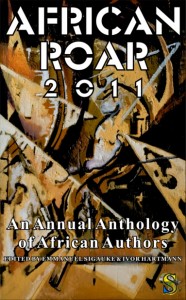
African Roar 2011: African Writers Whimpering

Adunni, my iPad just bought me African Roar 2011, an anthology of stories written by fifteen African writers, and edited by Emmanuel Sigauke and Ivor Hartmann. I don’t think Adunni wasted our precious money but I expected more; I hope this is not my Christmas present.  Contrary to what the anthology implies, it is not exactly representative of African writing; the writers come from just five English speaking countries; seven are from Zimbabwe, four from Nigeria, two from South Africa, and one each from Ghana and Malawi. I loved the debut annual anthology last year and reviewed it here. Sadly this year’s collection is mostly a gaggle of safe stories celebrating the familiar, tried and tired. There is little attempt at experimentation and there’s neither range not depth in many of the stories. These are mostly political statements about certain miserable conditions, wrapped in the pretend-toga of short stories. They feature pedestrian prose and lack energy and passion. Editing issues hint at a hurried publication.

Many of the stories are feverish experiments in self-absorption and narcissism. Memory Chirere’s tribute to the late writer Stanley Ruzvidzo Mupfudza is self-serving – and poorly written. Blessed silence would have been a more fitting tribute. Stories like the late Mupfudza’s Witch’s Brew are painstakingly devoted to decay, disease and conflict. Noviolet Bulawayo’s open lines in her story Main are lovely prose-poetry: “Main.   Main Street standing up straight and adjusting the rainbow-coloured wrap skirt that threatens to slide down her wide waist, black blood boiling in her veins. Bustling throbbing writhing street. Everything moving: cars, voices, ambitions, money, dreams, feet, smoke. Just moving moving moving — like a wind.” Nice, but then Main dissolves into a pointless story about death, and filth. The good news is that the story is so short it should not be called a short story. Bulawayo’s considerable literary talents are gainfully deployed to relentlessly documenting despair and mediocrity. Zukiswa Wanner’s story, A Writer’s lot about the joys and perks of being a privileged African writer doted upon by the society and the West is a botched attempt at humor. Wanner should find her own voice. She will never be Binyavanga Wainaina.

Gloom and doom have become chic signature tunes for defining the African writer – and Africa. These self-perceptions are true and they deserve the world’s attention and opprobrium but they do not speak to the range of life’s experience in Africa. Instead they only reinforce the persistent negative image that the world seems to have of Africa. African writers may be courting disrespect with their glum self-absorption. Case in point: Jerry Guo of Newsweek once conducted a profoundly incoherent interview of Chinua Achebe (Chinua Achebe on Nigeria’s Future, Newsweek, July 5, 2010) in which he referred to Things Fall Apart, as a story about “a simple yam farmer in tribal Nigeria.”  In the 21st century Things Fall Apart is being described in such a hideous fashion. Anthologies like African Roar 2011 should improve upon the silence and raise the bar for the quality of discourse in the burdens of Africa’s stories.

It is not all dreary. Dango Mkandawire’s prose shines in The Times. Ivor Hartman’s story, Diner Ten about cockroaches is so charming it could serve as a public relations charm offensive for that most loathsome of creepy crawly pests. Hajira Amla’s story Longing for Home was quite entertaining, albeit slightly inchoate and improbable. Helon Habila handles the same subject masterfully in The UK Guardian (The Second Death of Martin Lango). Uche Peter Umez’s Lose Myself gamely  makes a short story out of a one-night stand somewhere in America. It is one of the best stories in the collection. It is mostly successful but obsessive thoughts of home make the protagonist – and the story impotent.

Why are virtually all these stories so mindlessly obsessed with Africa’s political and social issues? Are African writers under pressure to write the single story? Issues of identity are on my mind. I am thinking specifically of the African writer’s preoccupation with identity. It is possible that the label African writer is having the effect of defining and limiting the writer’s range. It is as if African writers have sealed themselves hermetically in this bubble where they  toil in a culture of despair, relentlessly beating the same ‘African” dead horse to death. The good news is that, thanks to many obscure writers (alas), the literature of our continent is alive and well in many places other than in anthologies. The reader is well advised to visit those places on the Internet where all the stories of Africa dance riotously and assure the world of her people’s place in this market called humanity. I have  previously shared my appreciation here and here and on Facebook and Twitter. And yes, this is a shameless plug, please join me on Facebook and on twitter (@ikhide).

Interestingly enough last year’s debut issue of African Roar had a helpful introductory essay that provided appropriate context and coherence to that year’s collection. This year’s edition could have used an introductory essay. As an aside, next year, the editors should strive to produce a more user-friendly Kindle edition. I had trouble navigating the collection. I did find the biographies of the writers in the collection more entertaining than several of the stories. I had more fun reading The Granta Book of the African Short Story published by Granta and edited by the Nigerian writer Helon Habila. As I shared here, I have issues with that collection, but you cannot quarrel with the quality of its presentation and the thoughtfulness that went into it. Habila’s introductory essay alone is worth the price of the book.

Wainaina recently ignited a firestorm with his statements about the West’s obsession with what African writers have to write about. The article and the podcast in which Wainaina held forth about this are here. Wainaina did say, “If you are to ask me what are the greatest issues in Africa, I would say it is that people love, people fuck, people kiss, people speak.” That may be true, but you wouldn’t know it from reading African Roar 2011 (and come to think of it, Habila’s recent collection of “African stories”). These writers are too busy solving Africa’s myriad issues to make wild lust-filled love. It would appear that only misery makes them roar.

African Roar 2011 is available on Amazon.

Related essays:

The three Rs: Reading, Reading and Reading January 23, 2011

Why Are We Not Reading Books? August 29, 2011

Who Speaks for Black Africa?

The Caine Prize and Unintended Consequences May 28, 2011

The 2011 Caine Prize: How not to write about Africa May 24, 2011

Beyond the balance of the stories March 20, 2011

The writer, identity and purpose August 14, 2010

In search of the African writer January 24, 2010

Of African writers and their uncles February 6, 2011


The Trials of Chris Abani and the Power of Empty Words

I write this for Nigeria, beautiful but troubled land that houses my umbilical cord…

So, the other day I was watching a video clip of a Nigerian caught in the claws of the UK immigration. He had just alighted from a plane, clutching a fake passport and a detailed script for responding to pesky questions by UK immigration officials. The interview with the UK officials is at once funny and sad. If you have the time, you may watch the tragi-comedy here. When he is told he would be sent back home to Nigeria he breaks down in copious tears, kneels down and begs for relief. This warrior truly doesn’t want to go home for reasons different from the tissue of lies he has offered. The terror in his eyes hurts to behold. He looks like he is in his early thirties but he has definitely been schooled in the immigration laws of the UK; he loudly claims to be fifteen – a vulnerable minor in need of protection. He is clearly not fifteen but skeptical authorities decide to take him to a home where he would stay until his age is determined. He absconds and disappears into the catacombs of London never to be seen again. You cheer for this warrior until you realize that lacking any discernible skills his life is not going to be much better in London (English subtitles mock his halting English, humiliating hints of an abusive Nigerian educational system). Who knows, maybe his offspring will live a better life.  Our leaders should be shot. Yes, our leaders should be shot. I am not only referring to our political leaders. When the history of Africa’s troubled journey is accurately chronicled, the world will come to realize the horror of the self-serving perfidy of Africa’s intellectual leaders. We are the new self-serving colonialists perpetuating black-on-black crime on our own people. Ask the underclass of South Africa now attending to the narcissism of their black elite.

The degree of narcissism and self-absorption is mind-boggling. Many of our intellectual leaders are, like their political brethren, indifferent to personal responsibility. For them, flowery words are perfect substitutes for good character. Many will forever remember how the great fraud Philip Emeagwali wormed his way into credible history books as the “Father of the Internet.” Why, his face is permanently etched on a Nigerian postage stamp as a great son of Africa, this man who defrauds thousands daily by claiming that his graduate term paper makes him the founder of the Internet. His lies and exaggerations are copiously chronicled here by Sahara Reporters. If you need only the abridged Cliff notes, click on this. Please do not google “Emeagwali fraud,” your computer will crash from the e-rage. There are extremely reliable rumors that this trickster was set to receive Nigeria’s highest honor in 2010 until news of his hoax went viral on the Internet. Using his sordidly self-serving website here,  Emeagwali continues to ply his sick trade in America as a Black History Month pimp where folks desperate for black heroes uncritically accept his daring lies and obfuscations. By the way, whatever happened to the Nigerian government’s vow to investigate Philip Emeagwali?

When it comes to matters of immigration, I must concede that it is complicated; I generally make no judgment about how and why folks move from place to place. Right now, young people are doing daring things to escape what are admittedly harsh conditions in Africa. Hundreds die annually crossing roiling seas just to escape the disastrous consequences of their leaders’ perfidy. What they are doing is no different from what the colonialists did in coming to America. The face of immigration is browning, that is the only difference. This earth belongs to all of us, and you live where you can afford to.

The eighties and the nineties were particularly brutal years for Nigerians. Waves of murderous dictators took turns making life miserable for the people – and enriching themselves and their families in the process. Writers and artists were vulnerable. Many fought ferociously and were just as ferociously attacked for their beliefs and words. Many lost their lives and many are forever broken by the savagery that was visited upon them. The books of these brave warriors document their harrowing experiences in the hands of dictators. It is the truth. Well, not all of it is the truth. As in every instance, there are those who would take advantage of situations for self-serving reasons. Every now and then, a celebrated writer gets caught in the web of lies and exaggerations.  There is the sad case of Ishmael Beah, author of the memoir, A Long Way Gone, a bestseller about Beah’s days as a child-soldier. That book ran into difficulties when some dogged researchers did some homework and came up with the compelling conclusion that the book is mostly reams of lies and exaggerations (see some links here).  What is particularly tragic here is that Beah’s book is, in my humble opinion, a very good and important book; it could have been marketed as fiction, but no, I imagine that Beah and his agent concluded that the only way it would sell would be to claim fantastic adventures that have spurious basis in fact. The West’s hunger for child-soldier stories is insatiable and many alleged child-soldiers are wailing all the way to their suburban banks in Europe and America.

So the other day, I was doing some research on the acclaimed Nigerian writer Chris Abani and I came across these comic howlers on his Wikipedia page:

“Christopher Abani (or Chris Abani) (born December 27, 1966) is a Nigerian author. Abani’s first novel, Masters of the Board, was about a Neo-Nazi takeover of Nigeria. The book earned one reviewer to praise Abani as “Africa’s answer to Frederick Forsyth.” The Nigerian government, however, believed the book to be a blueprint for an actual coup, and sent the 18-year-old Abani to prison in 1985. After serving six months in jail, he was released, but he went on to perform in a guerilla theatre group. This action led to his arrest and imprisonment at Kiri Kiri, a notorious prison. He was released again, but after writing his play Song of a Broken Flute he was arrested for a third time, sentenced to death, and sent to the Kalakuta Prison, where he was jailed with other political prisoners and inmates on death row. His father is Igbo, while his mother was English born.”

“He spent some of his prison time in solitary confinement, but was freed in 1991. He lived in exile in London until a friend was murdered there in 1999; he then fled to the United States.”

Kalakuta prison! Who knows of such a prison? Based on these tales, in 2003, Abani is offered and happily accepts to be a recipient of the Hellman/Hammett grants awarded to 28 “brave” writers from all over the world. Here is Abani’s citation:

“Chris Abani (Nigeria), poet and novelist, was arrested in 1985 and again in 1987 when plots of his novels were said to be plans for attempts to overthrow the government. He spent six months in prison in 1985. In 1987, he was held in Kiri-Kiri Maximum Security Prison for a year and tortured. On his release, Mr. Abani entered Imo State University. Inspired by Wole Soyinka’s use of theater as protest, Mr. Abani formed a theater group that wrote and performed anti-government sketches. In 1990, he wrote a play, Song of the Broken Flute, for the University’s commencement exercises which the military head of state and military governor were scheduled to attend. The play, a series of monologues that decried government corruption and its effects on the people, landed him back in prison on treason charges. Released after 18 months, he graduated from Imo State University and joined the national service. Several attempts on his life while in boot camp prompted him to flee to England. He lived there quietly until publication of his prison memoir in 1997, when he began speaking out. As a result, the Nigerian government applied to have him extradited to stand trial for treason again. In December 1999, following the doorstep murder of his next-door neighbor, the only other Nigerian in the building, Mr. Abani left England for the United States. He now lives in California and is a doctoral student in literature at the University of Southern California.”

The story gets hilarious and changes with each re-telling. No one bothers to check. To be fair to his fellow writers, this award caused quite an uproar on krazitivity an online listserv of writers. He was put to task and he offered some defense of sorts before promptly disappearing out of sight. In the defense he pointedly avoids mention of the alleged death sentence. There were many responses, restrained, polite but expressing robust incredulity. The artist and poet Olu Oguibe asked for independent verification pointing out accurately that as an activist and student union leader himself he did not remember these tales; he did remember the late Chima Ubani who suffered eerily similar travails in the hands of the Nigerian government.  He has since expanded on his skepticism, with even more profound analysis on my Facebook page. The writer Nnorom Azuonye offered a compelling deconstruction of Abani’s 2003 defense here.

It is one thing for Abani to tell a lie and then move on with his life. It is another thing for him to continue to perpetuate the same lie at the expense of Africa. It is obnoxious and offensive, and if he was white, it would be considered racist. Since the confrontation/intervention in 2003, Abani has gone on to conduct moving interviews and given speeches expanding in graphic detail his alleged experiences. As I said earlier, the details get more fantastic in the re-telling and details and dates change each time. It is comic really. Watching Abani in 2008 here on TED, you wonder if he has delusions of grandeur, the man really believes all this stuff. You have to read this piece and watch the video clip. There is this piece of brilliant fiction where Abani talks about ending up in solitary on Nigeria’s “death row” and witnessing the execution of  “John James,”a 14-year old prisoner. “John James didn’t really understand death row and believed they’d get out. “They killed him. They handcuffed him to a chair, nailed his penis to a table, and let him bleed to death. That’s how I ended up in solitary, because I made my feelings known.” So many questions: How come no one has publicly called him on these lies? THAT is the real scandal. And the damage to Nigeria is needless. Such a brilliant writer, weaving unnecessary lies! Where is the outrage? Read this and marvel at Abani’s abilities to weave utter fiction. And yes, I have made up my mind, Abani is lying through all his teeth; he definitely lives in pure fantasy-land. Google Abani and there are all these Westerners fawning over him, they did not even bother to check the facts – reverse racism feeds some of our African intellectuals’ wallets. Read this interview and be royally teed. And here is another load of bullcrap. Abani ought to offer apologies for doing this to Nigeria and Africa.

These are questions I pose directly to Chris Abani: Were you really sentenced to death in Nigeria for your involvement in the Mamman Vatsa coup? Do you have copies of the extradition documents from the Nigerian government? Produce something, a newspaper clipping, anything and I will personally apologize to you for doubting you. It is amazing that up until now, no one has ever seen fit to call Abani on his lies and exaggerations. His appalling conduct threatens to distort permanently Nigeria’s already tortured history. There have been private complaints about his narcissistic behavior, yet no one has seen fit to come forth and complain about this outrage. The simplest explanation is that Abani is a hugely talented and influential writer; people, especially his peers are reluctant to confront him publicly because they do not want to be seen as raining on a talented writer’s parade. Words are powerful. In the hands of the gifted they can move armies to awesome destruction. It is not always a good thing. Words woven into lies can do major structural damage and trust becomes collateral damage. It is truly very simple; Abani should go to Nigeria, visit Kirikiri prisons like the writer and activist Ogaga Ifowodo recently did, show the world his cell and ask the authorities to give him copies of his incarceration documents. They are all there waiting for him. Failing that, he should shut up and keep writing. We will buy his books and love him regardless. Yes, will the real Christopher Abani stand up? In the name of Africa, I say stand up, speak the truth and sit down.

Binyavanga Wainaina, British Crumpets and Literary Insularity

My good friend, Chielozona Eze has uncharacteristically harsh words for the writer Binyavanga Wainaina who recently threw some of his world-renowned signature bombs into the dainty rooms of English literature. According to the UK Guardian, the prize-winning author Wainaina” has attacked the insularity of British authors, describing their work as “indigestible” for Kenyan readers, and suggesting that “you’d struggle to find any significant books that come out of Britain” about the African experience.” Read all about it here. In his blog, Eze responds with muscular fierceness:  “As one who owes his life to good luck and the empathic gestures from Europeans during the Biafran war, I find it somewhat disturbing that Wainaina, who was born circa a decade after the Biafran war, and far removed from the scenes of Biafran horrors, would make a sweeping condemnation of rescue/aid agencies such as Oxfam. In my case, in 1968/69, it was the Irish aid agency “Concern” that saved me and many other famishing, kwashiorkor Biafran kids. Without Concern, and perhaps, Oxfam, I would have perhaps succumbed to the famine that was orchestrated by fellow Nigerians/Africans. Why would any person in his right mind ever condemn Bob Geldorf for having responded to the human tragedy that took place in Ethiopia and Somalia? I am sincerely baffled.” I am still digesting Wainaina’s thoughts and trying to reflect on what it all means. Eze has certainly got the ball rolling. Never a dull moment. Enjoy the literary rumble in the e-jungle here.