Are We Children of a Racist God?

How the West views us as black people has been the question that has occupied African thinkers for a very long time. It is a question that has unfortunately eclipsed the even more critical question: Why do the others view us with such condescension and disrespect, bordering on racism?

I am still fuming after reading the book Onitsha by Nobel laureate J. M. G. Le Clézio, a book set in 1948, in Nigeria. Le Clézio lived in Nigeria with his family in 1948 at the tender age of eight. He was clearly taken by the injustices he saw against Africans at the time.

It is ostensibly written from the perspective of someone sensitive to the plight of Africans in colonial Nigeria, but who ends up unwittingly revealing his own prejudices. It is the classical story of white liberal orthodoxy, the type that earned writers like Joyce Cary and Joseph Conrad, Chinua Achebe’s rage.

Think of Nigeria in 1948. The University of Ibadan was founded that year. Chief Nnamdi Azikiwe, Nigeria’s first president had been long back from London and America. Think of Soyinka’s Ake, that wondrous memoir of Soyinka’s eclectic and wholesome childhood. Think of Chukwuemeka Ike’s book The Potter’s Wheel, about the adventures of a precocious little boy set in about the same time as Onitsha’s plot.

When you read Azikiwe, Soyinka, and Ike, you come away with memories crafted by African writers of a society that was embracing Western education with a robust fervor. Just like in the West. So, what then do we make of Le Clézio’s view of the same Nigeria of the 1940s as a place of simple-minded Africans sporting exaggerated physical features and child-like emotions and innocence?

Liberal orthodoxy is avuncular and patronising and it bestows upon the “helpless” African a benevolent but malignant label – subhuman. It is malignant because most days these days we spend our waking hours trying to convince the other that well, we are human, just like them. Why do they see us differently from how we see ourselves? Is racism alone the answer to that question?

In a perverse sense, the earthquake that rocked Haiti’s wobbly foundations exposed the pathetic rubble that passes for black life not only in Haiti but almost everywhere our people live. Chew on this: 10,000 NGOs pretending to do work have gulped billions of dollars in “aid” to Haiti in recent years and yet the country is so poor, it is called a Fourth World country. Nigeria is the next embarrassment waiting to happen. Every day Nigeria is rocked by quakes of thievery, savage violence and pure unadulterated incompetence. So, what is wrong with us?

As people of colour, it sometimes seems that we spend our days loudly proclaiming our humanity. We are on the defensive all the time. It is exhausting. How can we demand respect from others when we so obviously demand disrespect and ridicule? Call me a hopeless idealist but we can prove that we are able to overcome the machinations of a racist God.

The difference between our race and the other seems to be that their cognitive elite of leaders take care of their societies, while our cognitive elite take care of themselves only, the people be damned. Why is that so? Are we cursed? I reject the notion that this constancy of turmoil and neglect is our fate. We must take care of our own just as their cognitive elite takes care of their own people. We must care for those who clawed for every penny just so we can go to school.

We are suffering the result of a virtually uncritical acceptance of any and everything alien that lands our shores. This greed is killing us. We have made ourselves the other. We have helped ourselves earn it. In the ruins of Africa intolerance comes baying out of churches and mosques. If you don’t look like them you will not be born again. I think it is disgraceful that we are condoning hate in the name of intellectual freedom.

On a fairly regular basis we are made to endure horrid expressions of hatred and bigotry. Our thinkers, our intellectuals need to reflect upon their role in building the Africa of our dreams. Let’s dream of the impossible. Let’s undo the mean harvest of racist bigoted deities. As thinkers, we must be bold, we must explore new ideas, do bold things, not simply spend all day parroting nonsense in the name of scholarship.

As writers we should push for the next level of awareness. I urge all of us as thinkers to model the behaviours that have made the Western societies we live in so much more successful than our ancestral lands. Let it not be said that we are children of a lesser god.

To Be African: Ode to Contrived Misery

The term African is becoming a burden, a pejorative used to describe certain miserable conditions of the physical and psychological. Case in point: Claudine Gay, writing in the Root seems to object to her son being called African in her essay, My Son’s Called African and I’m Upset; Why? She is black. She is not the only one by the way; the great Tiger Woods once brushed aside that label by glibly referring to himself as Cablinasian, whatever that means. He openly admits that being called African-American bothers him. I doubt that he has ever visited a black-themed event. His father is black. Gay’s essay has understandably caused quite a stir in those watering holes inhabited by African intellectuals. The term “African” is under siege as people are now realizing that it is becoming proxy for everything Africans are not and should not be. By the way, it seems these days that the (in)action of just one individual is enough to draw sweeping generalizations about an entire continent of millions of individually unique people.  Westerners visit remote parts of Africa and write breathless and patronizing essays about “Africa.” Henning Mankell has an essay in the New York Times, In Africa, the Art of Listening, which makes the baffling and maddening point that his observations about life on a park bench somewhere in Mozambique reflect life everywhere in Africa.

African intellectuals for various compelling reasons are now flung and scattered amongst the cafes of Europe and the Americas where they pontificate about the condition that is Africa and yell at the white man for every perceived slight on Africa and Africans. We have every reason to fume (yes, I am a card-carrying member of that tribe of whiners). To be African is to be associated with everything objectionable – war, disease, crime, corruption, neediness and that ever-nagging suspicion in the minds of even the most liberal Westerners that we are somehow sub-human. It is a perplexing and infuriating situation that has kept African intellectuals on the defensive. In America for example, immigration is a huge and vexing issue; an issue that was considered ho-hum until the color of immigration became brown. Native Americans remember painfully that the new America is indeed a land of immigrants. Today, immigrants of color are being chased from pillar to post for doing exactly what the “founders” of America did eons ago. In the classrooms there is the persistent debate about closing the achievement gap in academic achievement among races and ethnicities.  When leaders are talking about the gap, guess who they are glaring at? Children of the poor, children of the black and brown.  In their eyes, African Americans and Africans are parked squarely in the wrong end of the Bell Curve.

Africans have every reason to be upset. However, it is helpful to focus on why things are the way they are. In Nigeria for example, the intellectual, religious and political elite have colluded to make a mockery of any and every thing that a people stand for. This they have done using pretend-processes and pretend-structures for self-serving ends. In Nigeria, the new Christianity is the new alcoholism ravaging the already dispossessed daily. Watch this video and reflect upon the caricature nation that Nigeria is fast becoming. Watch this disturbing video of abuse of young congregants in a church. Thieving pastors have rushed whoosh into a yawning vacuum that was created by generations of failed leaders. These new thieves are now raking in millions from their own self-serving failure to lead. We are muttering to ourselves and our people are chanting themselves to lunacy and irrelevance. Thanks to succeeding regimes of irresponsible ASUU stalwarts and government kleptocrats many of our universities would be shut down today in the West if they were poultry farms. The looting goes on unabated and the funds are used to create safe havens for the elite and their overfed families at home and abroad. Any Westerner coming to visit Nigeria today would be forgiven for taking one look and wanting to just pee on the whole damn place.  In America, racial and ethnic demographic data are gleefully used by leaders to justify funding for the classroom. Do not get me wrong; the bulk of these funds have been incredibly crucial in making huge positive changes in the lives of all children in the classroom. However, it has come at a cost. Thanks to this deficit-model approach of viewing our humanity, children of African descent are looked upon as issues-laden, disrespected by those in authority. The child of color grows up to believe that that a police officer is not a friend. The feeling is mutual. But then, I know many Africans in the West who boast with pride that they live in white neighborhoods. The self-loathing is real and it comes at a cost. In these neighborhoods Africans are routinely ignored, humored and patronized by the majority-white neighbors. Any wonder children grow up resenting the label, African?

Yes, we must also reflect on our role in the creation of this pejorative. Many of our African experts in history, world renowned scholars have devoted their muscular talents to penning exotic hagiographies about a mythical place called Africa. Any attempt to offer a different perspective is met with ridicule and opprobrium. I am a huge fan of African literature; these are exciting times to be a reader, thanks to the hard work of many talented writers of African extraction and I will go to my grave clutching an African novel, yes. However, this genre of literature called “African literature” is in danger of being stereotyped as ghetto lit, mostly devoted to celebrating exclusively exotica – war, disease, crime, etc. There is no balance to these stories, instead to the extent that they present only the single story (apologies, Chimamanda Adichie) they distort the history of our challenged continent. This is especially an important point since it is not clear to me that African historians are actively doing the hard work and research of documenting and sharing with the world the sum total of Africa’s history.

“African writers” are routinely herded into Western retreats and conferences by condescending, patronizing liberals where they regale the world with tales of woe, gloom and doom.  Their books and short stories are mostly their opinions about Africa, nothing more. Increasingly and alarmingly, these book readings, speeches, and so on are based on erroneous information – and outright fabrications for profit as we now know with the celebrated writer Chris Abani.  With their powerful words (these are ordinarily good writers) they have written literally into concrete eternity, a hugely distorted and negative history of Africa.  Using Abani as a case study I have previously tried to explain how contemporary African literature may be distorting African history. The writer Kennedy Emetulu has a long piece here meticulously detailing Abani’s dark history of lying for profit and more importantly distorting history in the process. Here is a profound passage in the essay:

“To understand the effect of Abani’s lies and how much damage he has done to our national history and to our psyche as a people, while making blood money from it and acquiring fame for himself, let’s just consider one of his poems from his Kalakuta RepublicOde to Joy. We are choosing this poem, because it is one of his works that he swears to be an eyewitness account of the suffering and experience he went through in Kirikiri Maximum Security Prison. It is the poem that canonized him in the literary hall of fame in the West and had laureates like Harold Pinter gushing about its stark frankness and so on. Indeed, it is the singular most popular of his poems. Personally, reading the poem does nothing for me; but until one understands the devious cultural mind-reading underneath it and the purpose Abani used it to serve and the purpose it serves its promoters in the West, one may think it’s just an innocent poem by a young African writer.”

“Today, that poem is emblazoned in the city centre of Leiden, the sixth largest city in Netherlands where it is being ‘celebrated’. Leiden is an old historical city located on the Old Rhine, twenty kilometres from The Hague and 40 kilometres from Amsterdam. It has one of the oldest and most prestigious universities in Europe, the Leiden University, established in 1575. Its importance as a learning and cultural centre in Europe is further emphasized by the fact that the city is twinned with Oxford, the location of the oldest university in England.”

Read Leiden’s Wall of Shame here and see how every day writers like Abani collaborate with the West in canonizing the term “African” in the concrete walls and minds of the West. You can be sure of one thing; that wall will never come down. A big fat lie has now come to represent Africa thanks to the ghetto literature espoused by Abani et al (there are many like him by the way). Before we start throwing stones at the likes of Claudine Gay, we should first look into ourselves to see and confront that which ails us. We may be our own worst enemy. As intellectuals and self-appointed priests of probity and justice, we must police ourselves; otherwise we lack the moral authority to yell at a policeman for furtively collecting crumbs as bribes.

The second coming…

[First published in Fogged Clarity literary magazine (2009)]

We sit around this fireplace
in the sky that never goes out.
We are staring at each other
and these words
are like the firewood that stokes the fire-of-many-faces.

We sit around this fireplace but we are cold.
Here take my firewood it burns bright
it burns long it burns hard.
Take my firewood and we will be warm.

In my dream I fled America, the land of large people that know no hunger, sad people that will never know the joy of feeding a pain because they are never hungry. In my dream, I landed in Nigeria on my father’s favorite palm tree drinking palm wine and eating the meal-that-satisfies-the-belly that I had stolen from my mother’s earthen pots. In my dream, my mother’s voice, strong voice of steel, rose up, sonorous in sorrow, beautiful in sadness, rose up to rebuke me for raiding her cooking pots. In my dream, my mother cursed me with the breasts that gave me life and succor. It was a beautiful curse, the rendering of it. It traveled through rivers of tribulation and rank disappointments and hit me smack in my conscience’s face:

“Your children will be aliens in the land of your birth. They will know prosperity all their lives, and in knowing wealth they will live with the poverty of prosperity all their lives. The joy of satisfying a hunger will elude them with the swiftness with which you have stolen from my pots. Their cooking tripods will always quake on two legs, because, you my son, you have made me a two-legged tripod in my old age.”

In my dream, I laughed hard and loud at the effete curses coming from my mother, this shriveled old lady perched at the foot of my father’s favorite palm tree. I shivered with sheer joy and satisfaction as my father’s palm wine and my mother’s cooking raced through me, thrilling my hunger cells with the sheer pleasure of good wine and real cooking.

Soon the voice called, called me, looking for her husband. I listened to the ululation of she-who-must-find-her-husband, and the tremors of the voice felled me from my father’s palm tree and I woke up in the bosom of a new day, staring at dew-drop dawn in America.

“Father, of my children, it is morning. Did you sleep well?”

 “Mother of my children, it is morning indeed. I slept well.”

Good morning, America. My eyes rise, lift themselves up from the icy ashes of my condition, and wag their sassy tails at life. Good morning, America. Life goes on, but this is not how the antelope planned the trip to the market place. In the antelope’s dreams, he was at the market place all decked out in the best suit the tailors of Italy could put together, his princely hooves wearing shoes made from supple soft Italian leather. When the antelope woke up, ye gods, he was all naked and tied up, and who is this filthy vermin offering him for sale to peasants? I am the antelope, and this is not how I planned this, this trip to the market place. But life goes on. Time cracks her whip. I flinch, lean out the drive-thru window into the arctic blast of winter in America and I ask the question on my master’s script: “Do you want fries to go with this ma’am?” Good morning, America. Life goes on.

This is where the cold stream froze
snap-crackle in the middle of nothingness.
This is where the cold frozen river
dragged the iroko tree by her hair to plant

The warrior sails from hair to feet of the iroko tree
and everywhere is the same
everywhere is frozen.

Sitting cold by this river of glass
watching my rabbit prepare for dusk
closing the shutters on dawn’s window.
Africa calls me with the smell
of warm ashes softening my maize and my heart.
I must go to the phone lines and talk to you
mama.

Izuma-of-the-great-plains listen to me.
Izuma-of-the-rugged-stout-bush hear me sing.

Summer slinks out of the swimming pool, waves goodbye to my children and their friend the ice cream truck, and goes back to bed with the ground hog. Good night summer, see you next year. We wake up in America reincarnated from the wet depths of winter. In America, our days do not morph into nights. The days clash into them and the explosions send us shell-shocked into the bosom of tired gods. Dawn comes with the rude roar of the bugler’s trumpet. And the cycle continues every morning. Come Spring, ice cakes flee America and slink back, into a thousand little streams to return as rock solid goddesses of the sea.

Another morning in America and like the morning before her, I fight my way out of our house, past my children’s needs, past her nostalgia for a simple place to rest from this thing called marriage. Miracles of all miracles, my jalopy wails to a start. I attack the ice on the windshield, the snow on the roof and the cold in my heart and in my bones with all the tools and strength at my disposal. The journey down the road to work is long; there are not enough roads for all the cars that the money in America has bought. We have too much and everywhere we go we take with us what our money has bought. And now the roads look like gigantic pythons suffering from indigestion. The ice crackles, breaks off and scampers off of my windshield and I join the motor lines of the new slaves going to the salt-mines of the west. And like frozen gods, the trees line either side of the boulevard to nowhere, guarding the snake lines of overweight cars as they wind through the path to the pantheon of the dollar-gods.

The heat rises from my feet and tucks me into my solitude; respite from that which chases me daily. And soon Africa comes calling to me, as she rises from deep inside the white man’s ilo* that resides in vinyl discs. Strong voices of my ancestors, indignant messengers of a constant condition, chase the drummers’ solo chant. And the rocking and wailing of horns cannot drown the beauty of our sisters’ insistent chorus. And one by one, my ancestors rise up from my windshield and remind me of the beginning of this journey that knows no end. And now I am the sum of my experiences. When I turned the corner of my mother’s favorite path, I came to this land that was like no other. Here there are no men and there are no women, there are persons. The people, they stopped going to the farm a thousand moons ago, but they still eat like famished farmers. For the food keeps coming in huge silos straight into their gullets. The people know no hunger but they hunger for the beauty that the goddess of hunger bestows on her faithful. There is no hunger in this land; even the poor know no hunger. And now there is a new hunger of the spirit that is born from prosperity. It is a hunger of the spirit. In this land called America, we have everything but we have nothing. The gods are punishing us. The gods that put hunger on this earth are angry with mere mortals for multiplying loaves of everything in their engineering labs. We were never meant to be content all the time. And now we know it.

We are never hungry. We eat when the time says we should be hungry. We went to the chicken place to get lunch, me and my mother, Izuma-of-the-restless-path. At the drive-thru, I punched the button for help and the voice called as if from the skies. The voice offered us a thousand combinations of a thousand offerings of a thousand choices that we do not need. I pine for my mother’s plate of steaming hot white rice and goat meat stew but it is not one of the thousand choices. I make a choice. I look behind me and the lines of the not-really hungry snake into the road, all staring at the drive-thru like a malevolent beast they would love to devour. Izuma watches me, her son, eyes welling with awe at the audacity and my mastery of the white man’s witchcraft. The voice asks me for money and I give the hole in the wall the plastic that gives birth to money. The hole in the wall gives me my receipt and a chute comes as if from the skies bearing our lunch. I give Izuma her lunch:

“My son, this is food from alien gods. How can I eat what the gods cooked?”

“Mama, please eat! It is food; human beings that you do not see cooked the meals.”

“How do you know this? I see no one. And you did not pay for this thing! Will they not be angry with us?”

I show Izuma my credit card and I try to explain the miracle of the plastic to her. She holds her box of chicken and after a long silence my mother’s voice delivers the verdict that flogs my dignity each time:

“The white man is amazing. He knows where God is but he will not tell us black people because if we know where he is, we will kill him!”

We will die and return in a thousand moons and there will be no nations as we know them. All these structures, all these walls, they will be gone, sold on eBay, wretched souvenirs of a time long gone. The walls of our Jericho will melt into vapor, victims of the wrath of the bugler’s horn. Think about this: These new wires in the sky that we can’t see, this thing that we can’t touch called the Internet; it is like a revolution that came, like the thief in the night. My friend the computer genius bought a big house and now he has no job. His job fled through the Internet to India where young people with accents tell you in America how to fix what ails your computer. In the bazaars of Mumbai, the food vendor sells fried potato cakes at dawn and sells computer help to the Americans come dusk. For every dollar my friend was making in America, they pay the Indians pennies. The Indians are happy, but my friend is miserable. The bank sold my friend his dream house. He bought a nightmare. Change is not coming, change has come. And why are my feet cemented to the tracks of a coming train?

Smell the ashes
swirling up from the ashes
dancing dizzy into the eaves
of the hut of happy memories.

Smell the maize
roasting merry on your fire log.
Take the maize, tongue
and this pear, tongue.
The chemist does not need your pipette
O heavens.

I am back from chasing mangoes in the mad man’s guava grove and my feet land in Nigeria, the land that houses my umbilical cord. The ashes of my childhood warm my pear and my memories. And my maize is done. Nothing has changed. Do you hear the beautiful wailing of horns? The sage Christopher Okigbo is leaning hard on his sorrows, trapped in a Fanta bottle of ogogoro,** watching his words morph into the reality that Nigeria has become. The warrior, Isaac Adaka Boro stalks the dark, dank oil polluted Niger delta in his water taxi, refusing to be consoled. The bard Celestine Ukwu has been drinking non-stop in the tombo bar wailing inconsolably for the return of Rex Lawson. And Kongi ,*** angry wise bard, offspring of the loin of the fearless gazelle, he roams the land warning of the coming inferno. Our story teller Hubert Ogunde is back, telling the deaf of yet another conflagration. Nigeria Ronu!****

It is not evening yet, but all is dark because the myrmidons of darkness have descended on our land like a swarm of locusts. My uncle Diesel is dead and our village is dying, felled by change. Death is not permanent, for the good death nurtures a rebirth. We shall see. Villages are dying in Nigeria, felled by change. Villages are dying in America, felled by the gods of Wal-Mart. But all is well. Everything is as it should be. Death is not permanent, for the good death nurtures a rebirth. Good night, uncle. Good night Diesel.

And darkness descends
wet blanket on a forlorn land
and we are touched dew-wet
and as one we have sinned…
What have we done?

ASUU is on Strike Again! Tell Us Something New!

Nigeria’s Academic Staff Union (ASUU) is on strike again. That is really not news, they are ALWAYS on strike; it would be news if they announced that they were going to be in the classrooms doing real work on behalf of the hapless children of the dispossessed trapped in those decaying pretend institutions euphemistically called “universities.” The abuse of other people’s children in Nigerian “universities” has been going on for a very long time. Below are two articles I wrote in 2009 about ASUU that dysfunctional body. Nothing has changed with ASUU, that bully-pantheon that has been hijacked by thugs in academic gowns.

By the way, this is not about individual members of ASUU, many of whom I admire individually as dedicated professionals. This is really about ASUU as an organization living on borrowed time and playing with our children’s future. ASUU is seriously farting its way to glorious irrelevance. Nothing demonstrates it better than the quality of its “communiqués”, “press releases” and similar articles of mediocrity that it has lovingly pasted on its pretend-website. Reading the politico-babble of ASUU (what little I can understand, such intemperate incoherence) one imagines that ASUU is still being hijacked by people called “comrades” who are under the delusion that the Soviet Union still exists and Che Guevara is writing romantic manifestos from some foxhole in Cuba. ASUU’s recommendations for solving what ails the educational system are alarming in how out of date they are. The language that ASUU employs is a throw-back to 60’s and 70’s Soviet era militancy when as youths, we wore berets, drank the cheapest beer in town (free!), and smoked anything that would light up. In those days, anyone that dared start a conversation that we didn’t like was roughed up. Nothing has changed; well, except the world. The world has changed. Listening to the histrionics of ASUU you wouldn’t know it. There is a joke that deep in Enugu’s Milliken hills there is a pre-Biafra war family that refuses to come down to the plains – until the Biafran war is over. ASUU is at war with imaginary enemies and refuses to come down from its high horse until its war with itself is over. We may have to relent and give them whatever they are asking for – gobs of useful US dollars. Maybe then they’ll teach our children and free them to go to the next step in their life – unemployed Nigerian graduates. ASUU has mastered a perverse form of bait and switch. In ASUU’s parlance it is called kidnap and blackmail:

Enjoy… or weep for our children!

And read this also while you are at it!

Chris Abani: Distorting Africa’s History

The world is now privy to the myriad lies and exaggerations of the acclaimed writer, Professor Christopher Abani regarding his imaginary ordeal in Nigeria’s prisons (mostly Kirikiri). The lies are compelling and give Africa a black eye: The death sentence imposed on him because of his involvement in military coups as a teenager and his alleged witness to the execution of at least one 14-year old through death by nailing of his penis to a chair until he bled to death. The shocking revelations of Abani’s “419” activities are detailed here on my blog.

There are many compelling reasons why Abani’s lies and exaggerations should not be ignored as mere fibs by someone intent on furthering his dream as a writer and intellectual. White folks need to understand the caste system in Nigeria. As the offspring of privilege, of a white mother and an upper middle class black father, Abani most likely luxuriated in the lap of adulation and luxury in Nigeria. Abani is biting the hands that fed him by lying about what did not happen to him in Nigeria. Shame on him.  You must understand the impact of these lies on innocent Nigerians who are viewed at home and abroad from the tortured lens of what passes for African literature today. Abani’s lies are not mere lies; these are muscular distortions of the history of Nigeria, and by extension, Africa.

Let me repeat: Chris Abani was never detained in Nigeria’s Kirikiri prisons. Abani was never at Kirikiri as a prisoner awaiting death. That is just not true. And he was never implicated in a military coup, never. And the most galling of the lies; Abani never witnessed a 14-year old prisoner on death row die by his penis being nailed to a chair so he would bleed to death. That these lies have gone unchallenged for over a decade is a damning indictment of those in his literary circle who knew about this and chose to keep quiet for whatever reason. It is also an eloquent testimony to the racism in the literary circle of the West populated by patronizing condescending Western liberals who work themselves daily into unctuous avuncular foam, willing to think the worst of Africa and Africans and consign us to a beggarly subhuman condition with their cloying, devastating faux kindness. They should keep their money, their grants, and their fake wines. We may be poor but we are definitely not idiots.

In the name of fiction, a tiny cabal of “African writers” seems willing to wheedle, lie and steal their way into stardom on the tortured back of Africa. As a result, Africa and Africans are being doubly victimized. In the decaying classrooms of Nigeria, children born into a war schemed by thieving politicians and lying intellectuals are being taught that dead white men discovered places like River Niger. And abroad their sons and daughters are assuring their white counterparts that in Nigeria 14-year olds are routinely executed by means so brutal and primitive, they reinforce the truth that Africa is a land of darkness. That is what Chris Abani and his roaming band of Diaspora literature pimps are telling young impressionable Westerners every day in classrooms. We should be outraged. If you do not believe me, here is the official website of  Professor Chris Abani who now teaches this kind of false odium every day at the University of California, Riverside.

“As a teenager in Nigeria, Chris Abani earned a little too much attention for the publication Masters of the Board, a thriller whose plotline about a military coup triggered paranoia in his country’s political dictatorship. Abani’s creativity combined with his college activism resulted in prison sentences from his government, sometimes in solitary confinement.”

“A collection of poems that grew out of that experience, Kalakuta Republic (2000), was described as “the most naked, harrowing expression of prison life and political torture imaginable,” by playwright Harold Pinter.”Reading them is like being singed with a red hot iron.””

This is outrageous. The distortion of our own history by our very own is beyond reprehensible, it is criminal and I intend to stop only when Abani stops. I am privy to private testimonials of Abani’s malfeasance, how it is near-impossible for honest hard working African authors to tell their story without some concerned Westerner in the audience asking about Abani’s ordeal and the penis nailing to death.

The University of California, Riverside must demonstrate to the world that it is not a racist organization by bringing down Abani’s website. What Abani is doing to Nigeria in the classrooms of America makes him an enemy of Africa and we must let the University of California know it in no uncertain terms. It is very simple: Abani is the accuser here. He has accused Nigeria of arresting him several times, putting him on death row, executing at least one teenager, seeking his extradition from Britain, lie, lie, lie. In the West where he peddles his lies, there is the presumption of innocence until you are proven guilty. The University of California at Riverside should at the very minimum ask Abani to take down the offensive lies about Nigeria on his website, failing which I would urge Nigeria to sue the university for defamation.

What should we do? Great question. If you are outraged enough email the responsible parties in the university and urge them to prevail upon Abani to remove the lies from the university’s website.  Chris Abani may be reached at Chris.abani@ucr.edu.  Andrew Winer, is Chair of Abani’s department; he may be reached at: andrew.winer@ucr.edu

Abani is trusted by the Western media; he gets rave reviews and attention wherever he goes to peddle his tales of African disease war and gloom. Sometimes children are the beneficiaries or shall we say victims of his lies as in this moving article in the Star Tribune about how he only charged $5,000 to attend an event thanks to the persistence of a little boy who wanted very much for Abani “the poet and activist” to come deliver a speech in his school. We are told Abani normally charges $50,000 to $100,000 per engagement. I can assure you that he did not earn those fees from simply being a professor; pretty much every dollar he has earned is from his tales as a teenage pain-in-the-butt-on-death-row-in-Africa. Why should we allow an adult to scheme children out of the money they made from bake sales? Here is how Abani is described in the article:

“Abani grew up under a military dictatorship and was imprisoned by the Nigerian government as a teenager for his writings. He speaks gently of his late mother, a 5-foot-2 woman with five children, “who stood up to soldiers who wanted to kill us.” He is the recipient of the PEN Freedom-to-Write Award and the Hemingway/PEN Prize for his bestselling novel, “Graceland.””

There are enough lies in there to sink the Titanic again.

If you feel outraged enough about the pimping of Africa for profit by the likes of Chris Abani, please send a nice polite email to the following at the Star Tribune and express your concerns about the misrepresentations in the article:

Gail Rosenblum, the columnist who wrote the piece: gail.rosenblum@startribune.com

Michael J. Klingensmith, Publisher and CEO: michael.klingensmith@startribune.com

Nancy Barnes: Editor and Senior Vice President, nancyb@startribune.com

Scott Gillespie: Editor, sgillespie@startribune.com

There is more. Abani’s lies have infected the hallowed halls of academia and institutions whose hallmark is excellence. Chris Abani is the 2001 recipient of the Netherlands’ Prince Claus Award for Literature & Culture. Write to the Prince Claus Foundation  at info@princeclausfund.nl and ask them to explain how and when Chris Abani was “a political prisoner of war” as they state on their website.

Chris Abani is the 2001 recipient of the PEN USA Freedom-to-Write Award. The award was given to Abani based on lies and misrepresentations about his alleged life as a prodemocracy activist in Nigeria. Write to the leaders of PEN USA at pen@penusa.org, ftw@penusa.org, libby@penusa.org asking them to explain the lies on their websites about Abani’s exploits.

Chris Abani is the 2003 recipient of the Hellman/Hammet Grant from Human Rights Watch, USA. Make your feelings known at http://www.hrw.org/contact-us.

Chris Abani says Africa is a land of savages that nail their children’s phalluses to chairs so they can bleed to death. Do you agree? If not, do something about it. Now. We are not savages.

Do something. Anything. Chris Abani knows he is lying through all his teeth; he has been in hiding since the revelations went viral on the internet. I shall not relent until the heat forces him to say something, anything. Please share the TED speech with friends in Amnesty and other institutions who can do something to tell the truth about what really happened. Ask them to investigate the penis nailing of a 14-year old, the death sentence on Abani, the stay in Kirikiri, etc, etc, etc. And more importantly show them the tales in his professional website, apparently the morbid basis for the lies he tells to American children everyday about the Africa of his nightmares. He also peddles his tales to school children for monstrous amounts of money, for example, here. This man’s actions are even more reprehensible than the stories fed to Nigerian children daily about Conrad’s heart of darkness and the discoveries of savage parts of Africa (the River Niger, etc) by dead white men. We must stop this man. Do this in the name of our children.

Chris Abani: Those Virgins of Flaming Change…

Chris Abani’s best novel in my mind is the Virgin of Flames, an all-American story about the salad bowl that is Los Angeles. It is masterful and a while back I fawned over it in a review.  However, I don’t believe the book was a blockbuster success in terms of sales. The American consumer seemed to have been confused; how can a writer with such a name write like this about us?

It is not easy: You are pegged from day one as an African writer, and my view is that as African writers, we help to perpetrate that unfortunate label. Why should I be writing ONLY African tales when I have been gone for 30 years? Why shouldn’t I tell the world about my life here? At some point exile becomes home.

There has been uproar on the blogosphere over my essay detailing all the horrid lies that Chris Abani has told against Nigeria which I chronicled in the blog post, The Trials of Chris Okigbo and the Power of Empty Words. The lies are too numerous to detail, the more I read about this guy, the more I am coming to terms with the enormity of what this “new” literature portends for the history of Africa. It is distorting it in a muscular way. This beggarly approach to earning a living diminishes Abani and his ilk – and the land of their ancestry. Most of these writers have never seen a hut. Abani was raised middle class by a white mother and a Nigerian dad. Was Abani ever on death row? He and his mother may have gone to serve doomed prisoners on death row brownies, but trust me, if indeed Abani had been on death row, the British would have had something to say about that. And loudly too. Even those of us who are Americans by paper, if Nigeria dares harass us at the ports of entry, America starts flexing her muscles. Abani’s lies are so juvenile and blatant they are not worth investigating 😉

Anyway, I did say I enjoyed The Virgin of Flames. Buy this book and enjoy it. Don’t buy Abani’s lies.

Enjoy my review of this lovely book 😉

Binyavanga Wainaina, British Crumpets and Literary Insularity

My good friend, Chielozona Eze has uncharacteristically harsh words for the writer Binyavanga Wainaina who recently threw some of his world-renowned signature bombs into the dainty rooms of English literature. According to the UK Guardian, the prize-winning author Wainaina” has attacked the insularity of British authors, describing their work as “indigestible” for Kenyan readers, and suggesting that “you’d struggle to find any significant books that come out of Britain” about the African experience.” Read all about it here. In his blog, Eze responds with muscular fierceness:  “As one who owes his life to good luck and the empathic gestures from Europeans during the Biafran war, I find it somewhat disturbing that Wainaina, who was born circa a decade after the Biafran war, and far removed from the scenes of Biafran horrors, would make a sweeping condemnation of rescue/aid agencies such as Oxfam. In my case, in 1968/69, it was the Irish aid agency “Concern” that saved me and many other famishing, kwashiorkor Biafran kids. Without Concern, and perhaps, Oxfam, I would have perhaps succumbed to the famine that was orchestrated by fellow Nigerians/Africans. Why would any person in his right mind ever condemn Bob Geldorf for having responded to the human tragedy that took place in Ethiopia and Somalia? I am sincerely baffled.” I am still digesting Wainaina’s thoughts and trying to reflect on what it all means. Eze has certainly got the ball rolling. Never a dull moment. Enjoy the literary rumble in the e-jungle here.

Telling all our Stories

Growing up in Nigeria, I viewed the world around me through books  most of which were regulated, for good or for bad, by the gatekeepers of traditional publishing. I was immensely entertained and educated by the vast majority of the books I read. In addition to the traditional fare, there was always self-publishing or publishing on the side. I remember the enthusiastic authors of that indigenous genre of works fondly known as Onitsha Market Literature. As teenagers, many of us honed our love letter writing skills with their hilarious pamphlets. I cherish my copy of the venerable Ogali A. Ogali’s Veronica My Daughter And Other Onitsha Plays And Stories. Enjoy my ode to that genre of entertainment here. The late great Professor Emmanuel Obiechina did ground-breaking work on Onitsha Market Literature, google him. I have a treat for you; the University of Kansas has a rich collection complete with their pdf texts here. It is not great literature but it is an important and hugely entertaining marker of a certain period.

The Internet continues the tradition of sharing all our stories despite the loud protests of the traditional gatekeepers of literature who seem threatened by the democratization of creative expression on the Internet. I have tremendous respect for books, but I am also fascinated by all the literary activity currently taking place digitally. There are many individuals leading this charge; the Nigerian writer who goes by the name Myne Whitman is easily one of the most important forces quietly shaping the trajectory of Nigerian stories on the Internet. She has a lot of energy and enthusiasm, she is passionate about the literature of the people who live within that geographic space called Nigeria, AND she has an extremely large following. As I said, she is also a writer. Her writing is not what you would call “serious literature”, she has written two books, A Heart to Mend and A Love Rekindled, both of them self-published.

I am still reading Whitman’s works and taking copious notes. One day I will have something to say about the works of folks like her, Kiru Taye, Ugo Chime, and Olapeju Ogunbiade, Nigerians who  plumb the depths of our sexuality and sensuality using the digital space. To read Ogunbiade’s contributions, go to Facebook and “like” her “Let’s Talk About it” community. Ugo Chime plies her literary trade here on Daily Times, Nigeria. Why do I mention these names in the same breath as literature? Well, because, we may not agree with these writers, but their contributions should be taken as seriously as that of those who seek to define our stories through books. Africa is a complex elephant and I worry that she is being described only by a set of observers. We are the sum of our lived lives. What folks like Myne Whitman are doing is insisting that all stories must be told and heard.

Myne Whitman has earned my respect on one level; as founder and proprietor of the literary site naijastories, she has helped to mentor and give rich voice to a large tier of writers that no one sees or seems to care about. She does not discriminate as far as I can determine, anyone with a muse gets published. It is a very busy site, it could be better organized, for one thing.  There are many enthusiastic writers there and sometimes the eyes glaze over. It would be great to set aside a space on the site that showcases works that have been peer-reviewed and judged worthy of accolades.  On that website there are ample opportunities for peers to review and provide feedback on one’s work. There are many sites like this on the web and on social media, and aspiring writers should sign on and join their peers in the arduous task of becoming a better writer.

Why am I saying all of this? I consider myself to be first and foremost a consumer of literature. I am very passionate about African literature and I do believe sincerely that these are exciting times to be alive if you love the stories of Africa. You can overdose on them for free on the Internet and writers like Myne Whitman make it possible. In my review of African writing, I have complained ad nauseam that Africa is being viewed from a very narrow perspective – through the books of a tiny band of writers who have unfettered access to Western publishers and arts patrons. It is time to stop complaining and start introducing them to the works of those who are hidden in plain sight – beginning with Myne Whitman and Naijastories. In terms of other digital resources I shared some thoughts here. I would like to hear from you: What are your favorite sites where writers hang out? By the way, this summer, I had a long rambling real-time chat with some members of the Naijastories community  that touched on a lot of my long-held views about literature, etc. It is a rough transcript but I like it a lot because I actually did not hold back much.

Enjoy.

Walks with Julius: Teju Cole’s ‘Open City’

NOTE: Initially published June 4, 2011 on Next.

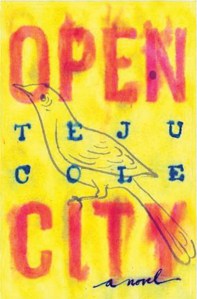
Teju Cole’s enigmatic new book ‘Open City’ is truly unusual. Imagine a book that, when doused with the rich waters of the writer’s curiosity and intellect, grows exponentially until it overwhelms the reader’s senses. In this experiment, Cole takes a different approach to writing a novel. There is virtually no plot to the novel, to use the term novel loosely, and the author dispenses with the use of quotes in dialogue. Thankfully, ‘Open City’ is a monologue a lot of times; Julius is in love with the sound of his own voice. Furthermore, it seems that every plot is hatched and allowed to promptly disappear into the catacombs of New York City and Europe, the settings for the book. The novel is rich and messy. Just like life.

Inspecting the catacombs ‘Open City’ is about myriad issues, most of them unrelated. The main character, Julius, an uber-brainy restless German-Nigerian, seems devoid of humour, appears to be clinically depressed and walks around New York City’s (and Europe’s) streets relentlessly, as if afflicted with the Sokugo. He picks up issues and conversations everywhere from the people and places he encounters along the way. Like a lonely prisoner exercising in a prison yard he ekes out snippets of conversations from fellow prisoners: “At first, I encountered the streets as an incessant loudness, a shock after the day’s focus and relative tranquillity, as though someone had shattered the calm of a silent private chapel with the blare of a TV set.” These are fascinating walks. Julius has a philosopher’s eye for detail and nuance; he is a restless spirit chasing his soul’s shadow. He walks around with an attitude, bearing a rarefied, perhaps contrived air of a know-it-all scholar. In the process, a historian’s gaze falls heavy on New York, and we can say the city will never be the same again.

Cole wrote ‘Open City’ his way and let the book find its audience. This is an interesting, perhaps brilliant approach to writing a novel and sharing one’s ideas. It is a tough book to follow if you are a mere mortal like me with garden-variety brains; it is an acquired taste because it is too rich in erudition but I highly recommend it. It grows on you. Do keep your smartphone tuned to Google; you will need an explanation of virtually every other word. Even the title, ‘Open City’ is of historical significance, google it. There are all these influences that are alien to the reader, the mind keeps asking, who is so and so? Julius muses darkly, “In that sonic fugue, I recalled St Augustine, and his astonishment at St. Ambrose, who was reputed to have found a way to read without sounding out the words.” And the reader wonders: Who are these people and why are they reading to themselves?
In an important sense, ‘Open City’ amply demonstrates the failure of the book as a traditional vessel of expression to contain all the vibrant ideas of a brain on steroids. Each nanosecond in Julius’s over-stimulated life is a digital picture recorded with too much detail. Slices of history are disjointed in an eclectic way. The book as a medium of expression does Cole’s robust ideas an immense injustice. It fails magnificently to carry the weight of Cole’s ideas and brilliance. Endless are the possibilities; endless is the genius that radiates out of Cole’s brooding demons. I imagine the book’s next reincarnation as a digital experiment on the Internet with every word that I did not understand configured as a hot link to even more ideas, with the streets of Manhattan plotted and mapped out, in 3-D, as a restless Julius, afflicted with the Sokugo, treks from dawn to dusk. And no, I will not tell you what the Sokugo is. Google it.

Immigration and colourful civilisations ‘Open City’ is definitely a refreshing and eclectic departure from the usual immigrant-suffering-in-Babylon offering. Weaving in and out of different civilisations, pondering multiple intelligences, Julius fills the reader’s head with the philosophies of the West and the Orient. But then Africa rears its dark head in this book, and it is never good. One of the few philosophers of colour Julius can muster is a blind beggar in Nigeria turning sage-tricks for alms. Naipaul is smirking: I told you so. There are only a precious few characters in the book that can truly engage the narrator’s intelligence. There is Professor Saito, the Japanese American. There is Dr Annette Mailotte the Belgian; and there is Farouq the Middle Easterner obsessing about Palestine and Israel. ‘Open City’ should be required reading in the catacombs of the world’s foreign offices where intellectuals and civil servants plot the next arcane law to throw at the truly dispossessed caught in that river of crocodiles called immigration. Through Julius, Cole captures the futility of the movement of people, races, civilisations, trees, bees, bed bugs, any and everything, even the air.

Through all this, Julius is a walking enigma. He obsesses and reflects with compassion on the history of savagery and injustice. However, when he is confronted with injustice in the present tense, especially concerning people of colour, he recoils with cutting indifference. Julius describes the journey of a black immigrant asylum seeker facing deportation with rich whiffs of incredulity, as if he is reading a third rate child-soldier story written by a third rate African writer turning story tricks for quick bucks. You wonder if he believes this warrior. He recoils from meaningful contact and discourse with the world’s downtrodden, less fortunate fellow immigrants: asylum seekers, taxi drivers, dishwashers, and security men manning museums built for smug overbearing intellectuals. Each time an African immigrant reaches out to him, he rejects the hand with cloying condescension. Who are these people? Surely they also have their own stories.

Interestingly, to me, the most moving and profound words in the book were uttered by an African American poet toiling inside a US post office as a clerk. He tries to engage an unimpressed Julius intellectually by sharing a poem: “We are the ones who received the boot. We, who are used for loot, trampled underfoot. Unconquered. We, who carry the crosses. Yes, see? Our kith and our kin used like packhorses, We of the countless horrific losses. Assailed by the forces, robbed of choices, silenced voices. And still unconquered. You feel me? For four hundred and fifty years. Five centuries of tears, aeons of fears. Yet, still we remain, we remain, we remain the unconquered.” Deep words, still, Julius’s words drip with condescension as he describes the poet as one “moved by his own words.” He makes “a mental note to avoid that particular post office in the future.” Naipaul would be proud of this.

Julius seems to have issues with his own identity and Africans. In talking about Nigeria, he alludes to another world, almost unspoken, as if with embarrassment (“my mind went to a hunting party flushing rabbits out of their holes”). As an aside, Cole’s book does not come with robust notes, appendices, and keys for explaining all those great Western writers and philosophers and classical musicians that Julius knows and delights in showing off on every page of his restless walk. Cole expects the reader to know these people or do the research. Contrast that with how Nigerian writers painstakingly provide helpful annotations, detailed footnotes and apologetic explanations for egusi, ofensala, ogbono, Rex Lawson, ogogoro, Gabriel Okara, Buchi Emecheta, etc. I do love Cole’s approach; let the reader do the research. African writers please take note; let your Western customers do the research.

Mimicry, narcissism and the Other ‘Open City’ wittingly or unwittingly dissects the duplicity and dishonesty of the intellectual of colour. Cole meticulously charts the lives of immigrants as they plod through the journey that is their life, this relentless movement that is coldly called immigration. However, Julius does not invest time in the dispossessed. He has strong opinions on what happened to them, not on what is happening to them. He finds natural kinship in those who have strong voices and opinions and who deploy them to whining about their lot as the Other. Their identification as the Other is for them an inconvenience to be branded as racism, bigotry, etc. It loosens liberal wallets and sells books. We come in full contact with the narcissism and arrogance that blind and bind the views of many intellectuals of colour, and present their vision as the bible.

Julius is a narcissistic bundle of contradictions. He is indifferent to a cripple at a stop light; and when he reflects on his breakup with his girlfriend, it is clinical – and it is a function of his narcissism that his girlfriend’s character is half-formed, inchoate. There is only room for one person in this relationship. His observation of the physically disabled leads him to an interesting musing about Obatala, the closest that Julius comes to reflecting on the deep, rich philosophy and mythologies of the land of his ancestry According to Julius, Obatala is “the demiurge charged by Olodumare with the formation of humans from clay. Obatala did well at the task until he started drinking. As he drank more and more, he became inebriated, and began to fashion damaged human beings. The Yoruba believe that in this drunken state he made dwarfs, cripples, people missing limbs, and those burdened with debilitating illness. Olodumare had to reclaim the role he had delegated and finish the creation of humankind himself and, as a result, people who suffer from physical infirmities identify themselves as worshippers of Obatala. This is an interesting relationship with a god, one not of affection or praise but of antagonism. They worship Obatala in accusation: it is he who has made them as they are. They wear white, which is his colour, and the colour of the palm wine he got drunk on.” We are all Obatala’s children.

Deconstructing the book and us The book exposes the savagery of civilised societies, built for and populated by savages. As one of the characters says about the fate of Native Americans, “it’s a difficult thing to live in a country that has erased your past.” Let me warn the reader again; this is one dense book, busy with issues on every page, absolutely nothing bothering mankind escapes Julius’s eyes: racism, global warming, Idi Amin, Ugandan Indians, Japanese American internment camps, bedbugs, birds, immigration, sexuality, date rape, the Palestinian question, Zionism, 9-11, the pace is dizzying and manic.

Chapter Eight is prophetic in how it almost foretells the Mideast uprising. It is deeply profound, with some strong but refreshingly bold opinions. The novel is relentlessly dismal, apocalyptic even in the past tense. Moving was Cole’s depiction of savagery and brutality in Nigeria’s boarding schools as he depicted Julius’s life as a boy at the Nigerian Military School. Although the narration is almost clinical, the author somehow pulls it off.

In Open City, the reader is turned into a psychiatrist and the mind becomes the couch. Julius talks nonstop, sometimes, it is numbing. However, once you get past the narcissistic self-absorption of the main character and his sidekicks, ‘Open City’ reveals itself as an important book, offering profound insights into a changing world. It is not nearly enough though: He browses past Harlem, not much going on there, as Naipaul would say, not much civilisation here, no thinkers to engage. Julius sees karma in the demise of companies like Blockbuster (a video rental chain) but there is little analysis where it matters as to how and why, and the effect of globalisation. Here, opinions are informed, one suspects, by a left-leaning liberal ideology: “They had made their profits and their names by destroying smaller, earlier local businesses.” There is a valuable lesson here. Julius walks nonstop meeting people and issues and expressing disdain for positions taken. His attitude is a quiet, perhaps overly enthusiastic evangelical rebuke of anti-curiosity and anti-intellectuality.

Loving and hating Julius I loved Julius, I hated Julius. He is a Walter Mitty character, a creep even. Julius is eclectic, some would say too eager to appear so, precise, almost anally-retentive. He knows his Chopin, Bach partitas, Beethoven sonatas and Shostakovich symphonies by heart. The peasant reader asks: Who are these people that Julius knows on a last-name basis? Who is Veláquez? Gilles Deleuze? Gaston Bachelard? Paul Claude? Julius comes across as a caricature of the African intellectual schooled in Western ways and loudly wearing his intellect like a pimp overwhelmed by his loud clothes. I estimate that Julius would need to have lived three productive lifetimes to acquire all the education and erudition he displays. Or lived one sad lifetime immersed in the study of Western books, classical music, art and architecture. I could not follow the streets of New York as Julius mapped them. I could not imagine them, the grid, the life, the noise, Julius seems entombed in the cloying clammy coldness of his thoughts. Sometimes, the novel reads like the thinly veiled autobiography of someone with several unresolved personal issues. It is hard not to imagine Julius as Cole.

Western reviewers have been generous in their praise of Cole’s book although some, desperate to share the same rarefied intellectual space that Cole apparently lives in, have gone overboard in the manufacture of inane babble-speak. Their disconnectedness from the lived experience in Nigeria is amusing and sad. There is a piece about a crime in the book that deeply disturbs and rattles the perspectives of a number of Western reviewers. Moralities are assumed to be universal across the seas; there is no discussion as to the context in the society that Julius came from.

Julius, bedbugs and the identity question This book is really about identity, starting with the question, who really is Julius? As he is being beaten by two thugs in a New York neighbourhood, Julius is musing philosophical thoughts. Who does that? Julius is many things. He has an exaggerated sense of his own importance in the world. And New York flicks him off like a bedbug. New York is not Lagos. Sometimes, for Julius, the world is a cold museum housing mummified remains of the past. I can almost smell the formaldehyde. The introspection is contrived, overwrought in most places. It is as if Cole was determined to empty his history, philosophy and art textbooks in the bowels of the novel. Some would argue that Julius is pretentious. Sometimes, details seem contrived. Julius can tell the species of birds dotting the skies high up above. His knowledge of classical music is encyclopedic; he knows dogs apart by breed.

He is dismissive of jazz: “Too often, it merely sounded sweet to me, cloying even, and I especially disliked it as background music.” Julius on classical music: “I returned to my browsing, moving from bin to bin, from reissues of Shostakovich symphonies played by long-forgotten Soviet regional orchestras to Chopin recitals by fresh-faced Van Clyburn Competition runners-up…” He is eclectic, some would say too eager to appear so: “I recognised the recording as the famous one conducted by Otto Klemperer in 1964. With that awareness came another: that all I had to do was bide my time, and wait for the emotional core of the work, which Mahler had put in the final movement of the symphony, I sat… and sank into reverie, and followed Mahler through drunkenness, longing, bombast, youth (with its fading) and beauty (with its fading). Then came the final movement, “Der Abschied,” the Farewell and Mahler, where he would ordinarily indicate the tempo, had marked it schwer, difficult.”

Open City is a mostly complex work of art that invites varied interpretations, a compressed book of books. No knowledge escapes Julius’s hyper-restless mind. He reminds the readers of the minutest detail. For instance he notes that in 1903, when Dr. Charles A. Campbell performed experiments on the bedbug cimex lectularius, he found that “bedbugs survived four months of isolation on a table in a sea of kerosene without food, they came through a deep freeze lasting 244 hours without being harmed, and were able to remain alive underwater for an indefinite period of time. The cunning of these insects… is remarkable and it appears that they have, to a certain extent, the power of reasoning. He described an experiment by Mr. N. P. Wright of San Antonio… in which, as Wright moved his bed farther and farther from the sides of the room, the bedbugs climbed up the wall to the precise height from which they could jump and land on him.”

Vladimir Nabokov and Teju Cole Random House has urged readers and reviewers to compare Open City with the works of Joseph O’Neill, Zadie Smith, W. G. Sebald and J. M. Coetzee. Cole certainly has had lots of literary influences. An intriguing, perhaps more appropriate influence would be Vladimir Nabokov. Literary scholars of literature would do well to study, compare and contrast Nabokov’s ‘Pnin’ with Cole’s ‘Open City’. There are great parallels between Pnin and Julius. Charles Poore, writing in the New York Times in 1957, noted that Pnin “is a comedy of academic manners in a romantically disenchanted world. The central character… becomes a sardonic commentary on the civilisation that produced him… an émigré of the old Russian school. He is tremendously proud of his American citizenship, enchanted with the glittering gadgetry of our culture, lonely, loquacious and heroic. He teaches classic Russian literature at Waindell… one of those small colleges whose existence is doing so much these days to add to America’s bulging store of scholarly satires.” Poore could have been talking about Cole’s Julius, the similarities are eerie. When talking about an African character Kenneth who wants to identify with him (“I am African just like you”), Julius gets irritated: “I felt a little sorry for him and the desperation in his prattle.” Sounds like what Pnin would have said.

Naipaul, Soyinka, Achebe, Said, these writers described the rage of the condition of people of colour. And each in his own way rejected the condition he found himself in. Cole has written a memorable book in the first person. It has been classified as a work of fiction even though there are parallels to his lived life. Avoiding the categorisation of ‘memoir’ allows Cole to ditch responsibility for the protagonist’s views and judgments. I wonder what he really thinks about these things. We may never know.