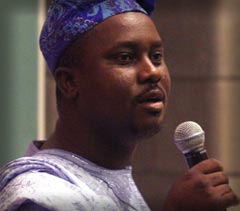
The second coming…

Ikhide R. Ikheloa's avatarPa Ikhide

[First published in Fogged Clarity literary magazine (2009)]

We sit around this fireplace
in the sky that never goes out.
We are staring at each other
and these words
are like the firewood that stokes the fire-of-many-faces.

We sit around this fireplace but we are cold.
Here take my firewood it burns bright
it burns long it burns hard.
Take my firewood and we will be warm.

In my dream I fled America, the land of large people that know no hunger, sad people that will never know the joy of feeding a pain because they are never hungry. In my dream, I landed in Nigeria on my father’s favorite palm tree drinking palm wine and eating the meal-that-satisfies-the-belly that I had stolen from my mother’s earthen pots. In my dream, my mother’s voice, strong voice of steel, rose up, sonorous in sorrow, beautiful in sadness, rose up to rebuke…

View original post 1,960 more words

[Guest Blog Post – Kenn Harrow] Bitter Freedoms: The Meeting of Africans and African Americans across the Great Divide

This paper was presented as a keynote address at the third TOYIN FALOLA ANNUAL INTERNATIONAL CONFERENCE ON AFRICA AND THE AFRICAN DIASPORA (TOFAC), Theme: Ethnicity, Race, and Place in Africa and the African Diaspora at Lead City University, Ibadan, July 2, 2013. Kenneth W. Harrow, distinguished professor of English at Michigan State University may be reached at harrow@msu.edu.

Why is it that the relations between African-Americans and Africans are often fraught? The expectations each has of the other might be too great. African Americans coming home to Africa might be expecting a homecoming, and find instead that they are strangers in a strange land; might find themselves subject to scams from those they thought would be their distant cousins; might find their own emotional expectations manipulated in such places as slave forts like Goree Island or Cape Coast, while they are being sold goods that are tailored to meet their presumed expectations. Maybe they are offered a title, an honorary place in a community, and then will be expected to make their contribution. Maybe they will be met with greetings like sister or brother, when nothing really, truthfully is there but smiles like those from sellers in the market offering them meretricious goods. And when they will have learned that the smiles and greetings were merely gloss, they will feel deceived, if not betrayed, while the seller will move on to his or her next victim….

This was the feeling of Saidya Hartman when she set out to Africa to find her roots. She recorded her experience in Lose Your Mother, brilliantly articulating the expectation of an African American who had known subaltern status in America. She had grown up in a society in which the marks of history were etched with the violence of racism and white supremacy, easily ignored or forgotten if you were white and comfortable, but not so easily lost in a society that still imprisoned vast numbers of young black men. Hartman traveled back to Africa in search of Mother Africa who had been lost to her in the mists of the Middle Passage, and in Ghana the search took her to the slave forts: “Standing in the dark recesses of the holding cell for female slaves, I felt both the pull and the impossibility of regaining the country lost. It has never been more clear than it was then: return is what you hold on to after you have been taken from your country, or when you realize that there is no future in the New World, or that death is the only future. Return is the hunger for all the things you once enjoyed or the yearning for all the things you never enjoyed. It bears the impress of everything that has been taken from you. It is the last resort of the defeated. It is the diversion of suicides and dreamers. It is the elsewhere of insurrectionists. It is the yearning of those who can ‘summon filial love for persons and places they have never known’…. The promise of return is all that remains in the wake of slavery” (99). But who would want to welcome back the defeated, the suicides, the dreamers, much less the insurrectionists, unless the hosts too had known defeat like the slaves, and led the insurrections. And the insurrection against what? The defeat by whom? What would independence mean in such a recognition of the returnee as one of us?

And what would be the expectations of Africans when encountering their African American brothers and sisters from the other side of the great divide?[i] For Soyinka, in The Interpreters, Joe was a troubled, light skinned, gay black artist, and in Soyinka’s lexicon in 1974, he didn’t belong to the world of the Interpreters, which marked his place as an outsider racially, sexually, and culturally for the intellectuals at Ibadan and Lagos. The young generation of Africans in the novel, secure in their ethnic identities, were sure of who they were, like Soyinka himself who can claim which god in the Yoruba pantheon he belongs to. They would view such figures as Joe, who sought his original roots in the red soil of Africa, as lost, while at the same time, as arrogant in his sense of privilege. Why did Soyinka turn to this figure of the defensive black American to represent the returnee from diaspora?

The key unstated question for the returnees must be, where do you come from? If the answer is not New York, or Harlem, or New Orleans, or Charleston, it is because it leaves unspoken what came before that, what came originally. Where did your ancestors come from? And then, unstated, but remembered, why did your ancestors have to leave? And finally, who was to blame for that? Famously, when Gates came to Africa, didn’t he, the most eminent of African American scholars and intellectuals, ask, why did you sell us?

In a column in the NY Times, April 22, 2010, Gates wrote, “While we are all familiar with the role [in the slave trade] played by the United States and the European colonial powers like Britain, France, Holland, Portugal and Spain, there is very little discussion of the role Africans themselves played. And that role, it turns out, was a considerable one, especially for the slave-trading kingdoms of western and central Africa.” He continues, “For centuries, Europeans in Africa kept close to their military and trading posts on the coast. …How did slaves make it to these coastal forts? 90 percent of those shipped to the New World were enslaved by Africans and then sold to European traders. The sad truth is that without complex business partnerships between African elites and European traders and commercial agents, the slave trade to the New World would have been impossible, at least on the scale it occurred.” For Frederick Douglas, America’s most famous black slave voice, the Africans who sold them off were savages: “The savage chiefs of the western coasts of Africa… for ages have been accustomed to selling their captives into bondage and pocketing the ready cash for them” (Cited in Gates’s article).

Gates could not let the bitterness he felt over this accusation of African complicity lie stagnant when he came to Africa to make his famous television series on Africa, “Wonders of the African World.” Instead, he asked in so many words, Why did you do it to us? And in his editorial in the NYTimes, he laid bare the grounds for the accusation: “For many African-Americans, these facts can be difficult to accept.” Despite such excuses as, “Africans were driven to this only by the unprecedented profits offered by greedy European countries,” he stated, “the sad truth is that the conquest and capture of Africans and their sale to Europeans was one of the main sources of foreign exchange for several African kingdoms for a very long time.” Then he asks, rhetorically, “Did these Africans know how harsh slavery was in the New World? Actually, many elite Africans visited Europe in that era, and they did so on slave ships following the prevailing winds through the New World. …African monarchs also sent their children along these same slave routes to be educated in Europe. And there were thousands of former slaves who returned to settle Liberia and Sierra Leone. The Middle Passage, in other words, was sometimes a two-way street. Under these circumstances, it is difficult to claim that Africans were ignorant or innocent.”

The key word here is “innocent.” The charge, you sold my ancestors, sticks in the craw. Gates forbore from accusing the white merchant class and their role in the dominant economic system for the fundamental workings of the slave trade, and instead focused on the African side of the trade. In his approach to his African interlocutors in “Wonders of the African World,” he appeared to many as condescending or paternalistic in assuming a position of accuser or ironic commentator—lacking respect for his African interlocutors or elders.

This attitude is what Ali Mazrui reproached Gates for when he asked, “Are we witnessing the birth of a new Black paradigm which combines cultural condescension with paternalistic possessiveness and ulterior selectivity?” And among Gates’s sins of selectivity, Mazrui focused on Gates not only knocking out virtually the whole of North Africa, but also Nigeria, “Africa’s most populous country. Nigeria as the center of the three of the largest and most historically dynamic cultures in Africa the Yoruba, the Hausa and Igbo [who] never qualified as one of the ‘Wonders of the African World,’ in spite of Skip Gates’ close relationship with Wole Soyinka, Black Africa’s only Nobel Laureate for Literature. Gates’ selectivity also got the white man off the hook for the Atlantic slave trade!”

Mazrui continues his critique of Gates by focusing on the slave trade as the central issue. Gates presented to his audience what every beginning historian knows about the slave trade, that Africans were captured in the interior by African armies, carted down to the coast, and sold to Europeans who took them across the ocean. In focusing on the African role—as if it were a surprising feature to be revealed—he created the impression that the primary responsibility for the trade lay with Africans. Here is Mazrui’s biting account of this aspect of Gates’s series:

“Now Skip Gates’ television series virtually tells the world that the West has no case to answer. Africans sold each other. Presumably if there are to be any reparations in the trans-Atlantic slave-trade, it would have to be from Africans to Africans. Skip Gates succeeded in getting an African to say that without the role of Africans in facilitating it, there would have been no trans-Atlantic slave trade at all.

To my astonishment when watching ‘Wonders of the African World,’ I heard a Ghanaian tourist guide at a slave fort (Elmina) tell African-American tourists that they were sold into slavery by Africans. Is this the policy of the Ghanaian government to tell tourists that it was not the white man but the Black man who was responsible for the Atlantic slave system? If not, why is not the guide sacked? He was saying to African Americans ‘We Ghanaians sold you!’”

Slavery is long since over. But the wealth it generated, the economic development of Europe and the United States was created by cotton and sugar thanks to free labor. The military and economic dominance of the west in the 19th and 20th centuries, the growth of mercantilist and then colonial capitalism, and now the global neoliberal order, all follow the historical trajectory launched with the slave trade. The diaspora of Africans and their transformation into African Americans was begun under the sign of the gun and the slaver.

Here on the African continent market forces created by European mercantilism and the slave trade led to the arming of Dahomey and the coastal powers. Old Oyo was faced with collapse when confronted with changing landscapes of power to the point that it couldn’t resist the incursions of Uthman Don Fodio from Ilorin. And when the fall of Old Oyo was completed in 1836, that resulted in the enslavement of millions of Yoruba speaking people who wound up in Brazil, the Caribbean, and eventually, South Carolina, Mississippi, New Orleans, and now New York. Doesn’t Eshu laugh in the New World, as Skip Gates told us in his first important book, The Signifying Monkey, where he showed how the trickster turned from his position on high as orisha in Yoruba religious belief into the monkey, the figure of the rebellious slave in the folktales of the American South?

When those slaves finally were freed in 1865 in the U.S., and began to make a life for themselves instead of for others, eventually an awareness was born that being black and a slave was not a permanent condition of inferiority, that “African” could be something more than an epithet to be ashamed of. By the 1920s blacks who had migrated up north to seek opportunities for a new life unchained from Southern poverty and bigotry created a new landscape of freedom in the heart of New York. The New Negro, as Alain Locke dubbed this figure, was fashioned into the symbol of modernity just as the New African was born in the 1930s and 1940s in Senegal and Nigeria and Southern Africa. The New African found himself wearing suits, dancing with the New African Woman to the rhythms of highlife in the urban clubs, joining the political movements, acquiring an education in the white man’s schools, and writing about himself or herself in French and English. In New York, the Harlem Renaissance was launched by authors who celebrated black identity as hip, cool like the jazz, and beautiful in ways that spoke to the full spectrum of gorgeous colors that adorned Harlem’s streets.

“Harlem Sweeties” by Langston Hughes

Have you dug the spill  

Of Sugar Hill?

Cast your gims

On this sepia thrill:  

Brown sugar lassie,  

Caramel treat,  

Honey-gold baby  

Sweet enough to eat.  

Peach-skinned girlie,  

Coffee and cream,  

Chocolate darling  

Out of a dream.  

Walnut tinted

Or cocoa brown,  

Pomegranate-lipped  

Pride of the town.   

Rich cream-colored  

To plum-tinted black,  

Feminine sweetness  

In Harlem’s no lack.  

Soon after the Harlem Renaissance was born in the 1920s, it was followed by the French African poetry movement of Negritude. There Afro-Caribbean and African authors met in the common struggles against racism and colonialism. Like Hughes’s “fine Sugar Hill,” Senghor’s life-giving praise for the black woman eulogized her with the words “femme nue, femme noire”– Naked Woman, Black Woman, whose color is life itself. Despite Soyinka’s mocking dismissal, French speaking Africans and their brothers across the water forged a great movement grounded in the assertion of racial value and pride.

Writing in exile from Paris in the 1940s, David Diop evoked an Africa that he wanted to know and acclaim as his own:

  “Africa of whom my grandmother sings
On the banks of the distant river
I have never known you
But your blood flows in my veins
.”

He envisions that Africa to be like a bent tree that will straighten up, “whose fruit bit by bit acquires/ The bitter taste of liberty”:

Africa, tell me Africa
Is this you, this back that is bent
This back that breaks
Under the weight of humiliation
This back trembling with red scars
And saying yes to the whip under the midday sun
But a grave voice answers me
Impetuous child that tree, young and strong
That tree over there
Splendidly alone amidst white and faded flowers
That is your Africa springing up anew
Springing up patiently, obstinately
Whose fruit bit by bit acquires
The bitter taste of liberty.

At the end of Death and the King’s Horseman, when Olunde has committed suicide, what was the taste of his death but that of the bitterness of liberty, a bitterness Africa has known over and over with its struggles since independence. What did Africa’s liberty mean to its former colonial masters, but bitterness for them too. What does Africa’s independence mean in an age of neocolonialism, or now, with postcolonialism and globalization.

And in the U.S., what did the liberty of the black slaves mean for them and their former masters?  What could they do when whites began to lynch black men to keep them from daring to become free citizens? What did liberty mean in the Caribbean Islands, especially after abolition when the landowners began to import thousands of indentured Asians to take the place of the black workers in the sugar cane plantations, and the newly freed black slaves struggled to survive in the cities? Many had to return to the plantations to live under conditions like those of slavery.

Freedom was never a simple affair with sweetness alone as its taste. The Caribbean saying has it, What Sweet in the goat mouth sour in his behind. When the son of Africa, Equiano, was carted across the seas, eventually he succeeded in overcoming the odds of enslavement, and rose to become a trader in black flesh himself, before ultimately joining forces with the abolitionists. He ended his years in England, denied by the British authorities the right to lead a ship back to his Africa. Although he succeeded in living at a great distance from the American South where a free man couldn’t walk the streets without risking his life, was there not a taste of bitterness in his mouth when he died? Freedom never came easy.

In the in the 1950s and 1960s when Africans were fighting to end colonialism, black Americans struggled for their civil rights while needing to come to terms with an African heritage. In Lorraine Hansberry’s Raison in the Sun, we have the New Negro heroine Beneatha, a college educated young woman whose brother Walter is a chauffeur for a rich white man. They live in the Chicago ghetto, with their mother and family, all crowded in one small apartment. How did Hansberry imagine and represent Africans in 1960, in her famous play, Beneatha, inspired by Asagai (her new African friend from the university) puts Olatunji’s drumming on her record player, proclaiming “enough of this assimilationist junk,” and begins to demonstrate how to dance “African style” to her sister-in-law Ruth.

Walter returns home drunk from the bar, where he has been listening to jazzy music. Inspired by Beneatha, he begins to dance as a warrior, and the two proclaim the glories of their African brothers and sisters. When the assimilated George shows up to take Beneatha out on a date, he is shocked at the scene, and when Walter extends his hand to George with the words “my black brother,” George turns away stating, “black brother, hell.”

The raisins in the sun were the dreams of the black migrants to the north, to cities like Chicago, who were looking for a new life. Walter has lost his way, while his sister, wants to go to medical school and to use the money from a life insurance policy from their dead father. Walter wants the money to invest in a scheme to open a bar, and when he is tricked out of the money, Beneatha’s future seems destroyed. The title of the film comes from Langston Hughes’s poem:

What happens to a dream deferred?

Does it dry up
like a raisin in the sun?
Or fester like a sore–
And then run?
Does it stink like rotten meat?
Or crust and sugar over–
like a syrupy sweet?

Maybe it just sags
like a heavy load.

Or does it explode?

At the same time that Raisin in the Sun came out Langston Hughes penned these verses about Africa in his poem “African Lady,” celebrating Africa as it was becoming free, and as  Martin Luther King spoke to America of his dream of blacks becoming “Free at last.” Hughes wrote,

Sunrise at dawn

Night is gone—

I hear your song

African lady

The dark fades away.

Now it’s day

A new morning breaks.

The birds in the sky all sing.

For Africa awakes

Bright light floods the land

And tomorrow’s in your hands

African Lady.

The film clip and verses convey the dream of what Africa represented to America’s poor black children, a dream that Hughes’s poem suggests might fester like a sore and rot, or explode, unless it led to real freedom. The African Lady is the hope for tomorrow. In 1961 Hughes was calling out, “Africa awakes,” but in Hansberry’s play, the awakening family faces harsh racist pressures from the whites when the family tries to move out of the ghetto into the suburbs and start a new life.

This description simplifies the complex dynamic of power and disappointment that marks the characters’ lives. When Walter stretches out his hand to his “black brother” at the end of the clip, the film highlights the dark irony in his gesture. Walter has returned drunk from the bar; the African dance is an illusion, punctured by the ironic response he receives from the middle-class assimilated George who has come to take Beneatha out on a date and who will have no part in this Afrocentric fantasy. George responds, “Black Brother, Hell.” The more “Africa” is portrayed as a series of make-believe gestures and drum music crafted by Olatunji, the more it seems a Hollywood movie dream created to amuse the American masses. The two poetic sides to Hughes’s dream, the dried up raisin or the African Lady of tomorrow, echo our oxymoronic title captured from Diop’s figure of Africa as embodying bitter freedom. If it was freedom, it was because it was won by a struggle. If it was bitter, it was because the question remained, was it for this that we struggled? Did we fool ourselves when we thought we had won?

And more important, was there ever any victory for Africa that did not require a victory for the whites as well—that is, could Africa ever be free as long as whites were still enslaved to the notion of their superiority. For Sembène Ousmane and other radical thinkers of the 1960s and 1970s, the answer was clear, as the opening scene in his film Xala demonstrates: no sooner was independence won than the fix was in, and neocolonialism, not postcolonialism began. The leadership was compromised, bought off, or broken if it resisted. No war in Africa was fought without European arms and often soldiers; and if they weren’t European, they were often Africans, like the Senegalese or Chadians, in the service of French or American interests. Weren’t there French and British and Russian arms in the Biafran war? There was no freedom without them; there was no joy that could be unabated as long as the economic system continued on a global scale to impose a new order of domination. The sweet taste in the goat’s mouth only fooled it into swallowing what would turn bitter at the other end. But more than that, we have to look for the sweetness of liberation not only from the success in winning independence, but in winning the Europeans, the whites, the former dominating classes, to a new regime that would eliminate the chains that defined the relations of the past. And it might be the case that the only way to complete that liberation is by acknowledging that the black on black relations, those of the African to Africans from the Diaspora, are not simply a supplement to the main stage relationship of colonized to colonizer, or blacks to whites in Europe, Africa or the United States, but lie at the heart of all those relationships.

How can freedom be won as long as there remain misapprehensions and resentments on both sides. Africans who see black Americans as violent, drug dealing, uneducated, and dangerous thugs. African Americans who know Africa only through the stereotyped Hollywood films. Africans who cultivated a highly educated class of migrants, thinking to encounter ghetto types in black America, whose culture had gangsta rap stars with violent lyrics and names that implied danger and crime. There would seem to be no hope of brother finding lost brother, sister finding sister, in this set of misrepresentations. With each disappointment, it seemed that historical differences would be too great to overcome.

Yet the long history of a shared struggle, repeated across the years in the efforts of such figures as Azikiwe, Nkrumah, Awolowo, Armah, Fela, and later Achebe, Soyinka, Adichie, has in fact marked a common exigency, as the struggles were often experienced in conjunction with an overseas education, a sojourn, or even a new homeland in the United States. In their education here, they might have encountered the work of Skip Gates, Houston Baker, Kwame Anthony Appiah, Cornel West, Toni Morrison, Audrey Lorde, and Amira Baraka who created a new field we call Africana studies, or Black Studies, or African and African American Studies. Black intellectuals shared an education and literature, even as the newly arrived African avoided seeking his black brother or sister. While the racial solidarity that once marked African American efforts to support the regimes of Lumumba or Nkrumah never seemed further away than now, the bitterness can’t quite expunge the memories of freedom.

There are certain moments in the representation of the meeting of Africans and African Americans, that will tell us with real precision what was meant by Diop’s phrase, the bitter taste of freedom. We can imagine what it means to stand here and there, in Africa and in America, when viewing the world, so that it might appear to be a mask dancing. When my African American students begin to study African literature, they are shocked, even in this day and age, to find that Africa is not the same as what they’ve seen in the movies or popular television shows; not the scene of barbarism and savagery, but of beauty and refinement and intelligence. Achebe’s original purpose in writing still obtains: “I would be quite satisfied if my novels (especially the ones set in the past) did no more than teach my readers that their past–with all its imperfections–was not one long night of savagery from which the first Europeans acting on God’s behalf delivered them” (Morning Yet on Creation Day, 45). But whose past are we to speak of, and how can we bridge the past of those who sold the slaves and those whose ancestors were sold, not to count those who were the buyers and shippers of slaves.

We all know that it is possible to bridge the uncertain gulf that divides us and them.  When Eshu dances, sometimes he creates a bridge:

“We are singing for the sake of Eshu

He used his penis to make a bridge”

As the story goes, Eshu overestimated the strength of his penis, his powers to bridge the gulf, and when the travelers tried to cross over, the penis broke:

“Penis broke in two

Travelers fell into the river.” (Pelton 131)

Apart for centuries, but now crossing the divide on the uncertain bridge of a god’s sexual instrument, how can the dancing mask be seen and recognized as coming from home?

To focus on the key question about why relations between African Americans and Africans have been so thorny, we can say each has sought in the other something that cannot be found, and yet that they need. We can see this quest, this link, this shared and shredded history, as a family affair. For some that family requires us to see in Africa the parent and the African American the child, and with Sonya Hartman’s Lose Your Mother, we can see how that quest for her was that of the child who couldn’t find her African mother.

Yet there is something else that we can capture in this rough meeting of the two worlds, the descendants of the slaves, and the descendants of those who stayed behind in Africa. It is something that almost no one can speak of these days without losing track of the threads of modernity that have marked these stories of diaspora and recognition. One missing link, one missing heartbeat of a moment that calls out to be captured, and held in one’s hand. Another might call this moment the DNA tie that answers the one question Diaspora always poses and never answers, “where are you from?” But the answer has been sought in the wrong place, and DNA gene science will never be able to provide it. Geography will not supply the answer either.

My friend the filmmaker Jean-Pierre Bekolo has been telling me that he is more and more preoccupied with his ancestors. Bekolo, of all people, the most hip of current filmmakers, the one whose Quartier Mozart rewrote the story of African cinema, giving us MTV moments, quartier cool dudes and supermodern chicks. What Bekolo wants is to know what it is to be in touch with his ancestors. When an ancestor is shared, if a brother or sister is lost, the ancestor must go looking for the lost one; the brother and sister keep calling out, and someone is hearing those calls. Eventually, the children of those who were lost have to write about it: angrily—why did you lose me; poignantly—where are you; desperately– help me. And then, maybe, not where are you, but where can I find the echo of you?

Lest I make this connection too singular or idealistic, I should add as a coda that this theme of searching that marked the encounter is not unique to Africans and African Americans. It is true of everyone, to some degree, to the extent that we are willing to reach outside the comfort zone of our familiar spaces. The great catastrophes of our times have taught us what feelings mark this searching, what Germans call sehnsucht, and Brazilians saudage, in English yearning, with black Americans giving voice to the yearning with an accent like a blue note. Yearning for something that doesn’t have a name, something missing, something marked by the holocaust and the slave trade, yet beyond them. If its elusive shadows haunt some, we have to recognize that there are moments when the shadow is touched, is given words, given a voice, like a drummer’s call that can be heard only when the dancer succeeds in crossing the penis-bridge by standing in more than one place, standing in more than one side of the ocean even, because, we are told, The world is like a Mask dancing. If you want to see it well, you do not stand in one place.

On both sides of the black Atlantic, Africans and African Americans have had to mark their status in terms of their relation to those in positions of privilege, positions more complicated than what is simply involved in definitions of race as black and white. Gender, class, caste, education, talent all are constituted in ways that make our simplistic understandings of racial identity misleading. If blackness had once signified an inferior status, an Africanness to be shunned, now in many circles, like music, sports, or film, it conveys authenticity and talent—an Africanness to be embraced.

When African meets African American, what is the privilege of being the “authentic” African, with his claims to the real original identity, as opposed to the false copy? New styles appeared in the mid-20th century as African Americans set out to reclaim an African identity and took to wearing dashikis and adopted African names. These claims of the authentic might be seen as form of freedom imagined as not entailing any bitterness, freedom without any price to be paid.

When Gates was returning to Africa, he enjoyed the privileges of difference. He knew he was privileged as a famous professor at Harvard as well as by being the producer of the television series, posing all the questions, deciding what would be shown on film, whose voices would be heard. His freedom was marked in his mastery of the word. To see this freedom as bitter is to understand it not simply in terms of a black American in quest of his authentic African forebears or relatives, but in terms of his own circumscribed freedom in the United States in relation to a dominant white social structure and history, one deeply marked in institutions of privilege enjoyed by white elites like those at Harvard ever since its creation. When he lost the key to his house in Cambridge, returning late one night, his neighbors saw him only as a black man prowling around the house . They called the police who arrested him. When he indignantly explained it was his own house, they arrested him anyway. That caused a national scandal, and Obama had to be called upon to settle the affair.

Had Gates come to Ibadan sixty-five years ago, what might he have encountered?  Students of the University College of Ibadan included Achebe, Okigbo, Soyinka, J.P.Clark, Saro-Wiwa, Osundare, Amadi, and Irele, a roll call of the great names in Nigerian letters. And yet there, too, the shadow of freedom’s tree was cast by the University of London whose external examiners oversaw the exams. European letters remained in a defining curricular position, as did the very language of privilege, the national language inherited from the colonial masters. No amount of mastery of that tongue and all its great authors, going back to Shakespeare could separate the freedom of creative expression from the bitterness of the old bent tree that David Diop identified with the African ancestor.

Every self is born in a conflictual and subservient relationship to its other; none of us starts on the path to subjectivity without knowing that the large shadow in which we stand expresses the power of those over us, whose position it will be our privilege to occupy only if we accede to its dominion. We struggle against it, while also accepting its superior position.

This is not only a metaphor for Africa’s relationship to Europe. It is also Europe’s relationship to itself, Africa’s relationship to itself, and in these configurations entailing self and other, they form imbrications over time in which the powerful seek to dismiss any fearful dissymmetry suggested by the notion that the underling might also come to occupy the position of the master. The master as a shadow might dissolve if he were to imagine such a reversal of circumstances; the slave as master might never imagine that he had once been born between the thighs of a slave mother. The freedom enjoyed by the self-blinded autocratic ruler who forgot where he had come from is exhilarating as long as it can ignore its taste of bitterness. Purposefully forgetting his beginnings, as if a beginning could ever be known, as if it were possible to repress it, refuse it. And yet the greater the refusal to acknowledge the other, the greater the taste of bitterness to be washed away, until all the opponents of the autocrats would have to be sacrificed and cast away, as Abacha tried to do with Ken Saro-Wiwa. The self can become itself only by passing through the shadow of the other.

Did Gates ever come to that point when asking who sold off his ancestors to the white man, as if he were not sitting in that same seat as the white masters? And when he imagined that learning at the feet of Soyinka about Eshu would give him access to that lost ancestor, did he know about the complicated business of crossing over the great divide, the middle passage, on the uncertain bridge of a trickster’s penis, one with a reputation of breaking for travelers who thought they were already safe on the other side?

This paper is in search of the bitter truth that is suppressed at each fantastic moment when African meets African American, beginning with Hansberry’s Raisin in the Sun, Langston Hughes’s poetry and the Harlem Renaissance, with these encounters now to be found in works of Chimamanda Adichie, Helen Oyeyemi, Sefi Atta and others of their generation. It entails bitterness because every moment in which freedom is achieved, it is achieved in relation to its other, and in relation to a lack marking the traces of a separation usually simply called the Middle Passage.

Hughes’s dream, the raisin in the sun, evokes the need for an authenticating fantasy of Africa, arising from the need to live in a society without the white other, the white ruling class. In such a dream, Africa would then appear as a place from which an Olunde, superior to the white district officer Pilkings, could appear, secure in his ability to fill in that lack. But he can resist the sweet taste of the fantasy because, unlike his father the Elesin, he has learned to bridge his own divisions abroad and back home, and knows what it is to make a new passage over the member of a trickster god.

In the dream of the future, for a bitter freedom to be won, it is necessary to negotiate one’s way across a new middle passage, one now grafted onto the old stories of Eshu and his magic member. If his penis could never be counted on not to break, still it could be stretched across the ocean as if it were merely a child’s game to do so. After all, what can’t Eshu do to create division and to heal the division, say that between two brothers:

Two brothers, one lighter, one darker, work on adjacent fields. One day Eshu walks on the dividing line between their fields, wearing a cap that is black on one side and red on the other. He saunters between the fields, exchanging pleasantries with both men. Afterwards, the two brothers got to talking about the man with the cap, and fall to violent quarreling about the color of the man’s hat, calling each other blind and crazy. The neighbors gather about, and then Eshu arrives and stops the fight. The brothers explain their disagreement, and Eshu shows them the two-sided hat.

I end with the question, who are the two brothers, and what do they do after Eshu has shown them his hat?


[i] Cf. Tracey E. Hucks, Yoruba Traditions and African American Religious Nationalism (Albequerque, NM: U New Mexico Press, 2012).  “Contemporary Africa and its migrants to the diaspora hold the voices that often delegitimize ‘Africans’ of the Atlantic world. This delegitimization is authoritarively ventriloquized in voices like the Ghanaian taxi driver in New York City who admonished that I should not self-reference as African American because I am not an African or the Nigerian man at the Mobil station in Harlem who, n the midst of a dispute with one of my  former students, sought to publically humiliate her by shouting, ‘You Slave! You Slave! You don’t even know where you’re from? You Slave!” (15).

Works Cited

Achebe, Chinua. Morning yet on Creation Day: Essays. London: Heinemann Educational, 1975. Print.

Gates, Jr., Henry Louis Gates. “Ending the Slavery Blame-Game.” New York Times. April 22, 2010

Diop, David. “Afrique, Mon Afrique.” http://www.col-grunewald-guebwiller.ac-strasbourg.fr/spip.php?article1017

Hansberry, Lorraine. A Raisin in the Sun. New York: Modern Library, 1995. Print.

–Susskind, David, Philip Rose, Sidney Poitier, Claudia McNeil, Ruby Dee, Diana Sands, et al. 1999. A Raisin in the Sun. Culver City, Calif: Columbia Tristar Home Video.

Hartman, Saidiya V. Lose Your Mother: A Journey Along the Atlantic Slave Route. New York: Farrar, Straus and Giroux, 2007. Print.

Hucks, Tracey E.  Yoruba Traditions and African American Religious Nationalism. Albequerque, NM: U New Mexico Press, 2012.

Hughes, Langston. “Harlem Sweeties.” http://www.poetryfoundation.org/poem/177389

–“A Dream Deferred.” http://www.cswnet.com/~menamc/langston.htm

–“Sunrise at Dawn.” http://www.thefreelibrary.com/Blues+in+Stereo%3A+The+Texts+of+Langston+Hughes+in+Jazz+Music.-a0208881648

Mazrui, Ali. November 11, 1999  BLACK ORIENTALISM? Further Reflections on “Wonders of the African World” by Henry Louis Gates Jr.” http://web.ccsu.edu/afstudy/updtWin2k.htm#Ali

Pelton, Robert D. The Trickster in West Africa: A Study of Mythic Irony and Sacred Delight. Berkeley: University of California Press, 1980. Print.

Soyinka, Wole. The Interpreters. London: Heinemann, 1970. Print.

Life in America: Cowfoot nor be corned beef…

For zazugist…

America Police nor go kill me O! Every week for America, we dey do environmental, that is, for night you go put your dustbin outside, for morning, environmental people go come carry am with their agbegilodo lorry. The dog and the deer wen dey our compound dem plus the vulture dem nor like me at all at all. Dem be racist because dem nor like say Black man like me dey gbaladun for oyinbo neighborhood. I don call police for dem tire, still yet dem nor dey hear word.

Di ting pass me. If I just put my dotty for outside like this those witch dem wen be animals go throway di dotty make everybody see dey laff me. I go wake up for morning, come see vulture and dog and deer they laff my dotty for road. See wahala o, all di cowfoot, abodi, roun’about, cowtail, chicken leg, chicken yansh plus eba and pounded yam and orisirisi rice don full ground. Whenever I put only oyinbo food like caviar, coleslaw, pasta and em corned beef for dotty dem nor dey troway my dotty for ground make people know say I dey enjoy. Mba O, na only when I nack our native village food (oporoko, white soup, isiewu, etc) naim dis witch dem dey fall my hand.

So, last week for environmental (yes o, nor be only una dey do environmental for Naija, we dey do environmental too na) naim di yeye racist dogs and deer when dey our neighborhood come throway all our dotty for road for America. Our yeye oyinbo neighbor wen nor kuku like us before as she dey waka im dog now, naim e see our dotty plus all di bone dem. See wahala! Riiiing! Riing! Idiot racist don call Police with blackberry say e see with im krokro eye “what appear to be finely ground fragments of human bones and remains!” Chei! See me see trouble o, malu wen go America don become James Brown! So naim police run come with their wahala, come see ambulance (I nor know wetin ambulance dey come do with malu bone, maybe na to take am go hospital *shaking my head*).

Even sef, police come with gun, whether dem wan shoot the malu bone I nor know. Some people come when dey call themselves HAZMAT (Hazardous Materials) team, with white coat, mask for face, gloves for hand, come dey touch everything for my doormot. Fire Brigade come too!

Meanwhile our neighbor don faint for our doormot after e don call lawyer (“Post Traumatic Stress Disorder on witnessing a possible murder scene!” Na money the idiot dey look for for my hand!). Dem tie one big rope all over our house wen dem write this nonsense: “STAY AWAY! YOUR TAX DOLLARS AT WORK!! POSSIBLE CRIME SCENE! SUSPECT MAY BE ILLEGAL ALIEN!!” Me I nor even know say all dis penkelemesi dey shele O, I dey inside baffroom dey baff dey sing Jim Reeves like olodo when never see hot and cold shower before!

Before you know am my iyawo and love of my life Mama_di_girl don run come meet me inside baffroom dey shout, “Ewooo! You kill person? Police dey look for you O! Abi you kill person when you dey drive and play with iyawo dem for Twitter and for Facebook? How many times I don tell you make you leave dem iyawo alone until you reach house? Agbaya! A whole old man like you! Shebi I tell you say dem take woman do you something, enh? You dis man, you nor go kill me! I hope say nor be oyinbo you kill o, otherwise na prison na im you go die put!! Olosi! If you go prison, who go take out the trash (dotty, for dose of una wen be ajepako!) If you go prison who go pay for this house? Shebi I tell you say mek you nor buy house, no, you must be like those wen better pass you! Papa_di_boy, if you die for inside prison, dem go still pay me your life insurance? Papa_di_boy!!! You nor go kill me for this America o! Why, Oh, Why did you go and kill an oyinbo person?”

Na so our iyawos dey do for America o, any kpem like dis dem don throw you under molue! Before I fit say Jack Robinson, Mama_di_Girl don grab me inside baffroom, naked, “Oya go and answer your papa name for Police, olosi murderer. Goddamn sheet mora focker!” Na by luck sef na im I take grab towel take cover my blokos before my madam deliver me to police thusly: “Officers, this is the alleged murderer that you are possibly looking for. Just to be clear, he is no relative of mine, he happens to be the father of my FOUR WONDERFUL AMERICAN CHILDREN who were born here you know. Please be sure to return my towel around his waist when you are done with him,  I would hate to lose it, I bought it on sale at Lord & Taylor’s, they don’t make towels like that anymore!”

As dem just dey measure my body to throw me inside their Black Maria na im I come dey shout like goat when see Christmas! “Officers! How family? Madam dem nko? They are goat bones! Goat bones! Malu! Malu! Oxtail! Oxtail!! Please don’t shoot!!!” Dem release me but them charge me for indecent exposure because the women police when come, when dem see my small chest when be like Papa Ajasco own and my small small muscle dem, and my flat yansh wen be like OBJ own, the idiots come dey laff so tay one of them come faint. Naim dem charge me for indecent exposure. Anyway dem don take the bone dem go lab for positive identification. Since dem born me, dis na di first time when I beg God make I fail exam! Come see me dey praise worship! “Spiritual powers die by fire! Die! Die! Die!” Until the result come, them say make I nor travel go anywhere. As if I wan travel before; where I dey go, who dash monkey banana, nor be money person dey take crase?

All this time when my iyawo and Police dey do me iso abi tire (“olosi, you wan nail for inside your fat head abi you wan make we necklace you with tire wen get petrol?”) the dog dem and the deer dem wen do me dis wayo just dey laff dey parambulate dey point at me dey fall dey laff dey parambulate dey point at me. Dem be witch I tell you. From now henceforth (oya laff my oyinbo now, hiss!) anytime when I eat goat meat and malu meat finish, I go grind the bone chop join, that is enh, I go hide the evidence like Baba Suwe. If I nor fit hide the evidence, I go wrap am with double Ghana Must Go bag, put am for the dustbin, then wait by the dustbin for the people wen dey carry trash to come carry am. Who wan die?

How una dey?

Guest Blog Post by Chielozona Eze: [Book Review] On Afam Akeh’s Letter Home & Biafran Nights

Book review: Afam Akeh, Letter Home & Biafran Nights. London: SPM Publications, 2012. Price: £9.95

Guest blogger Chielozona Eze is associate professor of English and postcolonial studies at Northeastern Illinois University, Chicago. He also runs a blog focused on African literture, African Literature News and Review.

Such long a letter

Afam Akeh is one of the better known names among his generation of Nigerian poets. He is not known for many volumes. In fact, his literary fame rests solely on his only collection of poems to date, Stolen Moments, published in 1988. Based on the mastery displayed in it though, the African poetry community eagerly anticipated his next volume. Letter Home & Biafran Nights is worth the long wait. Like the smell of mango freshly plucked from tree, the first stanza caresses your sense with its rich lyrical and philosophical sweep.

Where the largeness of the dream

is touched by the smallness

of one’s footsteps

there is travel guilt shed

like loose feathers

or discarded skin

This is easily one of the most remarkable beginning stanzas of the poems I’ve read in the recent past. Exposing a contrast between an individual and the universe that is symbolized by dream, the first stanza announces the overarching theme of the collection. One imagines the lone traveller’s paws against the infinite magnitude of the world that does not really care.  It is against this backdrop that this pilgrim, who might have seen himself as a prodigal son, suddenly sheds his guilt. The instinct for survival in a foreign environment takes over the rein of his life. This is, indeed, what most of the poems in this collection are about. A heart torn between loyalty to the land of his birth and the land he has taken refuge in, between personal survival and duty to the larger world.

The first poem, “Letter Home,” is divided into four sections that relate the narratives of four African exiles in the West. Their heartbreaking fates are linked to their home by the trail of the letter. Another of the poems, “Letter to Soyinka,” is a retort to what might have been perceived as Soyinka’s failure to understand why many children of Africa have fled the continent. It is biting in its direct, too direct, address to the Nobel laureate.

Is it the wine, weather

or women;

the gods that failed?

What potion

has your name on it?

How exit a love

that lays claim

on one’s life?

What talent

in your beard

is counsel for my fellows

this day of doubt?

But the anger of these lines is a mere expression of the speaker’s frustrations at not being in the land he loves and at being misunderstood by none other than Wole Soyinka, one of the best minds his country has produced. The speaker’s generation has been excreted from the land by the failures of the Nobel laureate’s generation.

The African immigrant experience in the West is not necessarily gloom. The speaker in “Dream Christmas” appears to delight in “seeing the world/white at Christmas, a dream of childhood.” Nor are the poems just about the fate of African immigrants. “The Living Poem: Manifesto for the Public poem,” is the poet’s ars poetica, the artist’s definition of what good poems should be about. Poetry is no longer a thing for the elite few; it is not an esoteric speak. Rather poetry should be “shaking hands with normal folk/not proud and poor like a listed building/leaning on public pity”

To me, Akeh comes to life most in “Biafran Nights.” In it, one feels the weight of history and of a people nearly decimated by genocide and the war that should have been avoided. In “Biafran Nights,” Akeh returns to the Nerudean lyricism that distinguished the “Letter Home.” It is a style of noble lyricism that seeks to marry heaven and earth in a single breath. In this poem, memory becomes a “master griot” that is “stubborn with tales.” And, as if to warn us that those who ignore their history are bound to repeat its mistakes, or perhaps that we cannot wish away our past, the ultimate griot reminds us of our “network of neglected moments.” It is all about a “land imperiled imploding like a myth.”

afamka2“Biafran Nights” is, thankfully, long and in three parts. I wish it were even longer. Each stanza is a cache of precious imagery, allusions, metaphors that leave no doubt that a master is at work. The whole poem is as soulful as the prayer of a truly humble believer in the infinity of the universe and the smallness of man; it is to be savored. See, for instance, how the second part begins: “Not a litany of events, history is human smells/and sounds, private motives in public spaces.” There could be no better wisdom than this, no better note of caution. Indeed, poetry, as the manifesto spells out, shakes hands with normal folk. Akeh is best as a philosophizing lyricist, who tends to make extensive, wisdom-packed statements. It is perhaps in respect to the depth and richness of the wisdom of these words that he chose to be as lucid as the biblical prophets.

Every once in a while one wished he had balanced the lyricism with more narrative and imagistic details. More descriptions. This is, however, merely a philosophical question that does not detract from the beauty of the collection. Letter Home & Biafran Nights is a literary success.

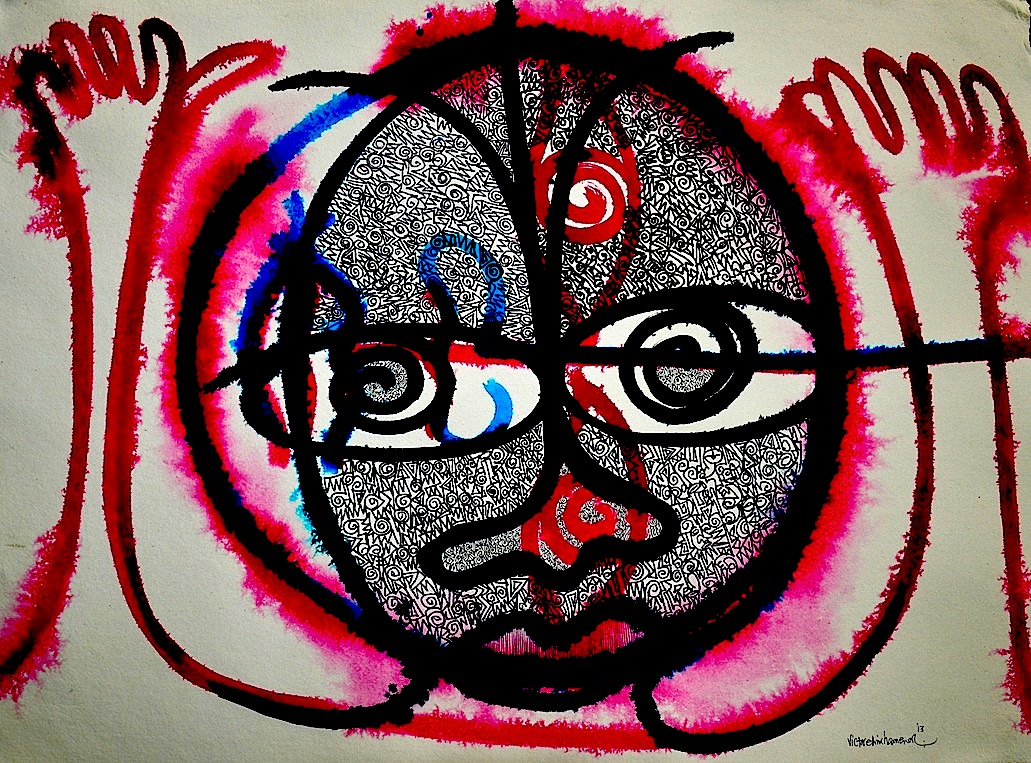
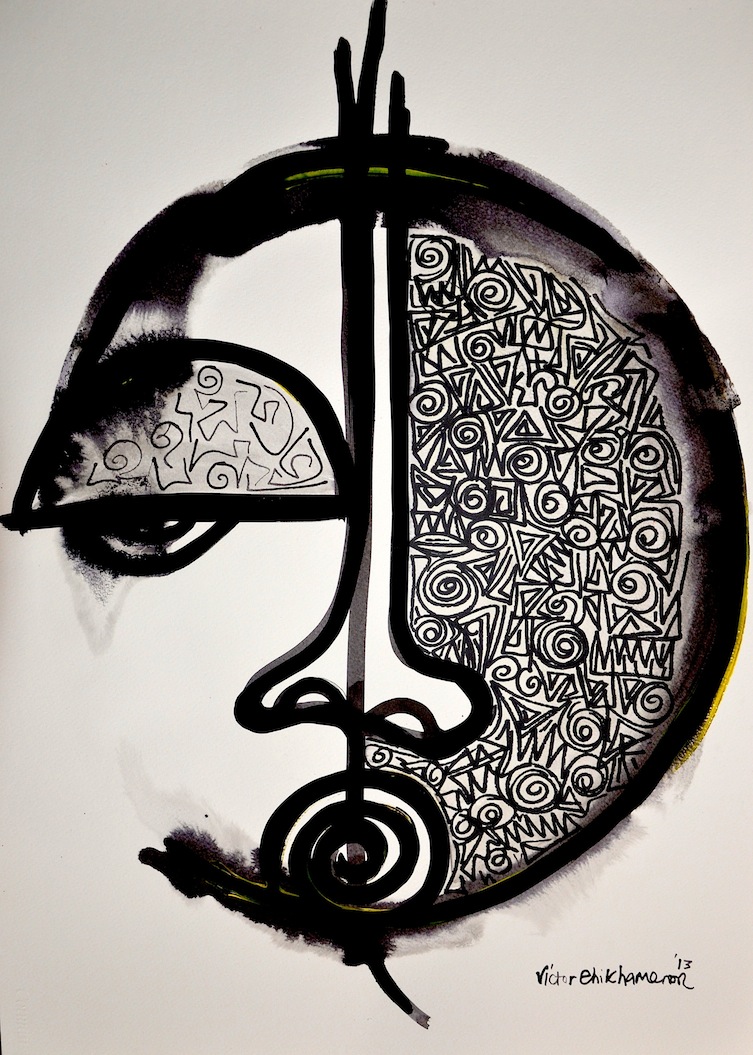
Presenting Victor Ehikhamenor’s luscious demons: Amusing the Muse – April 29 – May 31 2013

(Lagos, April 21, 2013) Temple Muse is proud to present Amusing the Muse, an art exhibition of recent drawings and paintings by Victor Ehikhamenor, one of Nigeria’s most progressive contemporary artists, who is also a celebrated writer and photographer.

Yesterday and Today Waiting For Tomorrow 23x31

Victor’s unique calligraphic style of black and white symbolic images presents  a fresh perspective on contemporary African art.  His style is influenced by the drawings he grew up with on the walls of sacred spaces in Udomi-Uwessan, Edo State, Nigeria. Over the years, we have seen his bold symbols encased in doors and window frames as in his Entrances and Exits series, or literally bouncing “off and through” vibrant, multi-layered, colorful paintings. His sculptures of repurposed mundane objects like old typewriters and generators are often thought provoking socio-political critiques, while his video art installations have seen art enthusiasts curiously intent on watching how he transforms blank spaces by completely covering them in a proliferation of symbols to become cocoons of fantastical imagery.

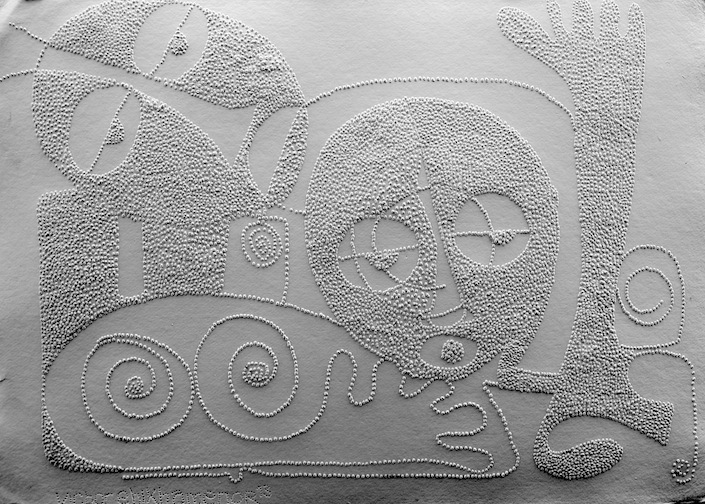
In Amusing the Muse, Victor presents an exciting new dimension to his art with his “Paintforation” technique that uses nail perforations on thick white handmade paper to create subtle relief work —  a new take on his popular face series. He explains that he has translated ancient rituals of body scarification evident in 16th and 17th century Nigerian bronze heads into his contemporary masks. But whether through his perforated “White Mask”, or his bold ink-color faces in which he uses symbols as highlights, almost like thoughts flitting across their minds, Victor’s art continues to tease and beckon.

”The face phenomenon dawned on me during the Occupy Nigeria protests, while I was photographing people,” explains Victor, who has a first degree in English Literature from Ambrose Ali University in Ekpoma, Nigeria, and two masters degrees in fine arts (creative writing) and technology management from the University of Maryland at College Park, USA. “I realized what really formed the mass of differences are the faces. People live and die by the look and shape of their faces. I believe faces define humanity. The face is the GUI (graphical user interface) of the brain.”

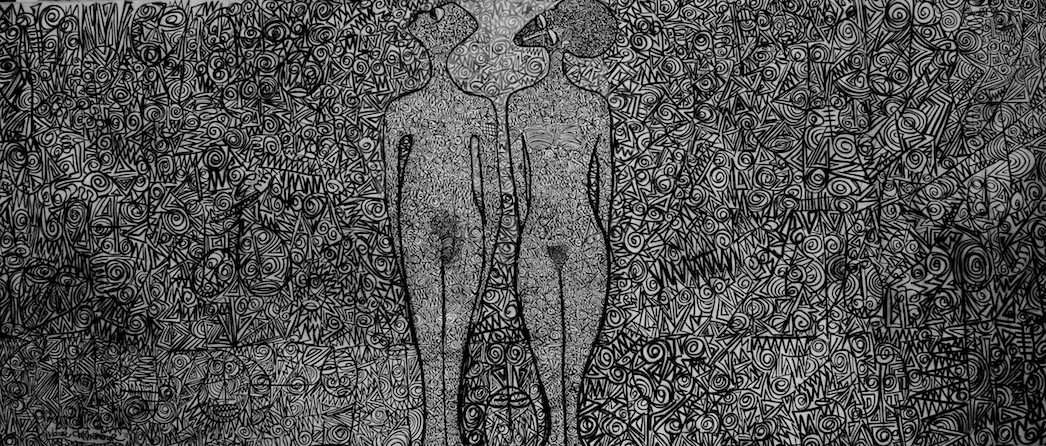
In three large canvas wall hangings spanning over 5 meters in length or width, Victor presents lone human forms completely engulfed in landscapes of symbols. “As a figurative-abstractionist I hate taming my style. I have started working on very large pieces, using charcoal on canvas. These works are stories and histories, myths and mythologies, tales and folktales, beliefs and disbeliefs, ” he explains standing in front of a work entitled Adam & Eve waiting for a flight out of Eden, an over 6 meter wide wall hanging,  which is his visual representation of  the entire book of Genesis told “in one fell swoop”.

Amusing the Muse is presented by Temple Muse, Nigeria’s foremost luxury design and lifestyle space, which may be one of Lagos’ best kept secrets. Temple Muse has been active in the highly competitive African design and fashion space since 2008.  It has established a quiet reputation of presenting cutting edge Nigerian fashion brands such as Tiffany Amber, LDA, Iconic Invanity and Ituen Basi, alongside global brands such as Emilio Pucci, Givenchy, and Matthew Williamson. Temple Muse has also taken part in internationally celebrated fashion fiestas such as Arise Fashion Week, Elite Model Look, as well as many other collaborations within Nigeria.

“In an effort to broaden our support of cutting edge Nigerian creativity, Temple Muse is starting specially curated art shows showcasing the hottest Nigerian visual artists in our pure white design space, ” explained the Creative Director of Temple Muse. “Victor Ehikahmenor’s exquisite and quirky drawings and paintings are the start of a dynamic synergy between contemporary art fusing with avant garde design and fashion.”

The show is curated by Sandra Mbanefo Obiago and is supported by Veuve Clicquot. It is open to the public from April 29th to May 31st, 2013.

Contrition with one eye open 30x22

Curatorial Statement: Sandra Mbanefo Obiago – Musing on Multiple Levels

Amusing the Muse, is a show of recent works by Victor Ehikhamenor, one of Nigeria’s most progressive contemporary artists. In describing Victor’s expressive energy, one must be willing to watch him perform on diverse creative platforms that reflect his unique perspective through paintings, photography, sculpture, mixed media works, graphic design, and writing.

I met Victor in 2008 when he returned to Nigeria from the United States to become the creative director of 234NEXT newspaper. What was immediately evident was that the pioneer NEXT team that brought us fresh investigative news and analysis were young Nigerians who were intent on breaking the cycle of conformism. Victor’s editorial and creative edge quickly attracted attention and had us watching him with keen interest as he impressed us with both his journalistic and artistic dexterity. His signature slogan Stand up, Stand out! encapsulates Victor’s aim to infuse his work with life changing dynamism.

Victor’s unique calligraphic style of black and white are symbolic images drawn deeply from his roots. His style is influenced by the drawings he grew up with on the walls of sacred spaces in Udomi-Uwessan, Edo State, Nigeria. Over the years, we have seen these bold symbols encased in doors and window frames as in his Entrances and Exits series, or created as black and white charcoal drawings, as well as literally bouncing “off and through” vibrant, multi-layered, colorful paintings and thought-provoking sculptures of repurposed mundane objects like old typewriters and generators. His video art installations have seen us curiously intent on watching how he transforms blank spaces by completely covering them in a proliferation of symbols to become cocoons of fantastical imagery.

In this exhibition, Victor shows us an exciting new dimension with his “Paintforation” technique that uses nail-like perforations on thick white handmade paper to create subtle relief work —  a new take on his popular face series. He explains that he has translated ancient rituals of body scarification evident in 16th and 17th century Nigerian bronze heads into his contemporary masks. But whether through his perforated “White Mask”, or his bold ink-color faces in which he uses symbols as highlights, almost like thoughts flitting across their minds, Victor’s art continues to tease and beckon.

I am particularly excited about how Victor’s recent works bring a new energy into the pure white design space of Temple Muse, Nigeria’s foremost lifestyle platform. His extra large charcoal on canvas drawings with human forms engulfed in a sea of symbols, are on the scale of pieces that were created for high vaulted international art galleries. These wall hangings bring an incredible energy and vibrancy to Temple Muse, known for its high end local and international luxury brands. What we have here is a synergy of contemporary art meeting bold and zesty design and fashion.

I hope you enjoy Amusing the Muse, Temple Muse’s first of many specially curated art exhibitions that will bring you some of Nigeria’s quirkiest new trends in cutting edge contemporary art.

Sandra Mbanefo Obiago

Curator

Lagos, April 2013

I dont know where to but let's go-30-1_2x22-1_2

Emmanuel Iduma: In Conversation with Victor Ehikhamenor

EI: To start with, was your process for this body of work, in terms of materials and concept, different from other projects you have worked on?
VE: Not drastically different but I always push myself to see how my materials will react to the concept I want to execute. I like surprising myself and my viewers. I also strive not to bore my collectors.

EI: Why did you choose “Amusing the Muse” as title for this show?
VE:  Often times the muse amuse me, it is my turn to amuse the muse too by deviating a bit from what she wants me to do. It sounds cheeky, but trust me it is the truth. However it a tribute to that muse, not necessarily in the visual rendition but in the titles of the works. Some of the titles are serious, but hilarious at the same time. It’s a fun show for me.

EI: In a number of the pieces, there is a splashy quality to the way colours are used. Is this deliberate? Was there something you were trying to achieve?
VE: [Laughs] I guess what you see as splashy is what others may see as the energy with which the works were executed. Those particular “splashy” paintings were done furiously as though someone set my brains on fire and I had stamp out the furnace furiously. As a figurative-abstractionist I hate taming my style. Sometimes I do not control colour runs, I let things take their own live paths. But there is sanity in the madness of it all.

EI: You have always tried to break conventions in your work. In this show for instance, there are a number of works where there is a conscious attempt to introduce new techniques in using paper. Was this an important aspect of this work and what are the challenges so far?
VE: I like experiment and tinkering with the norm. I believe what you are referring to are the ones I call “paintforation” (Painting by perforation). Every so often, I look at African “traditional” art, and see what my ancestors had done well and I usually borrow from that. As you may well know, my entire style as an artist is based on the ancestral shrine wall designs in my village. I consumed a lot of the stylistics as a kid and I have stretched that experience as an adult. Coming back to paintforation, when you look at some Benin or Ife masks, you would see tiny holes in the works, a form of perforation in rendering but on harder surfaces like wood, bronze or metal. Many old Oshogbo artists also perforated metal sheet to form art. I want to explore that tradition on handmade papers which I have just started to do here. The only small challenge I am facing so far is the lack of handmade papers in Nigeria art stores. So far I have to import or buy them whenever I travel out of the country.

EI: If you don’t mind, can you add a few more comments on “White Mask”?
VE: White Mask is the very first piece I did in the style of paintforation. It’s a tedious process; it requires punching a lot of holes to make any meaningful pattern. White Mask is commenting on the histo-sociological idea of masks only being associated with “blackness”. It is also interesting to know that I have come across some Africans or even African Americans who desperately want to be white by constantly wearing that invisible yet vicinal white mask. So we can say I am subtly visualizing Frantz Fanon’s idea in his book, “Black Skin, White Masks.”

EI: One of the works that stand out – perhaps because of its size – is “Adam and Eve Waiting for A Flight Out of Eden.” Did you find it easy, or difficult, maybe even exhilarating, while you worked on it, especially because it seems to be imbued with so much detail?

It’s also a new dimension in my work, size wise. You can say it is a “size” of things to come. I have started working on very large pieces, using charcoal on canvas. These works are stories and histories, myths and mythologies, tales and folktales, beliefs and disbeliefs. This particular one is based on the biblical story of Adam and Eve and all that surrounds them before they departed the Garden of Eden. The work is the entire book of Genesis told in one full swoop.

VE: “Faces” continue to dominate your work, whether as paintings or drawings. Is there any reason why you have been fascinated by visages?
EI: Let’s call it my “faces phase,” like Picasso’s blue phase. Face is the oldest and still the most used form for human recognition. In a crowded place, it’s mostly faces you would really see. This face phenomenon dawned on me during the Occupy Nigeria protests, I was photographing people but realized what really formed the mass of differences are the faces. People live and die by the look and shape of their faces during wars. He is Gikuyu, she kikuyu, he is Igbo, she is Hausa, he is from the Congo, she is Ghanaian; we can throw such statements and mostly be right by one look at our subject’s facial features. Your face is also the most important part of your identity in a travelling document such as international passport. I believe faces define humanity. You can read emotions such as joy, happiness, sadness, love, hate – only on a face. You hear phrases like “Hide your face in shame”, “Your face look familiar”. The face is the GUI of the brain, period. Yes, you will always find faces in my paintings and drawings.

EI: Can you speak a little about viewer responses to your work, especially since you started showing in Nigeria after a long absence?
VE: I never showed in Nigeria before I left. However, it has been encouraging is all I can tell you.

EI: What are your expectations for the reception of this work?
VE: I hope the viewers’ find something interesting and educating to take away, something transient yet transcendent beyond the colours and shapes of my paintings.

EI: Did you draw strength from the work of any other artist while working on this show?
VE: The works of our greatly talented ancestors always come in handy. But you have to realize there are so many artists who are doing great things within and outside the country, and I draw a lot of energy from them. A few of the most engaging Nigerian artists today are my close friend, our pulsating discussions outside the studio space fuel me when I am in my studio.

VE – Victor Ehikhamenor | EI – Emmanuel Iduma

 Emmanuel Iduma is the author of Farad, a novel (Parresia Publishers, 2012). He trained as a Lawyer, and works as a writer, critic and manager of creative projects in Lagos.

for more information please contact:   sandraobiago@yahoo.com, 08034021901

Adam and Eve Waiting For A Flight Out Of Eden 62x151

Ominira’s room

Memories of my past, harried dad chasing after you, little one, you with the two teeth, come rushing at me in the cold bluster of England’s faux indifference. How are you, princess? Miss me, do you?

I step into Ominira’s room. It is a mess. She won’t clean her room, this princess of ours. We have tried everything, nothing works. She stands there, dreaming, like me her father, dreaming into space, traveling a world alien to us. We are tired of screaming at her. She is tired of screaming at us. Nothing works. Ominira’s room. It is a pretty room. If only she would clean it. It is a pretty room made for little girls who have no care in the world. There are pink colors everywhere. I pick up her things from the floor .Lots of things.  She is standing there in the middle of her mess with eyes that ruin a father’s resolve. She stares at me, the beginning of defiance and tears welling up in her eyes. The dam of tears will break without fail once the scream-fest begins. I have no screams in me this morning. Wordlessly I begin to clean the room. Relieved, she flees the room, to go stare at the world through the computers that litter the house. She has won this battle. Again.

 I pick up her things, she has too much. And she has forgotten what she has. Because she has too much I retrieve a video game console from deep within Christmas wrappings shredded by feverish little hands. She wanted that hardware so badly. And she stayed at the foot of our bed, begging until we gave in. There are pretty little dresses with the names of alien designers on them. She will be back to them. She loves dresses. I hold one dress and remember the Christmas of my childhood in Nigeria. I don’t remember buying “ready-made” clothes. We went to the tailor. It was cheaper. And boy, were they creative, those tailors.

 Our little girl has too much. We must build shelves for her things. In one corner she has two bags of old clothing. They are not really old. She does not want them anymore. I take them out of the room to go join their relatives – more bags of clothes waiting for the trip to grateful relatives in Nigeria, or to indifferent charities in America who swear we are only doing it for the tax deduction, charity be damned.

There is a poster on the wall. It talks about girls being princesses and boys waiting on their princesses. I hope she keeps up that attitude. I will need the bride price for my old age. There is a poster on the floor. It is a wordless poster, full of dogs. She wanted a dog. We said no. Actually, mom said no. And now, we are miserable. Because she wants a dog. Everywhere we go we see dogs. And she sighs. She asks us questions about dogs. It is always about a dog. Can we get a dog? When are we getting a dog? Daddy, let’s go to the pet store, please! We are not getting a dog for this little girl. She has two gerbils, Lunar and Ginger. Ginger is dead, frozen one cold night, because you-know-who forgot to bring the cage up from  the cold basement.. Lunar survived by a shivering whisker. We had fish once. You don’t want to know what happened to the fish. But a dog!  In America, a dog has the status of a child. It is a permanent status for as long as the dog is alive. It is the law. We don’t need another child. This one, Ominira, is a handful.

 We did not get Ominira a dog. We got a dog poster instead. She did not like the dog poster and she left it on the floor with the rest of the rejected sacrificial offerings to a finicky princess. I snatch the poster from the floor and I go looking for our daughter. Where do you want this poster, princess? Her eyes light up like a puppy’s and she asks: Are we getting a dog, daddy? I avert my eyes and I ask her again: Where do you want this poster? She sighs and points to a general area near her bed. She doesn’t care for mute dogs that live in one-dimensional posters. I put the poster up. I step out of the room, lean out the door, look in and the room is clean and pretty again. I ask Ominira, What do you think? Silence. I turn around, she is gone. I can hear her at the foot of our bed, tormenting her mother, my lover, with the same question over and over again: Are we getting a dog today, mummy?

 I step out of the room, lean on the door. I look in and the room is clean and pretty again. She’ll be back to torment me with the awesome noise of her willful silence. Sigh.

Lost in America: Self portrait

Who am I? I am glad you asked. I am an area boy. That is the sum of my essence. I have been loitering around the earth doing what, I don’t know. I expect that when I get to the pearly gates, Orunmila will ask me: So… what did you go do over there? And I would reply: I have no idea! Shebi you were the one that sent me over there!

 So I have told you that I don’t know what I am doing here. I have found myself floating lazily on bits and pieces of the flotsam and jetsam of life, sometimes enjoying myself, sometimes, just being miserable, call it a bi-polar existence. I have three sets of admirers: Those who love me when I am rolling with the joy of the ride, those who love me when I am rolling with the rage of my condition and those who love me anyway. I don’t like formal education; I am happily anti-intellectual. My most miserable times have been spent being miserable under classroom arrest, quaking in my boots before someone with enough gumption to call me a student. The forced structure of a classroom experience, the suffocating dictatorship of the classroom’s hierarchy, the sage on the stage silliness instead of that guide by the side paradigm, man that stuff eats me up. But I lived through it all, I survived (I think) the tyranny of Catholic Boarding School (five hellish years) and the phoniness of a university education.

So I have all these certificates but so what? Na book man go chop? I can honestly say that they have been worthless to my sense of self-worth – they read like an after-thought, an irritating footnote to everything that I hold dear. I still read a lot but I don’t read a lot <grin>. I mean, if you read something and you don’t remember that you read it have you been reading? I think that the book as a medium of communication is dead. I exaggerate slightly. The book is on life support. Who read reads books anymore? Why bother? A monkey with a credit card can bag a PhD off the Internet in two weeks flat. Money talks. Just click on the one you want, it goes on your electronic shopping cart and voila, in two weeks when the post office delivers your certificate, you are now Obo the monkey, PhD!

Books just confuse the hell out of me. Take Ben Okri’s books for instance. I am yet to finish any one of his books. My ego will not let me denounce them as unreadable. I wish I had Chinweizu’s courage. Don’t get me wrong, I think that Ben Okri is a genius. In his books, poetry shows up in many places. Okri is a survivor of a war. Westerners roaming Okri’s world would definitely find a magical world, albeit one that is a grimly overrated reality for many children of Africa- mute witnesses to a looming tragedy.  Okri is one brainy warrior determined to tell a story to the world. But I don’t get Okri. I started out with The Famished Road. Dropped it. Picked up In Arcadia and left it somewhere in the bathroom, awed by its incoherence. Picked up The Famished Road again. And I have just stopped reading it again. The Famished Road is a ship-wreck of a novel – shimmering like glassy pieces of brainy material glued together by Okri’s nightmares. The Famished Road immerses you in the despair that you already know of – a story that goes nowhere, fascinating in its mindlessness, but Westerners in America’s suburbs would find it riveting in its grounding with an imagined reality. They will see a society forced into mindless drudgery, its citizens worshiping the deities churning their dreams into nightmares. There will be a need for heavy lifting to shift from this paradigm of irredeemable despair. Hope assures us of the triumph of the will of the beautiful children of Africa willing themselves to survive the vat of hellish carcinogens that is the world they have been thrust in. You will not find that hope in Okri’s world. Despair sells like hot crumpets. I will probably be back because my friend (who is soooo smart) loves Okri. She is always saying, Ikhide you must read Okri, you must read Okri, he is a diviner! I will read Okri again because my friend says to read Okri. But I don’t get Okri.

 I haven’t read many real books lately. I read a lot of junk on the Internet. Every now and then one comes across some good stuff but I wonder if the author knows… Many moons ago I read this really nice piece by the brilliant writer Tolu Ogunlesi – Burn a Bookshop Today; here is an actual quote from this genius: “After the man who invented education, the guy who invented books and publishing deserves the title of Public Enemy No.1.” And I say, Amen! And one last thing, this visionary (Tolu Ogunlesi, that is, not me!) suggests: “If you can’t burn a bookshop, there’s something else you can do: Kidnap a writer, especially a published one! That will discourage the unpublished ones.” A double Amen! to that! I shall be back.

Lost in America – Coming to America!

I don’t know why I came to America. The year was 1982. Nigeria was a world super power, our embassies all over the world routinely denied white people visas to come to Nigeria (yes, we did!). Sisi Clara at the embassy in Washington DC would take one withering look at the pale jelly fish quivering in her presence at the embassy, stamp a lusty DENIED! on his passport and shoo him off with the sage words: “Gerraway jo! Olosi! Your father will not see Nigeria, your mother will not see Nigeria! You will not see the yansh of Nigeria! Olosi! Olori buruku! Moose from Alaska!” And the wimp would slink off wailing: “I want to go to Nigeria! Waaaaaaaaah!” Those were the days. The Naira was stronger than the American dollar and university graduates were paid N300 a month. That was a lot of money in those days. I would know. So, my friend Fat Stanley and I were really enjoying life. We walked around telling people that we were university graduates and people gave us things for being graduates; their money, their daughters, their chickens and their goats. Sometimes they tried to give us their wives. Life was good. The Gulder was flowing, the suya was on the barbecue grill everyday, man, life was good.

 So, I don’t know why I came to America. I am a Nigerian in America. I have been a Nigerian since escaping to America. I have been trying not to be an American since I came to America. The harder I try, the worse it gets, this Nigerianness. There was no reason for me to leave Nigeria. It was 1982, Nigeria was a world super-power, richer than even America. My best friend was Fat Stanley and we were members of a posse of irresponsible Nigerian youths. We were irresponsible because there was nothing to be responsible for and about. Anything we wanted, our parents gladly gave to us. But we were miserable; America was calling out to our restless souls. In Nigeria, like most Nigerians, I did not enjoy being a Nigerian. I wanted to come to America to be an American. Fat Stanley wrote me long letters about the heaven called America and the nightclubs and the women. He wrote about enchanting evenings with American women spent on a strange American activity called a “date”, a ritual that seemed to involve spending dollars. But not to worry, Fat Stanley wrote, the dollars are there. He wrote me in the winters of his exile and my despair and sent me pictures of himself, plump, well fed, leaning on his Cadillac, his winter jacket draped in the dreamy white of snow flakes. He complained a lot in his letters: about the stress of having so many girlfriends, white, black and brown! White girlfriends! He complained about the sex, sex, sex, too much of it, because, you guessed it, he had too many girlfriends! He complained about the food, the chicken that you could have all to yourself, how boring! And the turkeys, he said were of the mutant varieties, giant birds that would make our Nigerian turkeys look like distressed pigeons. I cried and refused to be consoled until my family, actually, my entire village came together and stole enough gofment money to take me to America.

And then I came to America. It was great to see Fat Stanley. For ten minutes. And then I found out a few things about Fat Stanley and America. The Cadillac was not his. Fat Stanley loved taking colored pictures of himself posing by other people’s cars in the parking lot of American shopping malls. Even the winter jacket was not his. Fat Stanley no longer liked us holding hands with me for long walks, any walk, even like we used to do over and over back home in Nigeria. He said it was too gay, whatever that meant. Fat Stanley got one thing right though; there were lots of huge women. I vividly remember my first iyawo. Her right arm alone weighed more than all of my skinny little self and she ate like a starved elephant. Fat Stanley’s Nigerian accent was no longer his. He spoke like a masquerade – through his nose and with his tongue tied in several alien knots. I loved that part about him. I loved his new accent. I simply could not wait to sound like him.

When I first came to America, whenever I opened my mouth, Only Fat Stanley could understand me. Americans avoided conversations with me; they would bribe me with hamburgers not to talk to them. My lecturers promised me top grades if I didn’t raise my hand in class; it was just too stressful for them to decode my guttural sounds. My situation was very stressful to Fat Stanley. Each time, I opened my mouth, Fat Stanley would whine thusly: “Abeg arrange your mouth! Dem nor go understand you!” Fat Stanley told me I had to take accent reduction classes if I was to survive in America. I took the accent reduction classes in Mazi Okezie Ekene Dili Chukwu’s one-room “apartment.” Mazi Chuck as we called him had been in America for twenty years; he spoke like a Made-in-Aba American. I liked that. I took his classes and now no one understands my accent. Not even me.  Whenever I open my mouth, Americans coo “I love your accent! Is that British?” I find this habit racist, definitely aggravating. The people that irritate me the most are the Nigerians that come to the restaurant where I work. They step into my fast food restaurant and even though my name tag says JEFF (not my real name, long story, you won’t understand, trust me!) these bad belle messiahs would go “Nna men, na where you come from?” I always say Pittsburgh! They don’t like that. But who cares? Fat Stanley and I are still here, middle-aged dreamers luxuriating in the wretched promise of America’s love that never shows up. Fat Stanley is now simply Stanley, gone scrawny from shoveling snow and America’s bullshit off his driveway and his dreams. But who cares? We are Americans!

[Guest Blog Post – Professor Pius Adesanmi] The Hunt for Francophonism

By Professor Pius Adesanmi

Winner, the Penguin Prize for African Writing

Author of  You’re Not a Country, Africa!

(Remarks at the Anglophone-Francophone Cultural Conversations Panel Convened by the African Studies Program and the Department of Comparative Literature, Penn State University, February 27, 2013)

First things first. I want to thank the usual suspects for inviting me back home to give a talk. For those of you who are new members of the Penn State community in this audience, I use the word home because this is where it all began – I mean my career – amidst wonderful colleagues and under the exceptional mentorship of Professor Carey Eckhardt, my Chair in the Department of Comparative Literature, and Professor Thomas Hale who, at the time, was Chair of the French Department. Since I left to join other wonderful colleagues in another wonderful Department at Carleton University in Canada, every return to Penn State, for me, is an answer to the call of home, to the summon of origins. Penn State does to me what “the call of the river nun” does to the poet, Gabriel Okara, in his famous poem of the same title:

I hear your call!
I hear it far away;
I hear it break the circle of these crouching hills.

I want to view your face again and feel your cold embrace;
or at your brim to set myself and inhale your breath;
or like the trees, to watch my mirrored self unfold and span my days with song from the lips of dawn.

I hear your lapping call!
I hear it coming through; invoking the ghost of a child listening, where river birds hail your silver-surfaced flow.

That’s the river nun for Okara, that’s Penn State for me. Let me also ask this audience to join me in wishing Professor Eckhardt a wonderful birthday. Because she is present here, most of you may not have even suspected that it’s her birthday today! And while you are at it, you may also want to wish me a happy birthday. When my head obeyed the marching orders of my feet in the direction of Penn State after my doctoral degree, little did I know that I was coming to work and bond with a Chair whose birthday I share and who has been so instrumental to my development as a scholar. Yes, Carey Eckhardt and I were born the same day. Not the same year o!

I have modelled my title on a title and a concept. Everyone here, I’m sure, is familiar with the movie, The Hunt for Red October. That is where the hunt in my title comes from, given the resonance that the hunt for that elusive Russian submarine has for my own idea of a similar hunt for a particular kind of conversation across borders within the ranks of Anglophone African literary and cultural intellection.  Francophonism, I presume, oozes a whiff of the familiar for all of us here, given its immediate evocation of Ngugi wa Thiong’o’s atavistic struggle to rid African letters of the “parasite” (his word) he calls Europhonism.

I don’t need to belabour the meaning of that concept – Europhonism – for an audience such as this. Suffice it to say that if Europhonism, as coined and deployed by Ngugi, encompasses the entire corpus of modern African literatures produced in the language of the colonizer, it stands to reason that the concept must have component parts known as Anglophonism, Lusophonism, and, of course, Francophonism. To remain faithful to the theme of this panel, I have decided to focus only on the history of encounters, discoveries, and contact zones between Anglophonism and Francophonism. I will frame Anglophone African literature’s quest for a conversation with the Francophone text as the story of a hunt, not unlike the hunt for red October.

Although the coming into consciousness of the literary other across the iron curtain of language – the so-called Anglophone-Francophone divide – was a mutual process, I have decided to look at just one side of the story in a necessarily inexhaustive manner, while hoping that my talking point would lead to a fuller examination of both sides of the coin when we get to Q and A. For instance, since I will be addressing the conversations from the perspective of the Anglophones, I will not be talking about the journal, Présence Africaine, by far the most significant contribution to cross-border conversations in African literatures.

padesanmi_large-carleton-uLuckily, my brother and colleague, Professor Ken Harrow is here. Ken and I have been having wonderful and productive conversations in recent years so it’s a good thing you have invited both of us to this panel. We have agreed to a division of labour. I will take us down memory lane and bring things up to the beginning of the third generation phenomenon in African writing. Ken will take over and flesh things out while also paying attention to Nollywood. My approach in this exercise is part literary history, part anecdote, and part theory. In other words, I am going to be touching various parts of the body of an elephant like Bernth Lindfors’s proverbial blind men, hoping that the various parts will come together seamlessly to give us a window into Anglophone African literature’s discovery of and conversations with her Francophone African counterpart across generations.

Francophonism came to global reckoning ahead of its counterpart, Anglophonism. I am thinking of Négritude galloping to European recognition and canonicity after its discovery by André Breton and Jean-Paul Sartre and in the ambience of recognition afforded the Negro-African text by René Maran’s winning of the Prix Goncourt in 1921. However, contact zones emerged as soon as Anglophonism found her voice decades later. Sadly, the rich tapestry of Anglophonic voyages of discovery into Francophonism is always overshadowed by the story, so often told, of a foundational hostility. Everyone coming to the subject of how Anglophone African literatures discovered and processed the alterity of the Francophonic text always automatically thinks of Wole Soyinka’s famed outburst about the tiger and the tigritude. In essence, Anglophone Africa is said to have fired the first shot in what is then dressed up as an intractable sibling rivalry underwritten by the invisible leash of the coloniality – especially on the Francophone side.

Those persuaded by the thesis that Anglophonism rode to its first meeting place with Francophonism in an armoured tank love to present Eskia Mpahlele’s well-known hostility to Negritude as the younger brother of Soyinka’s foundational hostility. You will recall that Mpahlele was so vocal in his critique of Negritude in the 60s that he was eventually forced to defend himself against charges of “hindering or frustrating the protest literature of negritude its mission”. Hence, in his 1963 essay entitled, “On Negritude in Literature”, Mpahlele avers that his hostility to that Francophonic body of work is based on the fact that:

“Too much of the poetry inspired by it romanticizes Africa-as a symbol of innocence, purity, and artless primitiveness. I feel insulted when some people imply that Africa is not also a violent continent. I am a violent person and proud of it because it is often a healthy human state of mind; someday I’m going to plunder, rape, set things on fire, I’m going to cut somebody’s throat; I’m going to subvert a government; I’m going to organize a coup d’etat; yes, I’m going to oppress my own people; I’m going to hunt the rich fat black men who bully the small weak black men and destroy them; I’m going to become a capitalist, and woe to all who cross my path or who want to be my servants or chauffeurs and so on; I’m going to lead a breakaway church there is money in it; I’m going to attack the black bourgeoisie while I cultivate a garden, rear dogs and parrots; listen to jazz and classics, read “culture”, and so on. Yes, I’m going to organize a strike. Don’t you know that sometimes I kill to the rhythm of drums and cut the sinews of a baby to cure it of paralysis? This is only a dramatization of what Africa can do and is doing. The image of Africa consists of all these, and others. And negritude poetry pretends that they do not constitute the image and leaves them out. So we are told only half-often even a falsified half-of the story of Africa. Sheer romanticism that fails to see the large landscape of the personality of the African makes bad poetry. The omission of these elements of a continent in turmoil reflects a defective poetic vision. The greatest of Leopold Sedar Senghor is that which portrays in himself the meeting point of Europe and Africa. This is realistic and honest and a most meaningful symbol of Africa: an ambivalent continent searching for equilibrium. This synthesis of Europe and Africa does not necessarily reject the negro-ness of the African.”

I am smiling as I read this long quote because Mpahlele reminds me so much of his contemporary incarnate, the Nigerian literary and cultural critic, Ikhide Ikheloa, whose reputation as the “Area Fada” of contemporary Nigerian letters is soaring. This is the sort of irreverent spanking Ikhide would have given Negritude were he a participant in the Anglophone hunt for Francophonism in the 1960s and 1970s.  Beyond these hostilities, however, the picture is actually neater and speaks of an Anglophonic spirit of curiosity mediated initially by the cultural hand of Europe. I am thinking of the roles played by the likes of Ulli Beier, Gerald Moore, and Janheiz Jahn in initiating a conversation by breaking linguistic boundaries to bring Negritude poetry into the world and consciousness of the literary generation they worked with in Anglophone Africa, notably Nigeria.

Significantly, the journal in which this conversation started bore no other name than Black Orpheus, Jean-Paul Sartre’s famous baptismal name for Negritude poetics. We can get into the nature of these initial conversations during our discussions. Suffice it to say that Soyinka, Mpahlele, and their generation owe their awareness of Negritude poetry largely to the translations and commentary of these pioneering European Africanists. Jahn’s Muntu, for instance, contains an exploratory section on Négritude and Surrealism and Negritude and Expressionism that were very useful for the Anglophone literati and culturati in the 1960s. And no one can forget the impact of Beier’s and Moore’s 1963 The Penguin Book of Modern African Poetry in terms of the conversations it initiated between the major continental traditions in European languages: Anglophone, Francophone, and Lusophone.

I always like to think that this is what set the tone for the monumental work of cultural translation and literary conversation that Abiola Irele did in the 1960s. He almost single-handedly commenced the tradition of serious Anglophonic exegeses of the Francophonic text with his essay, “A Defence of Negritude” (1964).  Now, why would a contemporary of Soyinka, Achebe, Okigbo, and JP Clark need to mount a defence of Negritude in the charged atmosphere of the sixties? And in whose court was Irele defending Negritude? Let’s hear Irele out:

“While the concept of negritude has met with considerable success in French intellectual circles, though not without inspiring some controversy among certain French African elements, it has met with either suspicion or open hostility (and even ridicule) among English-speaking Africans. Much of this attitude arises, I believe, from grave misconceptions about the real aims of the movement in general, and in some cases, from prejudice and complete lack of knowledge. It is in this respect that the recent separate publication of Sartre’s preface in an English translation comes as a welcome move.”

Nobody, I believe, should be surprised that Irele went ahead to publish two seminal essays in 1965, “Negritude: Literature and Ideology,” and “Negritude or Black Cultural Nationalism”, to reduce his Anglophone contemporaries’ ignorance of the concept, increase the love, and enhance the conversation. Irele’s efforts – and the antecedent efforts of the Europeans – paid off. Subsequent anthologies of African poetry, this time edited by African literati, included selections from the Negritude corpus, complete with very helpful introductions for an Anglophonic audience. I am thinking, in particular, of Donatus Ibe Nwoga’s West African Verse, the text from which generations of Anglophone West African school kids, including yours truly, learnt to chant, “Africa my Africa/Africa of proud warriors in ancestral savannahs” in our pre-teenage and teenage years. Oh how we loved the intensity of:

The blood of your sweat

The sweat of your toil

The toil of slavery

The slavery of your children

We would turn it into music! In 1975, the hostile Wole Soyinka eventually allowed Senghor, Birago Diop, and David Diop to proclaim their tigritude to their hearts’ content in his edited volume, Poems of Black Africa.There is also A Selection of African Poetry (1976) edited by K.E. Senanu and Theo Vincent.

Since we are talking of the 1960s and 1970s, it is perhaps a good idea to mention the fact that the Anglophone hunt for Francophonism in the era was equally very productive at the level of thought. Anglophone African writers and intellectuals discovered and deployed Francophonic radical thought and intellection with considerable vigour. Frantz Fanon inspired generations of Anglophone African intellectuals, especially the neo-Marxist writers and literary scholars of the 1960s  – 1980s. Think of the essayistic careers of Ngugi wa Thiong’o, Eskia Mpahlele, Femi Osofisan, Bode Sowande, Niyi Osundare, Biodun Jeyifo. Through Fanon, the Anglophone world would also encounter his teacher, the Césaire of Discourse on Colonialism. Down the road, the Anglophones, especially those who trained in North American English Departments, would also discover the Edouard Glissant of Caribbean Discourse.

We could spend time talking about Anglophone discoveries of Francophonism in other genres – the novel, drama, and even music – but I’d like to talk about a doubly neglected genre: the short story. I did say that part of this presentation would be anecdotal. In the late 1990s, I made trips to South Africa on a Fellowship offered by the French Institute of South Africa (IFAS). My research mandate was to study the attention paid to Francophone African Literatures in the curricula of select South African Universities. You can see that I’ve been involved in these literary conversations between Anglophone and Francophone Africa for a while. Here was France recruiting a Nigerian to go to South Africa and examine the health of Francophone African literatures in that post-Apartheid clime. During my visits to South Africa, I got the opportunity to meet many South African writers and formed lasting friendships. One of them was the novelist and poet, Stephen Gray. Stephen at the time was always complaining about the lack of attention to the short story in both the creative and critical aspects of African literatures. “Look at Nadine Gordimer”, he would exclaim, “She is always represented as a novelist. Nobody seems to remember that half her career is that of a short story writer.”

Stephen wasn’t just agonizing, he was organizing. He had proposed and was working with Picador on a book of African Stories. He had received original stories from some of the continent’s best writers: Ama Ata Aidoo, Nuruddin Farah, Ngugi wa Thiong’o, Yvonne Vera and so many others. But he wasn’t satisfied. One day, over lunch at his house in Crown Mines, Johannesburg, he complained to me about a second problem. According to Stephen, super-imposed on the marginalization of the short story is a second problem: a complete lack of conversation between the short stories of Anglophone, Francophone, and Lusophone Africa. He was going to help overcome that problem by creating a common universe for stories from these traditions. “You’ll have to translate one of my French entries to English,” says Stephen, “a fantastic story by the Moroccan writer, Lotfi Akalay.” I acquiesced.

In 2000, The Picador Book of African Stories, edited by Stephen Gray, was published. Given the background I have provided about Stephen’s Anglophonic hunt for Francophonism and Lusophonism, you should not be surprised by this statement in his introduction to the volume:

“From the first I was determined that this Picador Book should not – as some recent anthologies of African writing have done – give the impression that all the literature in the continent worth reading is really written in English, with perhaps the odd translation attached. Only nineteen out of forty pieces were originally written in English, a fair proportion. French, being my reading language, I have always been able to keep abreast of French-language developments, and have convinced a team of translators to make rare, choice texts in French which I feel should not be overlooked available in English (in all thirteen pieces derive from the Francophone African world).”

Shortly after the publication of the book by Picador, one member of Stephen’s team of translators, a doctoral student at the University of British Columbia, was surprised to receive a cheque of one hundred pounds from the publisher for the translation role he played in Stephen Gray’s hunt for Francophonism! You can see that the financial aspect of my own participation in the Anglophone-Francophone literary conversation mirrors the story of Africa in a funny way. First, the French send me to South Africa to see if African literatures written in their language is being properly taught in that country’s Universities. In South Africa, I get involved in a project for which I am paid in the currency of the Queen of England. Those are the sinewy hands of Britain and France in Africa’s cultural work but, trust me, imperialism was nowhere near my mind when I got that cheque!

I am having to make a lot of shifts because of time constraint. Mentioning the year two thousand allows me to make another huge leap into what has been happening in terms of the Anglophone search for Francophonism. Although the phenomenon that is generally known as third-generation African writing was a phenomenon of the 1990s, it was discovered in the West and canonized only after members of that generation began to win international literary prizes. The Caine Prize was inaugurated and brought Helon Habila, Binyavanga Wainaina and Monica Arac de Nyeko to reckoning. Chris Abani got his break in the United States and so did Teju Cole. Chimamanda Adichie, Chika Unigwe, Lola Shoneyin all got their respective breaks. In Francophone Africa, a new generation emerged: Calixthe Beyala, Abdourahman Ali Waberi, Bessora, Alain Mabanckou, Kossi Efoui, Leonora Miano, Fatou Diome, and so many others.

I’ve heard many critical descriptions of this generation. For the Anglophones, I’ve co-edited refereed journals calling them the third generation; I’ve heard some use the term “post-Uhuru writers” for the East Africans; I’ve heard post-Apartheid for the South Africans. It’s a good thing that my very good friend, Gabeba Baderoon is here. She can tell us about her post-Apartheid contemporaries later. On the Francophone side of the divide, those writing Africa in my generation are known as “migritude writers” or, as my friend, Abdourahman Waberi describes them in a famous essay, “the children of the postcolony.”

In my opinion, it is now possible to talk of waves with third generation writing, especially in Nigeria. There is a sense in which the poets who blazed the trail in the 1980s-1990s cannot easily be lumped with the current twitter generation. I am thinking of a certain temporal and aesthetic distance between Chiedu Ezeanah, Toyin Adewale Nduka, Ogaga Ifowodo, Afam Akeh, Uche Nduka, Obu Udeozo, Olu Oguibe, Remi Raji, Amatoritsero Ede, Nduka Otiono on the one hand and much newer kids on the block such as Abubakar Adam Ibrahim, Richard Ali, Eghosa Imasuen, Ukamaka Olisakwe Evelyn, Sylva Nze Ifedigbo, and Chinyere Iwuala Obasi on the other hand.

How do these waves of third generation writers handle Francophonic alterity? Alas, the news is not so good. I cannot point to anything close to the active hunt for Francophonism and the cross-border discourses which characterised the Soyinka era. This is strange considering the fact that the new writers inhabit the borderless world of social media and the blogosphere.  Beyond the Anglophonic provincialism of too many of my peers in contemporary Nigerian writing for whom African literature starts in Lagos and ends in Johannesburg via Nsukka, Ibadan, and Nairobi, I can point to patterns of awareness of our Francophone contemporaries by particular writers who are inspired to invest in literary knowledges across Africa’s colonial language borders. For instance, Chuma Nwokolo, author of The Ghost of Sani Abacha, has taken Francophonic content extremely seriously for his ezine, African Writing, and would often consult me on Francophone writing during production period of particular issues.

Lola Shoneyin’s interest in our Francophone contemporaries goes all the way back to our Ibadan years in the mid-1990s. She would go through my vast library of Francophone novels, making me tell her about Beyala, Mabanckou, Waberi and a host of others and yearning for English translations. Today, that nascent interest has morphed into active engagement. The author of The Secret Lives of Baba Segi’s Wives counts Francophone writers – including Mabanckou – in her list of friends. Come November 2013, Shoneyin will be organizing a major book festival in Nigeria and she’s is paying considerable attention to Anglophone-Francophone conversations. Yours truly is billed to mount the stage with Alain Mabanckou at the event.

What I am saying is that the nature of the conversation has changed with the new generation of African writers on both sides of the language divide. While the writers in question have migrated en masse to social media, tweeting, Facebooking, and running very active blogs, that very medium fosters borderless co-presence more than it fosters serious conversation. Soyinka, Mpahlele, and others in their generation actively engaged Négritude and discoursed it. We cannot speak of that level of engagement of migritude by the new generation despite the increasing availability of migritude novels and commentary in English.  The Francophones are just as guilty of provincialism. As far as I know, Abdourahman Waberi and Patrice Nganang are among the very few who engage the works and discourses of their contemporaries in Anglophone Africa. Waberi has even featured yours truly in his blog after the Penguin Prize.

As far as conversations go, generational ezines fare generally better than blogs on both sides. Saraba Magazine, African Writing and other Anglophonic ezines pay some attention to Francophone material. Africultures, the famous internet age successor of Présence Africaine in the Francophone world, also pays the occasional attention to Anglophonic material. However, popular blogs by prominent literati on both sides create universes of Anglophonism and Francophonism respectively. Ikhide Ikheloa’s blog is doing incredible work for new African writing but it basks and waltzes in its Anglophonic non-attention to the other half of the continent’s literature, even in English translation. Apart from the already-cited Waberi who invests a lot in Anglophonic knowledges, the novelists Kangni Alem and Bessora run very popular blogs. Both blogs, like Ikhide’s on the Anglophone side, are monuments to Francophonic literary navel gazing.

Perhaps the privileging of social media co-presence over cross-border conversations is due in part to insufficient effort of cultural translation? If Abiola Irele robustly and relentlessly carried Négritude across to the Anglophone literati, who, in my generation, is doing the same for migritude today? Perhaps those of us with one leg in each world, Anglophone and Francophone, ought to do more carrying across work?  Perhaps we need to try harder to sustain the example of Abiola Irele? Perhaps somebody like me needs to return to the role I played for my generation in the Lagos-Ibadan axis of Nigerian letters in the 1990s?

Week after week, as a Special Guest Critic of the defunct Post Express Literary Supplement (PELS) edited by Nduka Otiono, I reviewed Francophone African novels, translated major interviews of Francophone African writers, wrote op-eds on burning issues in the Francophone African literary world, such as the Calixthe Beyala plagiariasm-of-Ben-Okri scandal, all for the consumption of my contemporaries. Sometimes, publications such as Glendora Review would lure me away from PELS and ask for reflections on current trends in Francophone African literatures. Sometimes, Odia Ofeimun, Harry Garuba, Akin Adesokan, Ogaga Ifowodo, Charles Ogu, Chiedu Ezeanah, Sola Olorunyomi, Nduka Otiono – folks I teased and taunted as one-legged writers because of the missing Francophone leg – would ask me to write about specific issues they wanted to know about the Francophone world.

I don’t do this kind of work anymore. I just do my thing. Abiola Irele still does. As recently as 2010, he published The Negritude Moment. This is what I mean by our failure to sustain his example. Is anybody doing this kind of cultural translation work for the wave of Nigerian writing represented by Abubakar Adam Ibrahim, Richard Ugbede Ali, Eghosa Imasuen, Olisakwe Ukamaka Evelyn, Sylva Nze Ifedigbo, and Chinyere Iwuala Obasi? I don’t know. Are these writers evolving in a world with sufficient inflatus for cross-border conversations? I don’t know. Shall we wake up one day to piquant and irreverent opinions about the Francophonic literary world on Ikhide Ikheloa’s blog? The answer, my friends, is blowing in the wind.