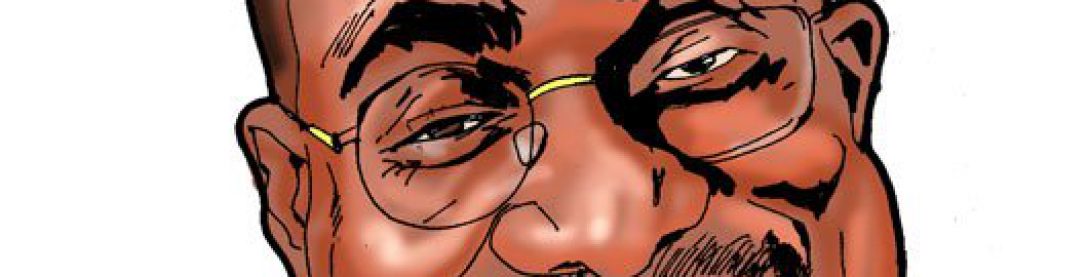
Ikhide the Terrible (Book Critic)

I get a lot of feedback on my columns, publicly and privately, I always appreciate those. Sometimes people write to hurl abuse at me under an alias; I find that cute because I can usually guess at the source from the literary style if the author is a prolific writer. Literary styles are like fingerprints, each one is unique to the author. I was reminded of my plight when I recently read Philip Hensher’s review of James Thackara’s The Book of Kings. This mother of mean reviews is full of well-crafted put-downs that are sure to end the career of even the most stoic of writers. I also read Amy McKie’s honest and fairly blunt review of Professor Akachi Adimora-Ezeigbo’s new book on the Nigerian civil war, Roses and Bullets. Amy was not happy with the book, which is a mean feat in itself; she is blessed with an even temperament. For her efforts, she heard loudly from Adimora-Ezeigbo’s fans. They were not happy with her and they lectured her on her blog. Interestingly enough, when I had earlier complained about the book in Of Biafra, Roses, Bullets and Valium, I suffered the same fate in the hands of her fans. Professor Adimora-Ezeigbo has a lot of loyal fans.

My detractors scoff at the idea that I am a critic. They are right; I am not a book critic. What I am is a consumer, a consumer of ideas. I do read a lot of books and offer my views as a consumer of the books. If I like the book, I fawn all over the author. If I hate the book, I retch all over the book. It is my right, especially since I buy most of the books I comment on. I am a picky consumer, yes, that is what I am. I have a huge problem with being called a book critic because it assumes that all I do all day is sit around patiently waiting for someone to write a book so I can gleefully pee on the book. First of all, I don’t think in the year 2012 people should be calling themselves “book critics”; that is so yesterday. The book is dying and ideas live everywhere now. We should have ideas critics. Let’s start a new industry of media critics; there is money to be made in ether!

So, I have gotten a lot of not-so positive feedback based on my loud opinions about books and the politics of literature. They have ranged in temperament. Emmanuel Iduma’s 2011 Caine Prize: Ikhide’s Complaint and Mukoma Wa Ngugi’s Wanted dead or alive: Happy African Writers, are polite but firm analyses of my works. However, a few have been fairly abusive. I am a faithful fan of the Nigerian writer Ngozi Chimamanda Adichie, but when I sheepishly suggested that her book The Thing Around Your Neck was not quite ready for prime time (here), her fans literally declared a fatwa on me. I am still in hiding.

A while back I got a request from a friend to review his friend’s book. I thought the book was awful and shared my thoughts with him via private email. He forwarded the email to his friend (sigh!) who responded with thunderous fury. He called me an arrogant   ignoramus. I am not an ignoramus. Another time, the writer Ahmed Maiwada was kind enough to send me his book Musdoki to read; I did not like many things about the book and I said so. That created a ruckus the likes of which I probably will never witness again. His friends threw him a pity party, and the wailing and carrying on was heart-rending. I was called all sorts of hilarious names, my favorite being an ignorant ethnocentrist who cannot stand successful Northern writers. For the record, Southern writers vehemently disagreed with this falsehood; they countered that I am an equal-opportunity jerk who hates ALL African writers.

A while back, the writer Sefi Atta launched an attack on me from an unrelated question during an interview. I remembered reviewing her book several years ago. Apparently she never forgot that review; her comments about my person are unprintable. Well, here is what she said: “I’m only aware of one critic who reviewed Swallow negatively, and that was in Next. Apparently, he is a bit of a joke and his reviews barely qualify as blogs.” I don’t remember her expressing her appreciation when I fawned all over her book Everything Good Will Come. I live in her head rent-free. We should both go to counseling to sort this out.

The latest writer to throw mud at what’s left of my dignity is Professor Tanure Ojaide. I love Ojaide’s poetry, but I do think he should stay away from prose, he is just not good at it and I said as much many years back when I read his novel, The Activist. Since then, it has stayed with him and finally this January, he lashed out at me in the Sun newspaper: “I don’t know whether it was a misadventure. Ikhide Ikheloa, who made that statement is not a serious critic. He also said a similar thing on Akachi Ezeigbo’s latest work, Bullets and Roses, saying he read only four pages and threw it away and that nobody should read the book. Nobody takes him seriously as a critic.”  Hmmm. I don’t know what I am, but one thing I know is this: I am not going away. Enjoy the review that has kept the gentle professor up at night. Here.

For January: I Am Still Here

January 2012. Strange month. I have been quiet on this blog. But I am still here. I never really left. I said a lot elsewhere but people were looking for me in the same places where my sometimes discordant, often cantankerous rant fills the marketplace. It is just that January 2012 was a strange month. There was the removal of the fuel subsidy on (New Year’s Day, no less) by President Goodluck Jonathan, the president of our Nigeria. As we all now know, #OccupyNigeria was immediately born and it proceeded to occupy our consciousness. That was some conflagration, albeit brief. It was as if Nigerians had finally woken up to the monumental fraud that passes for democracy in Nigeria. And man, they fought back ferociously. It is fair to say that despite the outcome, Nigeria will not be the same again ever after the Harmattan that was Operation #OccupyNigeria.

The days of January were incredibly exciting and frightening. The role of the Internet and the social media in fueling and organizing the rage on the ground was fascinating. News and information travelled all over the world at lightning speed, gunned by the multiplier effect of dissemination on Facebook and Twitter. Nigeria’s leaders looked like obese sheep caught in the headlights of an oncoming train wreck. This has to be the most incompetent and corrupt regime ever in the history of Nigeria. In retrospect, it makes sense now that brute force was the only tool that this government had to crush the uprising.

In the mayhem, something magical happened. A new word came upon the scene and this time people felt it – accountability. All it took to get the attention of powerful ministers in Nigeria was one hundred and forty characters on twitter. It was amazing. Many Nigerians found themselves tweeting multiple times per hour as information filtered in through what seemed to be infinite sources. For once, a few words on Twitter could get Aso Rock’s beleaguered spokesman Reuben Abati to reach for his decrepit tools of damage control. He was no match for e-journalists like Omoyele Sowore (Sahara Reporters) and the warriors of Twitter and Facebook. Nothing was more hilarious than watching President Jonathan read a speech that we had already read on Sahara Reporters (I swear everybody in Aso Rock secretly works for Sahara Reporters – including the president!). We saw many Nigerian writers of note and stature mixing it up with their readers on Twitter and Facebook and supporting the struggle with the force of their words. In this fight, we learned that there are new and infinitely rewarding ways of connecting with each other.

There was a dark side to this new empowerment. The power of free expression and random access organization was also a double-edged sword as it soon became clear that the filtering and quality control mechanisms of traditional (read analog) communications tools were missing. It did not seem to matter; disenfranchised Nigerian youths found a liberating outlet for their angst and frustration against a regime of thugs and thieves that had united to deny them basic rights like a decent education, and a future to look forward to. And as I look in the  e-eyes of all my friends on Twitter and Facebook, I get the sense that this struggle continues – in the name of all the blood of our young people that was spilled by the thugs of Aso Rock.

New leaders are born every day and many of them are avatars we will never feel or see. Let me just say that even the help in Aso Rock know the name Tolu Ogunlesi. Every re-tweet of his to his thousands of followers ensured that #OccupyNigeria activists were not going to retreat an inch from their position. Today, the word is even more powerful and dangerous that it ever has been in the history of the world. And the writer has a moral obligation to weigh the impact of his or her words on the world. As we saw in January, words can now spread like wild e-fire and send chills down the spines of even the worst dictators – or pour ice water on the raging fires of change as happened in the end when Nigeria’s organized labor pulled out of the battle.

The Internet continues to shape our world relentlessly. In the age of the Internet, new paradigms become tired clichés in nanoseconds. Facebook is becoming the new Microsoft with energetic and more visionary upstarts yapping at her knees. For the writer and the reader, life is good. It is now possible to review an entire book on Twitter or Facebook and get even more of an audience than from a newspaper.  So, I am on Twitter, Facebook, Yahoo Messenger, the BlackBerry Messenger, etc. And I have this blog. I have a lot to tell you. I wrote a lot while worrying about the young warriors of January. I have a lot to tell you because I read lots of books (the book is dying by the way, but the book will outlive me and I intend to be around for another 100 years). There are other things on my mind that I would like to share. But first I have to type them into Cecelia my computer from the foolscap paper I wrote them in with my biro. And yes, I said this first on Twitter and Facebook: The two best books of fiction I read last year were Twitter and Facebook. They were witty, insightful and free. I heartily recommend them. Don’t go away. I am still here. Don’t go away.